
“I actually believe cover music has been sort of analogue AI for a long time,” Cole said. He described learning songs by R.E.M., U2, The Smiths, and The Cure before applying lessons from their songwriting to his own material.
Cole’s larger point is familiar to anyone following AI-assisted creative tools: learning from examples is how people develop skills, and software could lower the barrier to writing, recording, and collaborating. He argued that AI may help players connect with other musicians and move from students of songwriting to more capable creators.
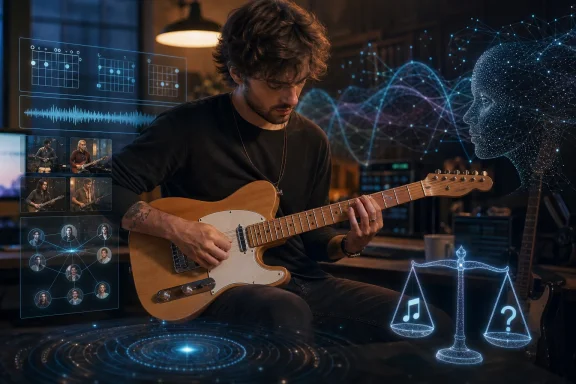 The Analogy Breaks at the Input Layer
The cover-band comparison works only at a high level. A guitarist learns a finite set of songs, interprets them through their own technique, and usually makes creative decisions in performance. A generative model can ingest and statistically reproduce patterns at industrial scale, potentially without a clear account of the source material, consent, compensation, or attribution.
That distinction matters because AI music tools are not simply digital lesson books. They can generate melody, lyrics, arrangement, voices, and production-ready audio, shifting the question from “will this help someone learn?” to “whose work made the output possible, and who is paid when it replaces work?”
For Windows users, the issue resembles the difference between an autocomplete feature in a DAW and a system that can produce an entire imitation track from a prompt. The former can accelerate a musician’s workflow; the latter can also compete with session players, composers, and rights holders.
Fender Has a Clear Reason to Bet on More Players
Cole’s optimism also fits Fender’s business. More beginners buying guitars, using Fender Play, recording in Fender Studio Pro, and collaborating online is a direct expansion of the company’s customer base. Fender formally installed Cole as CEO on February 16, 2026, following Andy Mooney’s retirement, after Cole had spent more than a decade leading the company’s Asia-Pacific business.
The practical AI opportunity for an instrument company is not necessarily an autonomous song generator. It could be tools that identify chords from a recording, create adaptive practice routines, generate backing tracks, transcribe riffs, or help players set up tones and recording sessions. Those uses preserve the player as the author and performer while reducing friction around learning.
Cole did acknowledge that the industry needs to be careful. But that qualification is doing substantial work. The central debate is no longer whether AI can make music easier to create; it plainly can. The unresolved question is whether AI platforms will be built around licensed datasets, meaningful artist controls, and transparent attribution—or around the extraction of work musicians never agreed to provide.
Fender’s chief executive is betting that AI will bring more hands to the fretboard. For players and IT-minded creators, the test will be whether those new tools empower musicians to make their own music, rather than making musicians optional.
