

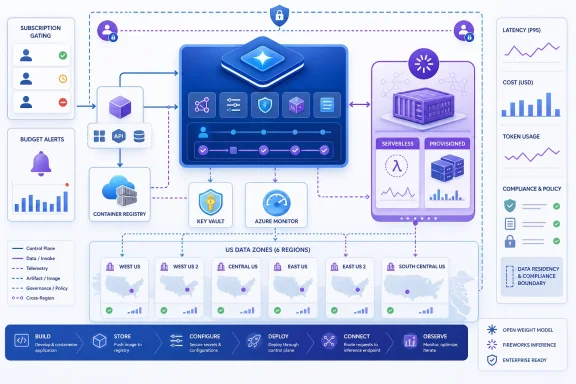
The architecture guidance, published by Microsoft Learn alongside Microsoft for Startups material, is sound in one important respect: it tells teams to measure before adding Azure API Management, Redis, databases, queues, or private networking. That is the right antidote to the familiar startup mistake of building an elaborate platform before proving that a particular model, prompt flow, and customer workflow work together. But “Azure-native” should not be read as “identical to every other Azure AI service” or as a blanket approval for regulated data.
Microsoft introduced Fireworks AI on Foundry in public preview on March 11, 2026. The current Foundry documentation now calls it generally available, while still requiring a subscription owner or contributor to register Fireworks.EnableDeploy in the Azure portal’s Preview features blade. The registration can take up to 30 minutes. For a founding team working in a shared subscription, that makes central Azure administration—not model selection—the first deployment dependency.
The smallest useful deployment is smaller than the diagram
Microsoft’s startup blueprint centers on Azure Container Apps calling a Fireworks model deployed through a Foundry project. Azure Container Registry stores the image; deployment credentials and endpoint details are supplied to the application; Azure Monitor provides optional observability. That is a sensible initial architecture for a web application or API that needs a single inference provider and predictable deployment mechanics.
The operational baseline should include more than a successful Playground prompt. Microsoft’s guidance identifies time to first token, total response latency, request volume, errors, retries, token consumption, estimated cost per request, and deployment usage patterns as the metrics to collect before adding services. For a startup, the more useful unit is cost per successful customer task. A low token price is irrelevant if a model produces failed tool calls, forces retries, or requires a second model pass to repair an answer.
The documentation also reverses a common infrastructure instinct. API Management belongs when a product needs tenant-level rate limits or gateway policy; Azure Managed Redis belongs when the application has genuinely repeated prompts or cacheable work; Service Bus is for work that can safely leave the request path. Adding these on day one increases cost and failure modes without making the first model call better.
There is one additional design point the blueprint only implies: cache deterministic, permission-safe results, not raw conversational traffic by default. A shared Redis key derived only from a prompt can expose tenant-specific context or return stale answers after an underlying document changes. Caching needs a tenant boundary, a model and prompt version, a retrieval-data version where applicable, and a deliberate expiration policy.
Foundry supplies the control plane; Fireworks runs the inference
The partnership divides responsibilities clearly. Microsoft Foundry supplies project management, Azure billing, Azure role-based access control, deployment workflows, safety tooling, and monitoring integrations. Fireworks supplies the managed serving layer for its catalog models and custom compatible weights. The application receives a standards-based endpoint, and Fireworks advertises compatibility with OpenAI-style Chat Completions and Responses APIs.
That API compatibility can reduce migration work for teams already using an OpenAI client library. It does not make models interchangeable. Tool calling, structured-output reliability, context behavior, safety behavior, latency under load, and output quality remain model-specific. A startup replacing a closed model with a Fireworks-hosted open model should retain its evaluation set and replay it against every candidate model before routing production traffic.
Microsoft’s model list also makes an important distinction easy to overlook. Some catalog entries support pay-per-token and provisioned-throughput deployment, while others currently support only provisioned throughput. The current catalog lists examples such as DeepSeek V4 Pro, MiniMax M2.5, and Kimi K2.6 with both offers, while other entries are marked PTU-only. “Open models through Foundry” is therefore not a single commercial option; the chosen model can determine whether a team has a serverless starting point at all.
Bring-your-own weights is the longer-term differentiator. Microsoft says customers can import compatible quantized or fine-tuned model weights and continue using the Fireworks runtime in Foundry, with LoRA or adapter-based support still described as public preview. That could let a company keep a fine-tuned asset close to its Azure deployment and governance process. It also transfers responsibility: Microsoft explicitly says it does not develop, train, fine-tune, or evaluate the safety, security, or responsible-AI characteristics of models deployed through Fireworks. The customer must do that work before exposing a model to users.
Serverless is US Data Zone; capacity has different trade-offs
For early experimentation, the relevant offer is Data Zone Standard, the pay-per-token serverless option. Microsoft documents Fireworks Data Zone Standard and Data Zone Provisioned availability in East US, East US 2, Central US, North Central US, West US, and West US 3. “Data Zone” means Microsoft routes traffic within its defined zone rather than promising that it stays in a named Azure region.
That creates a concrete architectural constraint for organizations outside the United States. Global Provisioned throughput is available in global Azure regions, subject to capacity, but the serverless starter path is not described as globally available. Fireworks independently describes its PayGo offer as operating in those six US Data Zone regions and positions PTUs as dedicated capacity with broader, global availability.
Provisioned throughput units, or PTUs, are for steady workloads where reserved capacity and more stable throughput matter. They are a poor default for a new application whose request volume is still speculative. Microsoft’s own startup guidance says to use provisioned capacity after measuring real traffic, not during early experiments. A startup that moves prematurely to PTUs can turn an inference experiment into a fixed-capacity commitment before it knows whether users will keep coming back.
There is a second quota issue. Microsoft Foundry changed quota management in 2026 so deployments of the same model and version can draw from shared subscription-level pools, including a shared pool per data zone for Data Zone Standard. Separate development, staging, and production deployments are therefore not necessarily independent capacity islands. Teams should set explicit tokens-per-minute limits on deployments and test burst behavior across environments before a launch, especially if multiple services share one Azure subscription.
Startup-credit messaging needs verification before finance signs off
Microsoft’s submitted startup announcement says Microsoft for Startups credits can be applied to Fireworks Data Zone Standard usage, while PTUs are reserved capacity and are not covered. A separate Microsoft Learn page says more broadly that Fireworks models are billed and sold through Azure and that startup credits apply, but tells customers to confirm credit eligibility for the selected model, deployment type, and region.
Fireworks’ own partner page describes a different split: it says Azure credits can be applied to PTU deployments, while pay-as-you-go usage is billed at standard token pricing and counts toward Microsoft Azure Consumption Commitment. Those statements do not cleanly agree on whether startup credits cover PayGo, PTU, or both. Do not treat Azure billing, MACC eligibility, and Microsoft for Startups credit eligibility as the same thing. They are separate commercial concepts.
The practical consequence is simple: before choosing a model or sizing capacity around a credit balance, obtain written confirmation for the exact Azure subscription, Fireworks model, region, and token plan. Then put budget alerts in place at 50%, 80%, and 100% of expected monthly burn. Microsoft warns that sponsored subscriptions transition to pay-as-you-go when credits run out, which means a successful application can keep running while its economics abruptly become more visible.
This is also where model A/B testing earns its place. Rather than comparing “cost per million tokens” alone, route a controlled fraction of equivalent tasks to two models and record task completion, latency, retry rate, cache-hit rate, tool-call success, and end-to-end cost. If one model lowers raw inference spend but drives more retries or customer escalations, it is not cheaper.
Azure governance does not erase the service’s data-handling limits
Microsoft’s official Fireworks-on-Foundry documentation states that data is shared between Microsoft and Fireworks AI, with different data handling and compliance rules applying. The service is currently excluded from EU Data Boundary commitments, does not have FedRAMP authorization, is unavailable in Azure Government, and is not applicable for PCI DSS; Microsoft says customers should not use it to store, process, or transmit payment or cardholder data.
Those are not footnotes for procurement to solve after an MVP ships. They should determine the first workload a startup puts through the service. A public coding assistant operating on non-sensitive repositories may be a reasonable candidate. A product that accepts payment data, operates under FedRAMP requirements, or has strict EU data-residency obligations needs an alternative design or explicit compliance clearance before requests reach the endpoint.
Production access should also move beyond application-level API secrets. Microsoft’s deployment guide suggests managed identity and Azure Key Vault for production, while its Foundry guidance requires Foundry project permissions in addition to subscription-level rights. Separate deployment identities, least-privilege project roles, Key Vault-backed secret rotation, and a decision on private endpoints are the baseline work once customer data enters the system.
Fireworks on Microsoft Foundry gives startups a credible managed path to test and serve open models, particularly when Azure billing, Entra identity, and Foundry governance are already part of the company’s operating model. The first deployment should remain deliberately plain: one supported model, Data Zone Standard where the region and data rules fit, Container Apps, Key Vault, telemetry, strict budget controls, and an evaluation suite. The next dollar should go toward proving task quality and unit economics—not toward a larger Azure diagram.