
Startup Daily first reported the approval on August 25, while ABC News confirmed the vote and the attached conditions from the George Town Council process. The proposed facility would occupy the former Gunns pulp mill site and sits alongside Firmus’s wider Tasmanian build-out: a 104MW site under construction at St Leonards near Launceston and a proposed 52MW development at Wesley Vale.
For IT infrastructure buyers and operators, the approval is a useful case study in the gap between a data-centre developer’s grid-support commitments and the legal permissions that ultimately govern a site. Firmus has sold the Bell Bay project as renewable-backed AI compute capacity with flexible demand. But the permit conditions narrow the circumstances in which its on-site generators can run, and the company still has not publicly detailed a completed Tasmanian power-supply arrangement that would add new local generation at the scale its plans require.
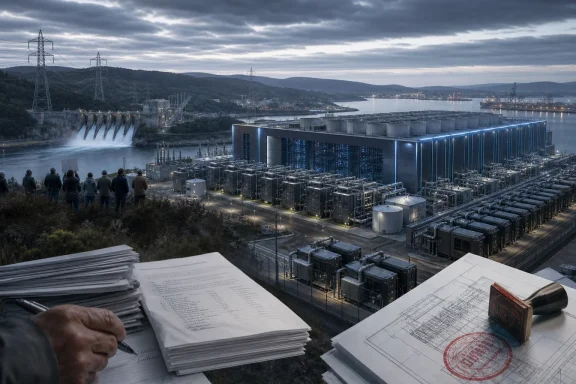 The permit approves a building, not the whole resource model
The council’s decision was made under a statutory planning process, which is narrower than the dispute playing out in the community. Council planners acknowledged objections about electricity demand, water, noise, air quality, lighting and environmental effects, but said some concerns were outside matters the planning scheme allowed the council to decide.
That limitation is central to why the vote has become contentious. Residents and the Greens have argued that a local planning permit is the wrong instrument for deciding whether Tasmania should allocate large volumes of electricity and water to AI infrastructure. Firmus, meanwhile, has argued the project will bring construction work, permanent jobs and computing investment to the region.
The development’s 288MW figure is significant, but it should not be read as a guarantee of constant power draw. It is a maximum design capacity, and actual demand will depend on the fit-out, customer workloads, cooling conditions and operating schedule. Still, the project is large enough that ABC News reported Firmus’s three-site Tasmanian portfolio would make the company the state’s largest electricity user, ahead of established industrial customers.
That outcome is why the project cannot be assessed only as a warehouse-scale construction approval. The key question for the state is whether the electricity, network capacity and new generation behind the facility are added in time — and paid for by the developer rather than absorbed by other users.
Firmus has said it will fund new transmission, invest in grid-firming capacity and require suppliers to develop new renewable generation and storage. In July, however, Firmus co-chief executive Oliver Curtis told ABC News that negotiations with Hydro Tasmania had not been concluded and that he could not discuss a specific Tasmanian contract. The company’s broad commitment is therefore clear; the final, public details tying Bell Bay’s power demand to new Tasmanian supply are not.
Diesel-generator rules expose a practical constraint
George Town Council imposed unusually consequential conditions around the project’s backup generation. Firmus must submit a revised bushfire and emergency management plan before construction begins after incorrectly listing 128 diesel generators in its application rather than 276.
The corrected number does not itself prove the generators will operate routinely. Data centres commonly deploy distributed backup generation to support redundant power architectures. But it changes the scale of the equipment that regulators and residents must evaluate for emissions, noise, fuel handling and testing.
The council’s conditions say the generators may operate during an unscheduled mains-power failure, a genuine emergency, or inspection, testing and maintenance. More importantly, the permit caps the combined annual time in which more than one diesel generator can operate simultaneously at 24 hours.
That condition sits uneasily beside Firmus’s earlier public commitment to respond to grid signals every five minutes by reducing load, shifting non-urgent compute work or switching to on-site backup generation. A data centre can still curtail workloads during peak demand, and it can test or use limited backup capability within the permit. But routine large-scale generator dispatch cannot become the project’s everyday grid-relief mechanism if it would exceed the 24-hour annual cap or fall outside the defined permitted uses.
This is more than a local noise-control detail. Across the data-centre industry, flexible load is increasingly presented as an answer to concerns over AI-driven electricity demand. Bell Bay shows the operational distinction that matters: throttling servers, deferring batch workloads and using batteries are one category of flexibility; running hundreds of diesel engines for peak shaving is another. The approval permits the former concept in principle, but it sharply constrains the latter in practice.
Firmus must also conduct a noise survey within 60 days of starting operations and submit an air-quality assessment within 12 months. Those are post-approval checks, meaning the community will not have final measured operating data until after the site is live.
Water claims are smaller than the application allocation
Water has become the other point of friction because the numbers in circulation describe different things. Firmus says Bell Bay will use 8.7 million litres of water a year, largely relying on dry cooling and turning to water-assisted cooling only during hotter conditions. Startup Daily repeated the company’s comparison that this is below the annual use of three typical restaurants.
But ABC News reported that the development application sought an allocation of 19.2 million litres a year from TasWater, equivalent to about 110 households’ annual use. Firmus said it expected to need less than half of that amount. Both statements can be true: one is the requested maximum supply allocation, while the other is the company’s forecast operating use. They should not be treated as the same measurement.
Dry cooling reduces direct site water consumption, but it does not make cooling cost-free. Amr Omar, a senior research associate at the University of New South Wales School of Mechanical Engineering, told ABC News that dry cooling generally requires more electricity to cool the same computing load. Whether that shifts water use elsewhere depends heavily on how the electricity is generated.
Tasmania’s hydro-heavy grid gives Firmus a better starting point than data-centre projects dependent on fossil-fired generation, but it does not remove the transmission and capacity question. A large new load can still require investment in firming, grid upgrades and additional generation if it is not to compete with existing customers during constrained periods.
The federal government’s policy direction has caught up with that concern. The Australian government’s March 2026 data-centre expectations called for developers to support the energy transition and use water sustainably, but they were expectations rather than a permit-specific mechanism. In the weeks before the Bell Bay vote, federal and state leaders were also negotiating national standards intended to require data centres to bring additional renewable supply, minimise water use, prefer non-drinking and recycled water where possible, report usage transparently and contribute to necessary infrastructure.
Tasmania has backed the broad direction of national water standards. What remains unresolved is how those eventual standards will apply to projects approved before the framework is enacted, and whether Firmus’s contracts will deliver measurable new capacity before its facilities materially increase demand.
Jobs figures have moved, without a public explanation
Firmus says Bell Bay is expected to create more than 380 construction jobs and support more than 115 permanent local roles once operational. The construction figure is substantial for a regional project, although the permanent employment number is the better guide to the site’s long-term direct workforce.
There is a notable discrepancy in the company’s public job estimates. In July, Curtis told ABC News that Firmus expected to create about half a full-time job per megawatt across its Tasmanian sites. Applied to Bell Bay’s 288MW capacity, that formula implied 144 jobs at the site. The latest 115-role figure is 29 lower, and neither Firmus nor the council has publicly explained whether that reflects a revised staffing model, a different definition of local roles, or a change in the planned operating configuration.
That does not mean the current number is inaccurate. It does mean the earlier per-megawatt formula should no longer be used as a proxy for employment outcomes. For a project whose economic case has been publicly framed around jobs, the difference deserves a clear accounting before construction starts.
The site remains open to appeal by people who made representations to council, with ABC News reporting a 14-day Tasmanian Civil and Administrative Tribunal window after the decision. Absent a successful appeal, Firmus will move into detailed design, procurement and construction planning.
Tasmania now needs enforceable disclosure, not more promises
The Bell Bay vote has settled a local planning question. It has not settled the larger policy argument over who supplies the electricity, who pays for network upgrades, how much water is actually consumed in operation, or whether the economic return matches the resource commitment.
New South Wales has already set a more concrete benchmark: its August framework ties a streamlined planning pathway to performance measures on environmental efficiency, community benefits, additional water and energy supply, and protections against shifting network costs to households and small businesses. Bell Bay has no equivalent public, permit-linked requirement spelling out the new renewable generation that must be operational before a 288MW AI facility reaches scale.
Firmus must now publish the Tasmanian contracts and technical commitments that turn its renewable and flexibility promises into verifiable obligations. Until it does, the most important fact about the Bell Bay approval is also the least glamorous one: the council has approved the facility and imposed operating safeguards, but the long-term energy bargain behind Tasmania’s largest prospective data-centre load remains unfinished.