
The distinction is important for Windows developers and IT teams evaluating Flutter for a new application. HackerNoon’s Learn Repo can surface useful implementation write-ups—Bluetooth printing, responsive layouts, BLoC, Firebase, CI/CD, Partner Center publishing, and Dart streams all appear in the collection—but it does not separate historically popular reading from material that remains compatible with today’s SDK, platform tooling, package APIs, and store requirements.
HackerNoon presents the August 1 collection as a list of posts ordered by reader engagement data. Its own Learn help page describes the ordering differently: by “most reading time created.” The company’s GitHub organization adds another variation, describing Learn Repo paths as ordered by reading time and editor ranking. Those descriptions may refer to overlapping signals, but HackerNoon does not publish the score, date range, weighting, or a “last verified” field for individual entries.
That leaves readers with a useful discovery list—and an opaque recommendation system.
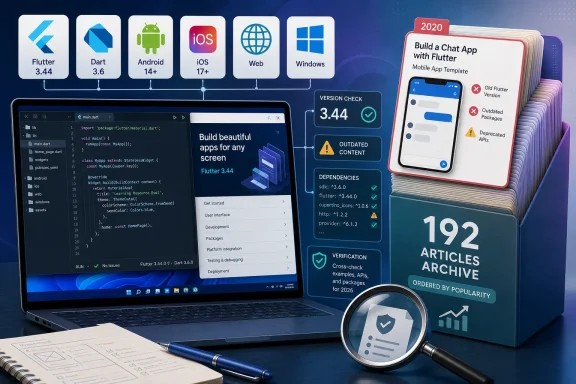 The First Result Is a 2020 Templates Roundup
The most revealing detail is at the top. The number-one Flutter item is explicitly a July 2020 market roundup of app templates. It may still offer design ideas or show how early Flutter projects were structured, but its rank measures historical attention on HackerNoon rather than present-day technical fitness.
That is not a narrow concern. The collection also places older framework comparisons high on the page, including Flutter versus React Native versus Xamarin. Such comparisons age quickly because Flutter, Dart, Android, iOS, Windows, Microsoft’s .NET stack, and the competing frameworks all change their supported platforms, build systems, rendering paths, language features, and deployment rules over time.
Flutter’s own release documentation lists stable releases through Flutter 3.44, released in May 2026, and identifies the documentation set as reflecting Flutter 3.44.7. Since 2020, Flutter has expanded and refined support across mobile, web, desktop, and embedded scenarios; its documentation now includes dedicated release paths for Windows, Linux, macOS, web, Android, and iOS. A tutorial built around a 2020 SDK cannot be presumed safe for a 2026 app without checking every dependency, Gradle setting, platform configuration, and API call.
For a developer using Windows 11 with Visual Studio Code or Android Studio, the practical problem is less likely to be a broken Container or ListView example than surrounding project configuration. Older material may describe obsolete project scaffolding, former Android embedding assumptions, legacy Firebase setup, deprecated plugin interfaces, or package versions that no longer resolve cleanly. A reader who treats this index as a sequential course could spend the first hours learning patterns that need immediate migration.
“Reader Engagement” Does Not Mean Technical Review
HackerNoon’s Learn material is clear about one thing: it aims to help people find what other readers consumed. Its help documentation calls the result a community-measured form of “essential-read-ness,” while the GitHub description says stories are organized by reading time and editor ranking. That is a defensible approach for archive discovery, especially when the library is free.
It is not the same as editorial certification of code quality, security, correctness, or maintenance status.
The Flutter list demonstrates the difference. Highly practical entries cover subjects that remain central to real projects: state management with BLoC and Riverpod, isolates and concurrency, HTTP requests, Firebase integration, responsive design, testing, WebView use, build flavors, app size, Windows distribution, and CI/CD. A developer researching one of those topics can use the list as a keyword-rich starting point.
But it also includes broad market-opinion pieces, agency marketing articles, historical framework comparisons, newsletter posts, and material only tangentially connected to Flutter. HackerNoon’s method rewards attention accumulated over time. It does not indicate whether an author tested an example against the latest stable channel, whether a package is maintained, whether the post distinguishes a native platform constraint from a Flutter constraint, or whether a tutorial has a public source repository with an active issue tracker.
The list’s wording—“192 Blog Posts To Learn About Flutter”—therefore promises more coherence than the underlying selection method supplies. The more accurate description would be: 192 HackerNoon stories associated with Flutter, ranked through an engagement-related system.
That is not a cosmetic difference. A curated course starts with fundamentals, makes version assumptions explicit, builds from widgets and Dart language basics toward state, networking, testing, deployment, and platform integration, then marks specialized material as optional. This list starts with what HackerNoon readers spent time reading.
The Tagging Pulls In Material That Is Not Flutter Training
The collection’s lower ranks show that tagging, rather than a strict editorial syllabus, determines inclusion. At number 140, it includes another HackerNoon Learn compilation about Firebase. Number 145 is an interview with a HackerNoon contributor. Number 148 is a general article about machine learning’s impact on mobile applications. Number 151 is about Xamarin. Number 152 is a HackerNoon newsletter issue. Number 158 is simply about React 18 features, and numbers 187, 189, 190, and 191 are HackerNoon newsletter or Noonification items rather than Flutter tutorials.
These are not necessarily bad stories. They are evidence that a Flutter tag can be attached to adjacent discussions, generic mobile development content, publication newsletters, or a story with a brief Flutter reference. The collection is complete only in the sense that it displays 192 entries returned by HackerNoon’s classification and ranking pipeline; it is not complete in the sense of 192 focused Flutter lessons.
There is a second consequence: useful but lower-ranked practical articles can be buried under general-interest content that earned more engagement. The final item, “Flutter Streams Explained with a Collage App,” is more narrowly instructional than several entries above it, yet it appears at number 192. A reader searching for a specific operational lesson should search by topic and inspect publication dates, not assume that rank 20 is more useful than rank 192.
HackerNoon also does not state whether the list is a fixed snapshot or will automatically change as engagement totals change. The page provides a publication date of August 1, 2026, but no individual review dates, compatibility labels, or update policy. That omission matters in a fast-moving package ecosystem: even a strong article can become a liability after a breaking SDK, Dart, Android Gradle Plugin, Xcode, or plugin release.
What Still Makes the List Worth Using
Used correctly, the index has real value. It exposes a large body of practitioner writing that an official documentation search may not surface, including niche integrations and implementation accounts from developers who encountered a specific problem. The Flutter collection includes topics that official documentation cannot exhaustively cover, such as thermal Bluetooth printers, Appium automation, local-network messaging, Rive animation, server-driven UI experiments, and publishing Windows applications through Microsoft Partner Center.
For WindowsForum readers, the entry on Microsoft Partner Center publishing may be especially relevant because it points toward the less-discussed final mile of a desktop app: packaging, identity, submission, and store distribution. Yet the story’s placement at number 160 should not be read as a verdict on its quality or relevance to a Windows deployment. It is simply lower in HackerNoon’s ranking system than articles that drew more engagement.
The most productive way to use the 192-post page is as a secondary research index:
- Start a new project with Flutter’s current official getting-started material, stable release notes, and breaking-change guidance rather than any article in the archive.
- Use HackerNoon’s list to find implementation approaches for a specific feature after establishing the target Flutter and Dart versions.
- Check the original post’s publication date, linked package versions, source code, issue activity, and platform assumptions before copying commands or configuration.
- Treat framework comparison articles as period pieces unless they identify their tested versions and were updated recently.
- For Windows builds, verify desktop support, packaging instructions, and Microsoft Store requirements against current Flutter and Microsoft documentation before release.
A Good Archive Needs Version Signals
HackerNoon deserves credit for keeping its material openly readable and for exposing an unusual amount of its organization around learning paths. Its GitHub profile describes a broad free technology library, while the Learn service gives old posts a route back to readers who may never encounter them through chronological feeds.
The missing feature is version-aware curation. A basic label showing publication date, latest validation date, Flutter/Dart version, target platforms, and whether a post is a tutorial, comparison, opinion piece, or unrelated tag spillover would turn this from a popularity list into a far stronger learning tool. A separate “current SDK” filter would be more useful to working developers than a single all-time rank.
Until that exists, the new Flutter index should be read for what the record shows it is: a free, broad, and sometimes valuable map of HackerNoon’s Flutter-adjacent archive. It is not a 192-step path to learning today’s Flutter, and its number-one result—a templates list from 2020—makes that limitation impossible to miss.
