
 Overview: Prompt Engineering Is a Useful Skill, Not a Magic Career Label
Prompt engineering has moved beyond typing a clever request into ChatGPT and hoping for the best. In a workplace setting, it means framing a task clearly, supplying the right context and source material, specifying an output format, setting boundaries, evaluating the response, and iterating until the result is useful.
That makes prompt engineering relevant to far more than software development. Marketing teams can use it to structure campaign drafts. IT administrators can use it to summarize incident notes or prepare documentation. Analysts can use it to turn raw notes into tables, briefs, or presentation outlines. Developers can use it to generate test plans, explain code, and accelerate early drafts of technical documentation.
However, the hype around dedicated prompt-engineer jobs deserves perspective. A study analyzing 20,662 LinkedIn job listings found only 72 prompt-engineer postings—fewer than 0.5% of the sample. The research also found that employers looking for prompt engineers valued communication and creative problem-solving alongside AI knowledge and prompt-design skill. That research is an important corrective to claims that a short course alone will unlock an entirely new career.
The practical opportunity is broader and more durable: learn to use AI competently within an existing role. A certificate can make that learning visible, but a portfolio of before-and-after work examples, tested prompts, reusable templates, and well-documented AI workflows will carry more weight than a badge alone.
The First Rule: Verify What “Free Certification” Actually Means
The phrase free AI prompt engineering certification course can describe several very different offerings:
- A free course that awards a completion certificate
- A free training path that grants a digital badge
- Free access to material, but a paid final assessment or certificate
- A time-limited free trial that lets learners finish a course and claim a completion credential
- A promotional challenge that offers an exam voucher subject to deadlines, geography, eligibility, or limited availability
- A paid course that includes some free introductory modules
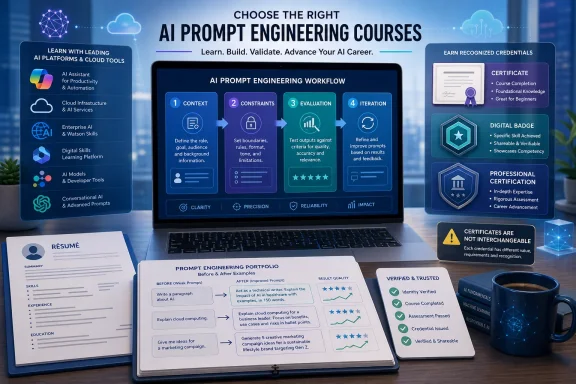
That distinction matters for job seekers. A certificate of completion proves participation and completion. A digital badge may contain metadata about the issuer, skills, and assessment criteria. A professional certification generally implies a separate, standardized exam and is usually more rigorous—but it is not automatically better for every career goal.
For Windows users and IT professionals, the best approach is to select learning paths that map to practical tools already used at work: Microsoft Copilot, Azure AI, AWS, Google Gemini, ChatGPT, or internal generative-AI systems. The course is valuable when it teaches reliable habits that transfer across platforms.
Google Prompting Essentials: Strong Structure, but Not Universally Free
Google’s Prompting Essentials is one of the better-known beginner-friendly programs because it frames prompting as a repeatable work skill rather than a collection of gimmicks. The associated credential describes four modules covering effective prompt design, evaluation, iteration, responsible AI, text-to-image and multimodal prompting, prompt chaining, and introductory AI-agent concepts. Google’s Credly badge page confirms those learning outcomes.
That curriculum is useful because it does not stop at “be specific.” Effective prompting usually requires a process:
- Define the task and intended audience.
- Supply relevant context, examples, or reference material.
- State constraints such as tone, length, format, and exclusions.
- Ask for a structured result.
- Review for accuracy, bias, unsupported claims, and missing information.
- Revise the request or add better source material.
The Cost Caveat
Google Prompting Essentials should not be advertised as permanently free without qualification. Google says its Career Certificates and Career Essentials programs in the United States and Canada use a $49 monthly subscription after a seven-day free trial, although local pricing can vary and scholarships or sponsored access may be available. Google’s program FAQ makes the pricing model clear.
That does not make the program a poor choice. It simply means learners should describe it honestly:
- Good fit: Professionals who want an orderly, workplace-oriented introduction and can complete the program within a trial or have sponsored access.
- Credential type: Google course certificate/badge, depending on the enrollment route and completion process.
- Best value: Learners who will actively practice with multiple AI tools rather than only watch videos.
- Risk: Paying month after month without completing the material or producing work samples.
Google’s emphasis on iteration and responsible use is especially valuable. The core skill is not producing an eloquent first prompt; it is knowing how to identify why an output failed and systematically improve it.
Microsoft AI Skills Fest and Microsoft Learn: Most Relevant for Windows-Centric Careers
For readers building skills around Windows 11, Microsoft 365, Azure, Power Platform, and Copilot, Microsoft’s training ecosystem is particularly relevant. Microsoft Learn offers extensive AI training organized by role, including business users, developers, IT professionals, security professionals, data specialists, and leaders. The company’s AI learning hub positions these materials around Copilot, Azure AI, agents, and enterprise AI adoption.
Microsoft’s AI Skills Fest has also been a major free learning initiative. The 2026 event ran from June 8 through June 12 and offered role-based content for developers, business leaders, students, marketers, customer-service professionals, and technical practitioners. Microsoft’s event announcement described it as free and online.
The Certificate Voucher Is Not the Same as a Guaranteed Credential
Microsoft’s AI Skills Fest offered more than training. A Microsoft representative stated that eligible participants who completed a featured learning playlist could submit a claim for a free certification voucher, with voucher codes beginning distribution on June 16, 2026. The official discussion also noted requirements such as registration through a company email address.
This is precisely where learners need to read the conditions closely. A free event can include:
- Learning modules
- Event attendance
- Achievement badges
- Challenge completion
- A voucher opportunity
- A discounted or free certification exam
Those are separate benefits. Completing content does not necessarily mean a learner has automatically earned a Microsoft Certification. The distinction should remain clear on LinkedIn and on a résumé.
Why Microsoft Learn Is Still a Strong Long-Term Choice
The advantage of Microsoft Learn is that it supports a progression from basic AI literacy to practical enterprise administration and development. It can help learners understand:
- How to use Microsoft 365 Copilot responsibly
- How to work with prompts in organizational contexts
- How to design and evaluate AI agents
- How to consider security, governance, and data handling
- How Azure AI services fit into application development
- How generative AI affects IT operations and support workflows
For Windows professionals, that context is more valuable than generic prompt templates. A prompt used to summarize meeting notes is different from one used to troubleshoot PowerShell output, draft a security-policy explanation, classify help-desk tickets, or generate an initial deployment checklist.
The risk is vendor narrowness. Microsoft-focused training can build highly useful skills, but learners should still test their methods on more than one model. Prompt behavior differs across Copilot, ChatGPT, Gemini, Claude, local models, and enterprise tools grounded in proprietary data.
AWS Educate: Free, Accessible, and Better for Cloud-Aware Beginners
AWS Educate is one of the clearest examples of genuinely free training with shareable credentials. AWS says the platform is open to learners regardless of education, experience, or career stage; it requires no credit card; and users as young as 13 can register with an email address. AWS Educate’s official page also says learners can complete free, self-paced courses and earn shareable digital badges.
Its value is not limited to cloud infrastructure. AWS Educate offers an entry point into generative AI concepts, foundation models, and prompt-based application building. AWS specifically identifies Introduction to Generative Artificial Intelligence and Introduction to PartyRock as AWS Educate courses; PartyRock teaches learners how to use prompts to build AI applications. AWS Training and Certification’s overview also lists an Essentials of Prompt Engineering course focused on creating, refining, and optimizing prompts.
Where AWS Educate Stands Out
AWS Educate is especially attractive for learners who want more than text-generation tricks. It encourages a transition from “I can ask an AI assistant a question” to “I understand how a cloud AI workflow is assembled.”
Its strengths include:
- Free self-paced access with no credit-card barrier
- A beginner-friendly route into AI and cloud concepts
- Digital badges that can be shared professionally
- Practical exposure to cloud tooling and AI app concepts
- A pathway toward AWS Skill Builder, Amazon Bedrock, and broader AWS learning
The Limitation: A Badge Is Not an AWS Certification
AWS Educate badges should be presented accurately. They are useful evidence of learning and can strengthen an entry-level profile, but they are not the same as an AWS Certification exam credential.
That distinction should not discourage learners. For someone targeting cloud support, junior development, data, or IT operations roles, a credible sequence of AWS Educate badges plus small practical projects can be more persuasive than a vague claim of being “certified in AI.”
IBM SkillsBuild: One of the Best Free Credential Paths for Broad AI Literacy
IBM SkillsBuild deserves attention because it combines short-form practical courses with formal digital credentials. The platform offers AI learning tailored to students, job seekers, and adult learners, rather than treating AI education as a developer-only discipline.
IBM’s course materials include Prompt Engineering: Shaping Better AI Responses, which covers prompt types, technique selection, and best practices for writing effective prompts. IBM also offers courses and credentials around AI literacy, generative AI, retrieval-augmented generation, AI ethics, and workplace applications. IBM SkillsBuild’s credential catalog describes credentials that validate skills ranging from foundational AI knowledge to generative-AI techniques and practical work with large language models.
Why IBM SkillsBuild Is More Than a Prompt-Writing Course
The strongest feature of IBM SkillsBuild is its broader framing. A prompt engineering credential becomes more useful when paired with knowledge of:
- AI fundamentals
- Model limitations
- Responsible AI
- Bias and ethics
- Data privacy
- Retrieval-augmented generation
- Workflow design
- Evaluation and human oversight
IBM’s materials explicitly connect some digital credentials to generative AI, prompt engineering techniques, Python libraries, and ethical considerations. Its credential descriptions show why this approach is more substantive than a basic prompt-template course.
Best Use Case
IBM SkillsBuild is a strong option for learners who need a free, structured, career-facing credential but do not yet know whether they want to specialize in cloud, software development, data, cybersecurity, or business AI adoption.
Its potential drawback is breadth. Learners who want to become productive in a specific ecosystem—such as Azure OpenAI, Amazon Bedrock, or OpenAI’s API—will need follow-up training and hands-on projects beyond the introductory credential.
LinkedIn Learning: Useful Completion Credentials, but Usually Subscription-Based
LinkedIn Learning can strengthen a public professional profile because course completion credentials integrate naturally with LinkedIn. Its Getting Started with Prompt Engineering learning path includes six courses and approximately seven hours of material, covering foundational prompting, multimodal workflows, Gemini, and AI-agent prompting. The learning path offers a badge of completion.
The platform’s individual prompt-engineering courses also issue shareable completion certificates that can be displayed in the Licenses & Certifications section of a LinkedIn profile. LinkedIn Learning’s course page describes the credential as shareable and downloadable.
Useful, but Not Necessarily Free
LinkedIn Learning often offers a one-month free trial, access through employers, libraries, schools, or promotional campaigns. That makes it possible to complete a course without paying—but it is inaccurate to call the platform universally free.
The best strategy is simple:
- Confirm whether access is available through an employer, library, university, or trial.
- Select a focused learning path rather than sampling dozens of disconnected lessons.
- Complete the path before the access window ends.
- Add the completion credential only after finishing it.
- Turn at least two course concepts into practical work examples.
A LinkedIn Learning certificate is helpful because hiring managers can immediately see it on the same platform where they review a candidate’s employment history. Still, it should support—not substitute for—a concise portfolio showing real work.
OpenAI Academy: A Fast Route to Practical AI Foundations
OpenAI Academy has become a more concrete option for learners who want first-party training from the organization behind ChatGPT. Its course catalog now includes course-completion certificates, not just webinars and resource libraries. OpenAI Academy’s courses page says its curriculum is designed around practical AI skills, workplace tasks, and repeatable workflows.
The most accessible starting point is AI Foundations. OpenAI describes it as a self-paced introductory course that takes about 70 minutes, requires no technical background, and awards a course-completion certificate once the full course is finished. The AI Foundations course page says learners practice clear instruction writing, useful context-setting, output review, and responsible AI use.
Why This Matters
OpenAI Academy’s approach is less about elaborate prompt formulas and more about productive habits:
- Choose a real task.
- Explain the desired outcome.
- Give the model enough context.
- Review the result critically.
- Build a repeatable workflow.
- Keep human judgment in control.
That is a strong model for non-technical professionals. It reinforces that generative AI is not an autonomous authority. It is an assistive system whose output still needs validation, fact-checking, and appropriate handling of confidential information.
Important Risk: Product Familiarity Is Not Universal AI Expertise
An OpenAI completion certificate can show that a learner has completed practical training in ChatGPT-oriented workflows. It should not be presented as universal proof of expertise across all large language models, enterprise AI platforms, or AI security disciplines.
A well-rounded learner should take the habits learned through OpenAI Academy and apply them elsewhere: compare outputs between systems, identify model-specific quirks, test prompt structures, and learn when retrieval, automation, human review, or conventional software is a better fit.
Learn Prompting: Best for Going Beyond Basic Productivity Prompts
Learn Prompting is a useful resource for learners who want a deeper and more technical understanding of prompting, AI safety, red teaming, prompt injection, and jailbreaking. The site offers free learning materials and lists courses in introductory and advanced prompt engineering, AI agents, retrieval-augmented generation, AI safety, and prompt hacking. Its course catalog also includes a free seven-day prompt-hacking course focused on LLM security.
This security dimension matters. Many beginner courses teach users how to make models more helpful. Fewer teach them how prompts can be manipulated, how untrusted text can influence a model, or why AI systems should not be given sensitive data without appropriate safeguards.
The Certificate Is a Paid Upgrade
Learn Prompting’s training materials can be accessed for free, but its certificate wording must be read carefully. The platform states that learners receive certificates of completion by upgrading to Learn Prompting Plus. Its certification page makes that condition explicit.
That means Learn Prompting is an excellent free study resource, but not necessarily a free certificate path. This is not a flaw—it is simply an example of why learners should separate the value of educational content from the cost of a credential.
For those pursuing more technical AI roles, its focus on adversarial prompting and safety can provide a differentiator. Employers increasingly need people who understand not only how to get useful output from AI systems, but also how to reduce the risks of prompt injection, data exposure, harmful content, and unreliable automation.
How to Turn a Course Into a Stronger Professional Profile
A certificate alone is rarely enough to change a hiring decision. The most credible AI learners show how they used the material.
Build a Small Prompt Portfolio
Create a private or public collection of practical examples, with sensitive information removed. Each example should include:
- The original task
- The initial prompt
- The first output’s weaknesses
- The revised prompt
- The improved result
- The human review steps used
- A note on limitations or risks
For example, an IT support professional could document a workflow for transforming rough incident notes into a structured knowledge-base draft. A marketer could show how they generated campaign variations while preserving a brand voice. A Windows administrator could demonstrate a prompt framework for explaining PowerShell commands, creating troubleshooting checklists, or drafting change-control documentation.
Make Credentials Easy to Verify
Add an earned credential to LinkedIn only when the issuer provides a legitimate completion record, badge, or certificate. Use the issuer’s exact title and avoid inflating the achievement.
Good wording:
- “Completed Google Prompting Essentials”
- “AWS Educate digital badge: Introduction to Generative AI”
- “IBM SkillsBuild digital credential: AI Fundamentals”
- “OpenAI Academy: AI Foundations—Course Completion Certificate”
- “LinkedIn Learning: Getting Started with Prompt Engineering”
Poor wording:
- “Certified AI Engineer” after a short completion course
- “Prompt Engineering Expert” without substantial project evidence
- “Microsoft Certified” after attending a Microsoft learning event but not passing a Microsoft Certification exam
Focus on Trustworthy AI Use
The professional value of prompting increasingly depends on judgment. A useful AI practitioner knows when not to use AI, when an answer must be independently verified, when information is too confidential to paste into a chatbot, and when a result needs a qualified human reviewer.
This is particularly important in healthcare, legal, financial, HR, security, and public-sector contexts. The ability to create a polished answer is not the same as the ability to create a correct, safe, compliant, or defensible answer.
The Bottom Line
The best free AI prompt engineering learning path depends on the outcome a learner wants. AWS Educate and IBM SkillsBuild are among the clearest no-cost routes to shareable digital credentials. Microsoft Learn is highly relevant for professionals building careers around Windows, Microsoft 365, Copilot, Azure, and enterprise IT, while AI Skills Fest-style promotions can add value when eligibility rules are met. OpenAI Academy now provides a practical, first-party course-completion certificate for beginners. Google Prompting Essentials, LinkedIn Learning, and Learn Prompting remain valuable, but their certificate options can involve subscription fees, trial access, or paid upgrades.
The most useful credential is the one supported by real practice. Learn the frameworks, test them on work-like tasks, build a portfolio of refined prompts and reviewed outputs, and show that AI is being used with accuracy, security, and human accountability in mind.
