
The developer’s latest briefing follows its July 30 multiplayer reveal, which detailed Horde Siege, Versus modes, maps, progression, and cosmetics. The subsequent post concentrates on the part that will decide whether E-Day still feels like Gears: movement commitment, cover readability, shotgun encounters, and the enemy combinations that force squads to reconsider a position.
The practical takeaway is not simply that Marcus can slide and jump. The Coalition is deliberately slowing down cover-cancel chains and making movement trajectories easier for opponents to read. If the rules work as described in the August beta, E-Day could materially change the rhythm of competitive Gears rather than merely add new traversal animations to the existing wall-bounce meta.
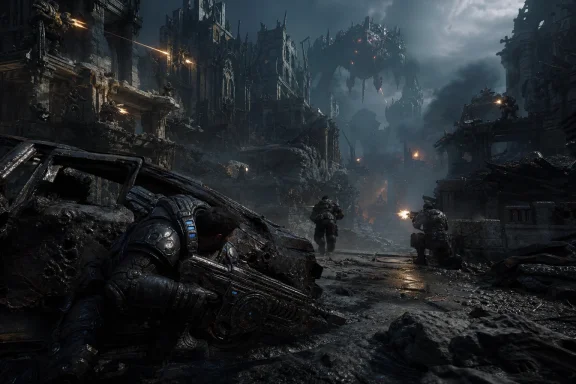 Cover now has a failure state
The series has traditionally treated cover as a binary proposition: a player is either safely attached to a waist-high object or exposed. E-Day adds what The Coalition calls “low ground” cover, allowing a Gear to shelter behind a low wall, debris, or the remaining lower section of an object after gunfire destroys its upper half.
That is a more consequential addition than it initially sounds. A player in low-ground cover drops prone with their back against the obstruction, moves more slowly, and remains somewhat exposed. It is a survival tool rather than a new dominant defensive stance. The design acknowledges a basic problem with more destructible and varied arenas: when cover is damaged, the old all-or-nothing system would often leave players with no meaningful response between standing up and dying.
The Coalition has also expanded the shapes, heights, and openings it recognizes as cover. Players can crouch or slide under low gaps such as a truck’s undercarriage, lean low around some edges, and aim through narrow apertures including vehicle windows. Mantling and climbing no longer require players to enter cover first; facing an object and pressing the appropriate command is enough.
Those systems should make Kalona’s streets and interiors less dependent on rows of carefully placed waist-high barricades. Xbox’s earlier campaign presentation showed the studio building larger spaces with vertical routes, damageable surfaces, and alternate approaches. The July update ties those ideas to the core controls: jumping onto a vehicle or ledge, crossing a gap, sliding through an opening, then taking cover is intended to be one continuous decision rather than a string of separate context-sensitive actions.
There is an important limit. The Coalition says jumping is built around reachable ledges, vehicles, gaps, and flanking paths, rather than freeform platforming. That constraint matters. A full unrestricted jump would create sightlines and evasive options that Gears maps were never designed to contain. The stated approach adds verticality while keeping players exposed long enough for weapons and positioning to retain their value.
The Coalition is putting brakes on cover bouncing
The studio’s most specific competitive change is a 1.5-meter restriction on cancelling an attempt to enter cover. In recent games, players could begin the cover-enter animation and cancel it at almost any point, creating rapid direction changes and the repeated cover-bounce movement familiar to experienced Gears players.
In E-Day, a player must travel much closer to the object before cancelling. The Coalition says this puts the character on a more predictable path, slows chained cancels, and means a player on the opposite side of cover must enter Gnasher range before breaking away. Momentum has also been rebuilt so characters cannot halt and reverse direction instantly.
This is not a small quality-of-life adjustment. It changes the information available in a close-range fight. A player seeing an opponent approach cover should have a clearer idea of whether that opponent will commit, slide past, cancel, or be forced into shotgun range. The Coalition is explicitly describing the benefit as counterplay: animations, weapon direction, distance to cover, and slide distance should be more legible.
Windows Central’s multiplayer hands-on coverage and PC Gamer’s preview both characterize the new game as returning to a more classic Gears structure—symmetrical map lanes, shared starting loadouts, power weapons on the map, and tactical team control of positions. The new movement rules are the mechanism that makes that goal plausible. A game cannot claim to prize space control if skilled players can continuously erase positional risk through near-instant reversals.
The trade-off is equally plain. Veteran players who view wall bouncing as the series’ highest-skill expression may see the system as a deliberate reduction in mechanical freedom. The Coalition is not obscuring that choice; its own wording is “no more hyper-bouncing.” The studio still wants cover entry to be among the fastest actions in the game, but sprinting, evading, and sliding are intended to become viable alternatives rather than supports for endlessly cycling cover cancels.
Whether this lands will depend on tuning, not the policy statement. The August beta is where players can measure the effective cancel window, acceleration, slide recovery, shotgun consistency, and networking behavior under actual match pressure. Those are the variables that will determine whether movement feels deliberate or simply sluggish.
New gunplay rules raise the value of timing
Every projectile in E-Day will use simulated ballistics and travel time, according to The Coalition. The studio says tracers and hit effects will correspond to that simulation, and shots beyond a weapon’s useful range will require players to lead targets.
The likely effect is strongest on long-range and explosive weapons, where travel time is easiest to notice, but it could reshape movement choices throughout the sandbox. A sprinting or sliding opponent is no longer only a question of aim tracking; distance, direction, and velocity become part of the shot calculation. That reinforces the movement changes: predictable momentum is useful to an opponent only if projectile behavior also rewards anticipation.
Players will be able to swap shoulders while aiming, a long-requested option in third-person shooters because it lets them expose less of a character model when peeking around a particular side of cover. Sniper scopes receive sway, and some automatic weapons reward short bursts through recoil tuning. Smoke grenades will use volumetric smoke intended to block both player and AI sightlines, giving squads a credible way to reposition rather than treating smoke as a largely cosmetic screen.
The Gnasher is receiving the most scrutinized rework. It drops from eight shells to six but gains round-by-round active reloads, letting a player load one or two shells instead of committing to a complete reload cycle. The Breechshot receives the same system, while retaining a one-shot headshot kill in PvP.
That makes the Gnasher more forgiving after an empty magazine but less forgiving before one. Six shells tighten the margin for missed shots and force more reload decisions; loading individual rounds offers a way to re-enter a fight quickly at the cost of time and vulnerability. It is a better fit for the broader design than simply increasing damage or reducing fire rate, because it adds decisions without taking the weapon’s central role in Gears combat away.
The Prototype Lancer gains a faster rate of fire and a larger magazine. The Hammerburst returns to a six-round burst model inspired by the first game, with a perfect active reload boosting rate of fire. The Retro Lancer retains strong recoil, while the Snub is tuned as a fast-draw, rapid-fire finishing weapon. Heavy weapons can be carried while moving—albeit more slowly—and removed from turret mounts, a notable addition for Horde Siege where portable firepower can change a failing defense.
The enemy changes are designed for squad responses
The Locust overhaul is more than a visual redesign. The Coalition says Armored Wretches can scream to disorient players and limit their actions; Seeders now function as mini-bosses that must be baited into exposing a vulnerable head; and Reavers can deliver Drone squads before serving as mobile armored threats that leap and cling to high walls.
Boomers also gain an execution threshold: after sufficient damage, players can finish them with a Lancer chainsaw. That creates a risk-reward moment in an encounter that has usually been solved at range. A coordinated team can save ammunition and end a dangerous fight quickly, but only by moving into lethal proximity.
These additions fit the new Horde Siege format, where three squads of four operate on connected maps, pursue separate objectives, encounter shared events, and can converge on bosses such as Corpsers and Brumaks. The official multiplayer deep dive confirms that players will be able to scavenge abandoned fortifications and equipment left by squads that extracted earlier. This is a substantial departure from the familiar single-base Horde loop, and it makes mobility, route choice, and recoverable heavy weapons more meaningful than they would be in a static survival arena.
The beta is a systems test, not just early access
The immediate test begins on August 6, 2026. Pre-orders qualify for the early-access portion of the multiplayer beta, but they are not the only route in: Xbox’s store listing also names Game Pass Ultimate and PC Game Pass members. The early-access window runs from August 6 through August 10; GamesRadar reports the wider open-beta weekend will follow from August 13 through August 17.
The Coalition has confirmed that the beta includes the Golden Quarter Horde Siege map. Xbox’s listing confirms cross-platform multiplayer for Xbox Series X|S, PC, and handheld devices, and advertises support for keyboard and mouse on console. Console players still need a Game Pass tier that includes online multiplayer to play online.
For PC players, the game is being built on Unreal Engine 5 and DirectX 12, with hardware ray tracing, DLSS 4.5, Reflex, AMD FSR, Intel XeSS, Unreal TSR, and Advanced Shader Delivery planned. Microsoft has promised shader precompilation through its PC storefronts to reduce first-run shader stutter, but it has not yet published final system requirements, supported GPU tiers, or performance targets for the beta. Those omissions matter more than another feature list: a rebuilt movement model and strict competitive timing need stable frame pacing and low input latency to work as intended.
Gears of War: E-Day launches October 6, 2026. The August beta will show whether its new movement preserves the weight of Gears while making fights more readable—or whether the series’ most dedicated PvP players decide that the cure for hyper-bouncing has removed too much of the game they learned to master.
Update: PC beta requirements arrive as Versus joins early access (August 6, 2026)
TechSpot reports that Microsoft has published preliminary PC system requirements for the August multiplayer beta, filling in a major gap from the earlier beta announcement. The stated minimum target is 1080p at 60 fps on the Medium preset using an upscaler, with 12GB of memory; the recommended target is 1440p at 60 fps on High with 16GB.
Both tiers require Windows 10 or Windows 11 version 22H2 or later, an SSD, and 80GB of available storage. Microsoft reportedly cautions that the figures apply to the beta and may change before the October 6 launch.
The early-access beta also includes 4v4 Versus after all. According to TechSpot, PvP was not initially planned for the August 6–10 early-access period, but Microsoft added it following player feedback. That means eligible pre-order, Game Pass Ultimate, and PC Game Pass players can test both Horde Siege and competitive matchmaking immediately, rather than waiting for the August 13 open-beta weekend.
