

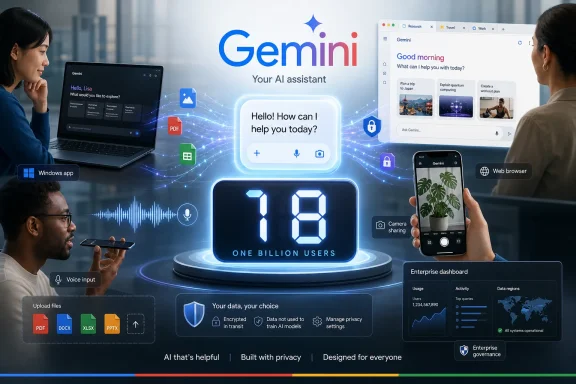
Ars Technica first reported the August 11 announcement, including comments from Gemini chief Josh Woodward on voice, camera sharing, schoolwork and image generation. The immediate practical consequence is that Gemini is no longer best understood as an AI feature sprinkled through Search, Gmail and Android. Google is claiming a billion people deliberately used its dedicated conversational assistant within a month — a usage level that turns product changes, data controls and browser integration into mass-deployment issues for Windows users and IT teams.
The number also arrives only weeks after Alphabet told investors Gemini had exceeded 950 million monthly users. Google had reported more than 900 million at I/O on May 19 and 750 million at the February earnings call. Even allowing for the company’s rounded “over” figures, the path from 900 million in May to 1 billion in August is extraordinary growth for a standalone AI interface.
Google’s billion-user count excludes the largest Gemini distribution channel
The most important clarification is what Google is not counting. Gemini models sit inside Google Search, Gmail, Drive, Chrome, Android and a long list of other services, but the billion monthly users in this announcement are tied to direct Gemini usage rather than every encounter with a Gemini-powered feature.
That distinction eliminates the easy explanation that Google simply counted everyone who saw an AI Overview in Search. Google separately said at I/O that AI Overviews reached 2.5 billion monthly active users and that AI Mode crossed 1 billion monthly users roughly a year after launch. Those are different surfaces with different behavior: seeing an AI-generated answer inside Search is not the same as opening Gemini and writing, speaking or sharing material with it.
For Google, this makes the Gemini number more valuable than a broad “AI reaches billions” claim. A user who opens the app, visits the Gemini site, or starts Gemini Live has taken an intentional step into Google’s conversational interface. That is the behavior Google needs if it wants Gemini to become a destination for research, creation, coding, tutoring and eventually agent-driven work rather than merely a component behind existing Google products.
The count still does not tell outsiders how often those people return, how many are paying subscribers, how many use advanced models, or how much the service costs Google to run. A monthly active user can be someone who tried Gemini once. Google has not disclosed retention cohorts, average prompts per person, the share of active users on free versus paid tiers, or a standardized methodology allowing outside analysts to compare Gemini’s figure directly with ChatGPT, Meta AI or Microsoft Copilot.
That missing information limits what a one-billion MAU headline can prove about revenue or long-term loyalty. It does prove that Google has built a distribution engine for Gemini at a scale its AI rivals must take seriously.
“Fastest ever” depends on where Google starts the clock
Google’s record claim is harder to assess than the raw user total. The company publicly opened Bard, Gemini’s predecessor, to users in the United States and United Kingdom on March 21, 2023. On February 8, 2024, it renamed Bard to Gemini and introduced the Gemini mobile app. Google’s own announcement at the time called the conversational service “formerly known as Bard.”
If the clock begins with the Bard experiment, the service took nearly three and a half years to reach one billion monthly users. If it begins with the Gemini rebrand and app launch, it took about two and a half years. If it begins with a later product redesign, model release or global availability expansion, the duration shortens again. Google has not specified which of those dates it uses to support the “fastest-growing product” claim.
There is another complication. In May, Google described AI Mode as a Search upgrade that surpassed one billion monthly users “in just a year.” The company can reasonably classify AI Mode as a feature of Search rather than a distinct product, while treating Gemini as a product. But that distinction is doing substantial work in the comparison. Public statements now describe two Google AI interfaces at the one-billion mark, one achieved in a year and one presented as Google’s fastest product to the same milestone.
The claim may be correct under Google’s internal product taxonomy. What is missing is the taxonomy, the launch date and the list of prior products against which Gemini was measured. Without them, the record is a marketing superlative rather than an independently auditable milestone.
Google’s own public baseline also raises a smaller but concrete counting discrepancy. At I/O in May and again in its June investor presentation, Google said it had 13 products with more than one billion users. Ars Technica’s report describes Gemini as joining 13 other Google products at that level. Those statements cannot both be true unless one of the previous 13 dropped below the threshold or Google changed the composition of the list. If all 13 remained above one billion users, Gemini would be Google’s 14th billion-user product.
Google has not published an updated roster explaining the difference. It is a detail, but it illustrates the problem with treating a corporate milestone as a fully transparent measurement.
Voice and visual sharing are becoming the real Gemini interface
Woodward’s additional numbers explain what Google believes will sustain the app’s growth. According to his comments reported by Ars Technica, 63% of active Gemini users employ voice input, while a growing portion use the product entirely by voice. Of the people who use Gemini Live, 20% share their device camera feed or screen with the assistant.
Those figures shift Gemini from a desktop chatbot model toward an ambient assistant model. A conventional prompt box competes with search engines, browser tabs and productivity software. Voice conversations and live visual context compete more directly with the way users ask another person for help: show them the problem, talk through it and ask follow-up questions.
For Windows users, this transition is uneven. The core Gemini website is available in Chrome, Firefox, Opera, Safari and Microsoft Edge, but Google’s current product lineup lists a native Gemini app for macOS rather than Windows. On Windows, Gemini remains primarily a web and browser experience, with Chrome receiving the deepest integration through Gemini in Chrome and Gemini Live.
That has administrative implications. Google says that Gemini in Chrome can process the content and URL of the current tab and any other tabs a user explicitly shares. If a user asks Gemini to search Chrome history, the relevant URLs are collected as well. Organizations that allow Chrome’s Gemini integration should therefore treat it as a browser data-sharing feature, not merely another sidebar chatbot.
Google’s privacy documentation says Gemini Live audio, video and screen shares are not used to improve Google services by default. That is a meaningful default, but it is not the entire data story. When Gemini Apps Activity is enabled, Live recordings and transcripts can be stored in the user’s account; Google says transcripts may be used to improve services and models. With activity disabled, Google says Live chats can still be stored for up to 72 hours to provide the service and process feedback.
For an individual, that means checking Gemini Apps Activity before using Live for anything involving work screens, customer data, internal dashboards or source code. For an IT administrator, it means verifying which Gemini features are enabled for managed Google accounts and whether employees can use personal accounts in unmanaged browser sessions. The announced billion-user threshold increases the odds that these choices are already being made informally by staff.
Education uploads and image volume raise governance issues
Woodward also said 38% of Gemini requests related to school include an attachment, prompting Google to prepare new study tools in the coming weeks. The statistic does not establish whether the attachment is an assignment, a course reading, a screenshot, a worksheet or a document created by somebody else. It does establish that file analysis, rather than text-only prompting, is becoming central to how students use Gemini.
That makes school AI policy a data-governance issue as much as an academic-integrity issue. A student uploading a teacher’s materials, peers’ work or a document containing personal information can create risks that a simple “do not use AI to write essays” policy does not address. Google’s planned study features may make Gemini more useful, but the company has not yet detailed which accounts, regions, age groups, school administrators or privacy controls will govern their rollout.
The image figure is larger still: Woodward said Gemini users generate 150 million images per day, largely through Google’s Nano Banana tools. Annualized, that is roughly 54.8 billion images if the current rate holds. Google previously said Nano Banana had generated more than 50 billion images by May, so the new daily figure is plausible as a measure of present use rather than a one-off spike.
Google says those images carry its SynthID watermark. That is useful provenance infrastructure, but it should not be oversold as a truth detector. SynthID can help identify content generated by a participating tool when detection is available; it cannot establish that an unmarked image is authentic, nor can it prevent screenshotting, recompression, cropping, editing or generation through systems that do not participate. Google itself has acknowledged that watermarking works at scale only if other companies adopt it.
The practical result is a familiar one for support desks, educators and security teams: more AI-generated material will be easy to create than to verify. Treat an apparent Gemini watermark as evidence about origin, not a complete answer about whether an image is accurate, current or safe to trust.
Gemini’s billion-user milestone is significant because it measures direct adoption of Google’s AI assistant rather than passive exposure to AI inside Search. It also confirms that Google’s next contest with Microsoft, OpenAI and Meta will increasingly be fought through browser access, voice interaction, shared screens and connected personal data.
The headline record needs a footnote Google has not provided: a public definition of what counts as a product launch, an updated billion-user product roster, and a repeatable MAU methodology. Until then, the one-billion threshold is solid evidence of reach — but the “fastest ever” label remains Google’s own classification, not an independently demonstrated fact.
Update: Pichai identifies Gemini as Google’s 14th billion-user product (August 12, 2026)
Sundar Pichai now says Gemini is Google’s 14th product to reach one billion users, resolving the apparent roster discrepancy in Google’s earlier public counts. The clarification means Gemini joined 13 existing billion-user products rather than replacing or coinciding with an unspecified change in that group.
The figure was reported by KLSE Screener in an August 12 dispatch, which described Google’s calculation as based on people using the Gemini app across its ecosystem. That wording is less precise than the earlier emphasis on direct Gemini app and web usage, so it does not yet provide the standardized methodology needed to determine exactly which Gemini entry points count toward the monthly total.
For Windows users and IT administrators, the practical takeaway is unchanged: Gemini’s reach is now firmly at consumer-platform scale, making browser access, account controls and data-sharing settings increasingly consequential. Google still has not publicly broken out retention, paid-tier usage or the proportion of activity involving integrated versus standalone Gemini surfaces.