
The distinction is more than wording. GitHub’s changelog still says Kimi K3 is generally available and lists Visual Studio Code, Visual Studio, Copilot CLI, GitHub.com, the cloud agent, mobile apps, JetBrains IDEs, Xcode, and Eclipse as supported surfaces. But a separate GitHub documentation page listing Copilot’s supported models still names Moonshot AI’s earlier Kimi K2.7 Code and does not list Kimi K3. For administrators and developers checking the model picker today, the operational status is clear: the announced rollout is on hold, and the formal model catalog has not caught up.
GitHub has said it will resume distribution “as soon as possible.” Until that happens, teams should treat Kimi K3 as an announced-but-unavailable option rather than a model they can deploy or standardize on.
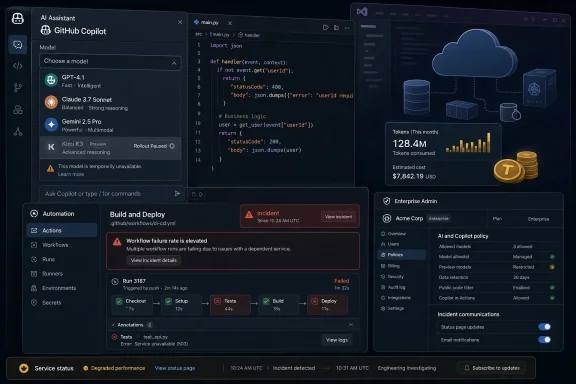 The announcement arrived with a same-day rollback
GitHub’s changelog presents Kimi K3 as a broadly available Copilot model, but its timestamp tells a more complicated story. The original August 6 post described a gradual rollout to Copilot Pro, Pro+, Max, Business, and Enterprise subscribers; the post was subsequently updated with the pause notice and a promise to publish pricing documentation.
That means GitHub has not withdrawn Kimi K3 from Copilot’s roadmap. It has stopped expanding access while it addresses an unspecified GitHub Actions incident. The company has not said whether the problem affects Copilot cloud-agent jobs, repository automation, the model-serving layer, billing, or another dependency. It also has not said whether any customers briefly received Kimi K3 access before the pause.
The missing detail matters most for organizations considering the cloud agent. Copilot’s cloud agent can use repository context and perform work through GitHub-hosted workflows, so a GitHub Actions incident is not merely background platform noise in this case. Yet GitHub has not identified whether Kimi K3 requests themselves caused the issue, exposed an existing Actions limitation, or were simply paused as a precaution during a wider service event.
No independent outlet had published a substantive report on the timing or technical cause of the pause when GitHub updated its announcement. The primary record is therefore GitHub’s own statement—and it is notably thin on what actually failed.
GitHub’s own documentation is not yet aligned
The strongest immediate warning sign is the mismatch between GitHub’s changelog and its documentation.
The changelog says Kimi K3 is available across Copilot’s primary developer clients, including Visual Studio and Visual Studio Code. GitHub’s supported-models reference, however, currently lists Kimi K2.7 Code as the only Moonshot AI model in general availability. Kimi K3 is absent from its tables for supported models, plan availability, client availability, extended capabilities, and default-enabled model eligibility.
That does not prove the rollout was improperly announced; model documentation frequently trails releases. But it does mean customers cannot yet use GitHub’s primary reference page to verify the full support matrix, whether a particular plan should expose the model, whether it supports special capabilities, or which IDE versions may be required.
The omission is especially relevant for Windows shops. GitHub named both Visual Studio Code and Visual Studio as Kimi K3 targets, but it did not publish minimum extension or IDE versions for the model. Its general model documentation advises customers to keep IDEs and Copilot extensions current, but that is not a Kimi K3 compatibility statement. A developer who does not see the picker entry cannot currently distinguish among a paused rollout, an organizational policy block, a regional limitation, or an outdated client.
GitHub should correct the record in a single place when the rollout resumes: identify the affected builds and surfaces, add Kimi K3 to the supported-model table, state its regional availability, and disclose whether any Copilot capabilities are excluded at launch.
The published price is token billing, not a simple model multiplier
GitHub says Kimi K3 will be billed at the provider’s list price under Copilot’s usage-based billing model:
- Kimi K3 input tokens will cost $3 per million tokens.
- Kimi K3 output tokens will cost $15 per million tokens.
- Cached input tokens will cost $0.30 per million tokens.
Those rates are important because “cost-effective” is GitHub’s characterization, not a guarantee of a low Copilot bill. Agentic coding workloads can consume large prompt contexts, tool outputs, repository files, and repeated planning turns. A workload with one million non-cached input tokens and one million output tokens would cost $18 at the published rates before any plan allowance, controls, or additional Copilot consumption rules are applied.
The steep difference between input and output pricing also changes how teams should evaluate the model. Sending codebase context is comparatively inexpensive, particularly when prompt caching works. Long autonomous runs that generate extensive explanations, patches, test output, or repeated agent messages will be driven more by the $15-per-million output rate.
GitHub has not yet added Kimi K3 to its public pricing documentation, even though the changelog says that update is forthcoming. That leaves practical questions unanswered: whether every named Copilot surface meters usage identically; whether cloud-agent activity has separate charges; how Kimi K3 consumption appears in organization-level billing reports; and whether any geography, data-residency, or compliance setting changes the rate.
For a business or enterprise administrator, this is a reason to wait before enabling the model even after access returns. The basic unit price is known, but the controls and reporting documentation needed to enforce a budget are not yet complete.
The hosting disclosures point in two directions
GitHub’s changelog says Kimi K3 is “hosted by GitHub on Fireworks AI.” That is a material operational detail for organizations assessing where source code and prompts are processed.
But GitHub’s separate model-hosting documentation describes open-weight Copilot models as hosted on US-based Azure AI Foundry infrastructure managed by GitHub and Microsoft. In the same section, it names Kimi K2.7 Code, says prompts and responses are not sent to the original model developer, and advises customers to review the model card and conduct their own evaluations.
The two statements may eventually prove compatible—for example, through a Fireworks-operated deployment arrangement—but GitHub has not documented that architecture for Kimi K3. The existing model-hosting page has not been updated to list Kimi K3 at all. As a result, customers should not assume that K2.7 Code’s documented hosting terms automatically apply to K3.
Fireworks AI states in its own security documentation that it does not log or store prompts or generations for open models without an explicit opt-in. That is useful context, but it is not a substitute for GitHub documenting the exact Kimi K3 service path, retention commitments, regions, and compliance availability inside Copilot.
GitHub’s broader Copilot policy adds another complication for individual subscribers. Since April 24, GitHub has said that Copilot Free, Pro, and Pro+ interaction data—including prompts, outputs, code snippets, and associated context—may be used to train and improve GitHub AI models unless the user opts out. Copilot Business and Copilot Enterprise data are excluded from that program. That policy addresses GitHub’s use of interaction data; it does not remove the need to understand how Kimi K3 inference is hosted and processed.
Business and Enterprise customers must opt in
Kimi K3 will be disabled by default for Copilot Business and Copilot Enterprise. GitHub says an administrator must enable a specific Kimi K3 policy before users in that organization can select it.
That default-off stance is sensible, especially because GitHub itself tells administrators to assess open-weight models against security, compliance, and data-governance requirements before enabling them. It also means a developer’s inability to find Kimi K3 after rollout resumes will not necessarily indicate a platform defect. In managed tenants, the first checkpoint will be the organization’s Copilot policy.
GitHub’s policy documentation confirms that model access can be controlled at enterprise and organization levels, and that controls can apply across authenticated Copilot surfaces. It also warns of policy drift when too many people can change settings without clear governance or audit-log review. Kimi K3’s arrival is exactly the kind of model addition that can expose that problem: a central enterprise policy, an organization override, client-specific controls, and data-residency restrictions can produce different availability for different users.
The immediate action for administrators is therefore limited. Do not enable a policy that is not yet available; do not ask developers to test a model that GitHub has paused; and do not infer production readiness from the “generally available” label alone. Review the intended data-handling position, identify which teams would be permitted to use the model, and decide what usage budget would apply once GitHub publishes its complete billing guidance.
Kimi K3 may become a meaningful new option for Visual Studio and Visual Studio Code users, particularly because GitHub is positioning it as an open-weight model for agentic coding at provider-list pricing. On August 6, though, the concrete consequence is simpler: the rollout is paused, the documentation remains incomplete, and enterprises have no reason to rush an enablement decision before GitHub explains the Actions incident and publishes the missing model, hosting, and billing details.
