
GM’s April announcement had already mapped out the two-stage approach: Gemini for natural-language interactions first, followed by a more deeply integrated assistant shaped by OnStar data. The new reporting supplies the practical distinction. Gemini can handle broad questions, route planning, entertainment and some cabin controls; GM’s own system is intended to understand the specific vehicle, its telemetry and the owner’s context.
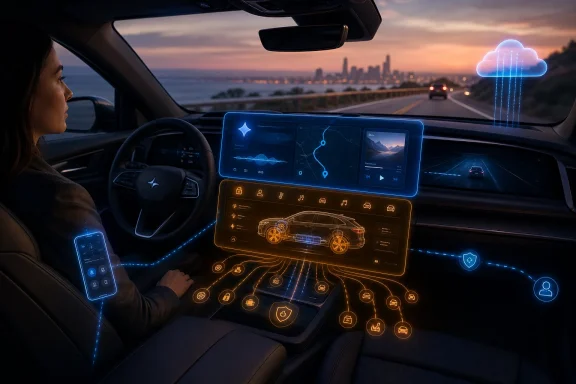 GM Wants AI to Reach Below the Infotainment Layer
According to CNBC, GM is working with an undisclosed large-language-model provider and expects the assistant to support predictive maintenance, vehicle telemetry, and more tailored ownership tasks. A request such as “kids setting,” for example, could potentially coordinate music, seating, climate settings and door locks rather than merely answering a question.
That is the important technical boundary. A general-purpose assistant sits largely atop the infotainment stack, while GM is aiming to connect its assistant to proprietary vehicle data and connected-service workflows. GM’s own technology materials describe the eventual product as being fine-tuned with vehicle intelligence and personal preferences through OnStar.
For Windows and enterprise IT readers, the parallel is familiar: the value proposition is not simply another chat interface, but contextual access to controlled data and systems. In a vehicle, that makes permissions, identity, data retention, remote-service integration and safe command handling far more consequential than the quality of casual conversation.
Gemini Remains the Front Door, for Now
GM has been rolling out Google Gemini to eligible 2022-model-year and newer vehicles equipped with Google built-in. Google’s assistant can accept more natural phrasing than older command-driven vehicle voice systems, retain conversational context, and handle tasks such as trip planning, text summaries, questions and selected climate or audio controls.
GM’s future assistant is not described as a Gemini replacement. Instead, the automaker appears to be building a layered strategy: Google supplies a broadly capable assistant and app ecosystem, while GM reserves vehicle-specific intelligence and service integration for its own platform.
That split gives GM more control over the data and experience that matter most to ownership—maintenance signals, onboard diagnostics, feature education, roadside services and personalized settings—without needing to build a general consumer AI product from scratch.
The Safety and Privacy Test Comes With Deeper Access
The launch timetable remains broad, with GM saying only that the integrated assistant will arrive later in 2026. The company has not identified the underlying model provider, named supported vehicles, detailed subscription requirements, or explained which commands will run locally versus through cloud services.
Those omissions will determine whether the assistant becomes a useful ownership tool or an intrusive new layer in the dashboard. A system that can interpret telemetry and alter multiple vehicle settings needs clear driver confirmation rules, narrow role-based permissions, reliable audit trails, and a practical way for owners to limit data sharing.
GM has made its direction clear: Gemini is the conversational starting point, but the company’s larger bet is on an assistant that knows the vehicle well enough to act on its behalf. The remaining question is whether GM can make that deeper integration genuinely helpful without turning the car into another opaque, always-connected endpoint.
