
Notebookcheck reported the global availability on August 17, with the base Neo-X1 priced at $2,099.99 and the Neo-X1 Pro at $2,899.99. GMKtec’s regional product listing confirms the hardware split: the base system combines a 16-core Ryzen 9 9955HX with an 8GB RTX 5060 Ti, 32GB of DDR5-5600 memory and a 1TB SSD; the Pro moves to the Ryzen 9 9955HX3D, RTX 5070 12GB, 64GB of memory and a 2TB SSD.
For Windows gamers and small-form-factor PC buyers, this is an unusual arrangement. The Neo-X1 is not a conventional mini PC built around laptop graphics, nor is it a standard Mini-ITX desktop using a socketed Ryzen processor. GMKtec is using AMD’s high-end Fire Range laptop CPUs on an MoDT—mobile on desktop—board, then pairing them with discrete GPUs whose public specifications match their desktop equivalents.
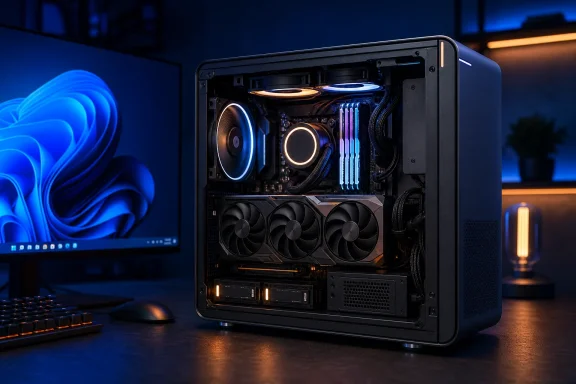 The desktop GPU question is not a small detail
Several reports surrounding the Chinese launch described the Neo-X1’s GPU pairing inconsistently. T3, for example, characterized both the RTX 5060 Ti and RTX 5070 as mobile GPUs. GMKtec’s specification table says otherwise: it lists the RTX 5060 Ti with 4,608 CUDA cores, an 8GB GDDR7 frame buffer and a 128-bit bus, while the Pro’s RTX 5070 is listed with 6,144 CUDA cores, 12GB of GDDR7 and a 192-bit interface.
Those numbers are significant because they match Nvidia’s desktop GeForce RTX 5060 Ti and RTX 5070 specifications. A buyer should therefore treat this as an SFF desktop with a soldered mobile CPU platform, not a gaming laptop motherboard with a higher-wattage laptop GPU placed in a box.
That changes the performance expectation, especially for the $2,899.99 Pro. A desktop RTX 5070’s 12GB memory configuration and 192-bit bus are materially more capable on paper than an 8GB-class GPU for games that push texture memory at 1440p and above. It also makes the 850W internal SFX Gold power supply less surprising: GMKtec is feeding a desktop GPU alongside a processor it says can run in a 160W performance mode and reach 170W at peak.
No independent reviews of the globally sold systems were available at publication, so buyers should not mistake the component list for proof of sustained clocks, thermals or acoustic performance. The compact enclosure has three system fans and CPU liquid cooling, but the real test will be whether the system can keep both its Ryzen 9 processor and full desktop GPU operating consistently under a long gaming or rendering load.
AMD’s X3D chip is the real reason to consider the Pro
The base Neo-X1 and Neo-X1 Pro are separated by more than the graphics card. The Pro receives the Ryzen 9 9955HX3D, a 16-core, 32-thread Fire Range processor with 3D V-Cache. GMKtec lists 128MB of L3 cache for the X3D model, compared with 64MB for the standard Ryzen 9 9955HX.
That cache advantage matters most in CPU-limited games, simulation titles, strategy games and high-refresh-rate play. In GPU-limited 4K workloads, the RTX 5070 upgrade will generally carry more weight. But the combined CPU-and-GPU step-up means the $800 premium is not simply payment for another graphics tier; it buys the configuration designed around gaming performance from both sides of the platform.
The MoDT approach has a trade-off. Ryzen 9 9955HX and 9955HX3D are powerful chips, but they are not socketed desktop CPUs. GMKtec provides two replaceable SO-DIMM slots, with support for up to 96GB of DDR5-5600 memory, but the processor is part of the board. This is expandable in the areas most buyers will touch—RAM and storage—without offering the CPU upgrade path expected from an AM5 desktop build.
A Geekbench result uploaded in July under the model name “GMKtec NEO-X1 Pro” recorded a valid Windows 11 result using a Ryzen 9 9955HX3D and roughly 64GB of memory. That is useful confirmation that the model existed in working hardware before its retail debut. It is not a substitute for a full system review, however, and it does not reveal GPU behavior, cooling noise, component choices or firmware quality.
Expansion is strong, but I/O is less forward-looking than the price suggests
GMKtec has given the Neo-X1 two PCIe 5.0 x4 M.2 slots, including one slot that supports the longer M.2 22110 format. The company rates each slot for up to 8TB, producing the headline 16TB maximum. The included SSDs are PCIe 4.0 drives, so buyers are paying for a platform with faster expansion headroom rather than receiving Gen5 storage in the box.
That is a sensible allocation in a prebuilt gaming PC. PCIe 5.0 SSDs remain a niche upgrade for most gaming workloads, while a second M.2 slot is immediately practical for growing game libraries, project files or local virtual-machine storage. The use of standard DDR5 SO-DIMMs and M.2 drives should also make post-purchase expansion simpler than on compact systems with soldered memory.
The port arrangement is less compelling. GMKtec lists two USB-A 2.0 ports and one 5Gbps USB-C port on the front. At the rear, the board supplies two more USB-A 2.0 ports, two 10Gbps USB-A ports and a 10Gbps USB-C port, plus 2.5GbE Ethernet, three analog audio jacks, HDMI 2.1 and DisplayPort 1.4. The GPU itself adds HDMI 2.1b and three DisplayPort 2.1b outputs.
The result is unusually broad display connectivity—GMKtec claims up to four displays, with 8K support on selected outputs—but there is no USB4 or Thunderbolt-class port in the published specification. That omission is difficult to overlook on a system starting above $2,000. It means no single-cable high-bandwidth dock option, no native USB4 storage pathway and no obvious high-speed external expansion route beyond conventional USB 10Gbps.
For a desk-bound gaming PC, that may be acceptable. For a user who wants a compact workstation to move between a desk, studio and conference room, the missing USB4 capability removes one of the main conveniences associated with premium compact PCs.
It is compact for a desktop, not a mini PC
The “mini PC” label has become loose enough to obscure what the Neo-X1 actually is. GMKtec lists a 350 × 165 × 265 mm chassis, or 350 × 165 × 310 mm with its handle, at approximately 14.6 liters and 7 kg. That makes it notably smaller than many traditional tower systems, but it is far larger and heavier than the palm-sized NUC-style computers GMKtec is best known for.
The size is the engineering compromise that makes the product credible. The chassis accommodates an internal 850W SFX supply, liquid CPU cooling, multiple case fans and a full desktop discrete GPU, while avoiding the proprietary external power bricks and constrained cooling setups common in high-performance mini PCs.
GMKtec’s own listing also identifies Windows 11 Pro as the installed operating system. That is more useful for the intended enthusiast and prosumer audience than a Windows 11 Home configuration, particularly for BitLocker management, Remote Desktop host capability, Hyper-V and local Group Policy controls. Microsoft 365 is not included.
Availability claims need a practical check before purchase
Notebookcheck says the machines are now available through GMKtec’s official store, and T3 reported an August 17 global availability date alongside the US prices. But regional storefront availability is not uniform: GMKtec’s Japanese listing showed the configurations but marked them sold out when checked. That does not disprove the global launch, but it means “available globally” should not be read as “ready to ship in every region today.”
GMKtec has also not yet established a substantial independent review record for the Neo-X1 family. Its product pages specify a one-year warranty in Japan, but prospective US buyers should verify the warranty terms, return procedure, shipping origin and support coverage presented at checkout rather than assuming every regional store uses the same terms.
The Neo-X1 Pro is a credible high-performance SFF proposition on paper because its published GPU specifications correspond to a desktop RTX 5070, not a laptop RTX 5070. Until reviewers test sustained performance and support experience, the safest reading is narrower: GMKtec has introduced a compact Windows 11 Pro desktop with unusually strong hardware and sensible memory/storage upgrade options, but buyers are paying launch pricing before its cooling, firmware and after-sales support have been independently proven.
