
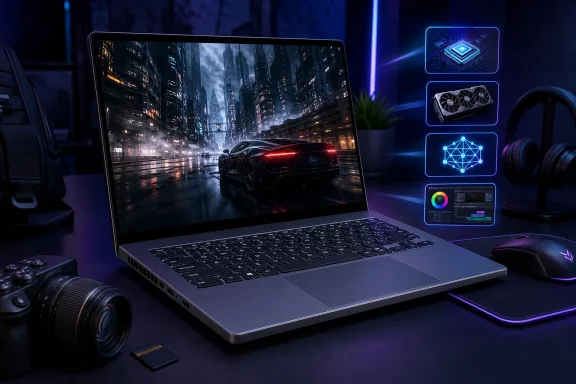
Ultrabookreview’s detailed testing finds that Asus has not fundamentally redesigned the G14’s familiar CNC aluminum chassis. Instead, the GU405 is a performance-oriented refresh: stronger cooling, a brighter 3K 120Hz OLED panel, a full-size UHS-II SD card reader, and GPU power limits that reach 115W in Turbo and 130W in Manual mode. Asus confirms those power targets and the Core Ultra 9 386H configuration on its product pages.
At 1.55kg for the RTX 5070 Ti and RTX 5080 chassis, the machine is still unusually portable for its class. But the higher-spec configuration is marginally thicker and heavier than the lower-power RTX 5060 and RTX 5070 versions, a distinction buyers should watch closely when comparing listings.
 Intel Changes the G14’s Battery Story More Than Its CPU Story
According to Ultrabookreview, the Core Ultra 9 386H delivers broadly similar sustained CPU performance to the Ryzen AI 9 HX 370 configuration in the 2025 G14, with the older AMD model sometimes retaining a small edge in long CPU loads. Intel’s advantage is efficiency: the review recorded markedly better light-use battery life, including roughly eight to 10 hours of text work and up to 12–14 hours of 4K video playback.
That matters more than a minor benchmark swing on a 14-inch laptop. The G14 has long been powerful enough for demanding work, but its earlier AMD-based configurations could be relatively thirsty away from the wall. The GU405 looks more credible as an all-day Windows machine, provided users are comfortable with soldered LPDDR5X memory and a single user-replaceable M.2 2280 PCIe 4.0 SSD slot.
The new panel also addresses a meaningful weakness in prior OLED G14s. Ultrabookreview measured more than 520 nits of SDR brightness, which improves usability in bright rooms even though the display retains a glossy, anti-glare-treated finish. Asus markets the panel with up to 1,100 nits peak HDR brightness and DisplayHDR True Black 1000 certification.
GPU Headroom Delivers, but the Fans Follow
The RTX 5070 Ti model reviewed by Ultrabookreview achieved a 16,198 Time Spy score in Turbo mode and 17,118 in Manual mode. The outlet found the higher-power 2026 implementation delivers roughly a 5–10% gaming uplift against the prior G14 RTX 5070 Ti setup, alongside the practical benefit of 12GB of GDDR7 memory rather than 8GB on lower-tier RTX 5070 hardware.
That is enough for capable 2560×1600 gaming, particularly in DLSS-supported games. Native 2880×1800 remains demanding in ray-traced titles, however, so DLSS 4 and Multi Frame Generation are central to the experience rather than optional extras.
The trade-off is acoustics. Turbo runs at roughly 48 dBA in the review, while Manual reaches about 52 dBA for only modest additional GPU performance. Performance mode, at approximately 42 dBA, appears to be the more practical setting for many users; Silent mode keeps noise below 35 dBA but sharply limits GPU power on the tested unit.
An Excellent G14 With a Difficult Value Proposition
Ultrabookreview’s conclusion is straightforward: the GU405 may be the strongest compact Windows gaming laptop available at its weight, but it is priced accordingly. Asus lists the RTX 5070 Ti model at $3,599.99, while the RTX 5080 version starts around $4,799.
The 2025 G14 remains the uncomfortable comparison. It lacks the brighter OLED, newer Intel efficiency gains, full-size SD reader, and higher GPU ceiling, but it can cost roughly $1,000 to $1,500 less in equivalent high-end configurations. For Windows gamers or creators who need CUDA, broad game compatibility, and a genuinely portable high-performance machine, the 2026 G14 is a formidable option. For everyone else, the previous G14’s discount may be the more compelling upgrade.
