
The practical change is larger than replacing one app icon. Saying “Hey Google,” holding the power button, or using another assistant gesture will invoke Gemini instead of Assistant; the email also says the removal applies to paired Wear OS watches, compatible headphones and earbuds, and phone-projected Android Auto. Google’s March 2025 announcement established that Assistant would disappear from most mobile devices, but it gave no precise cutoff. Google later pushed its original end-of-2025 target into 2026. The September 4 date is the first concrete start date users have seen.
Google has not, as of August 5, published a matching date-stamped announcement on its main product blog. Its public Android Auto help page still says only that Gemini is replacing Assistant on most mobile devices and that Google will share more details while completing the migration in 2026. That makes the email the operative notice for affected users, rather than a broadly documented launch schedule.
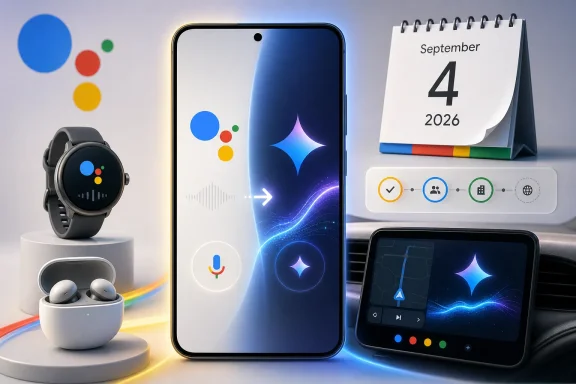 September 4 starts a rollout, not a single shutdown moment
The date is a beginning, not the day every Android phone loses Assistant. Google’s email says the company will start removing access on September 4 and expects the process to take “a few weeks” to reach everyone. It does not identify countries, Android versions, manufacturers, carrier channels, Google app versions, or a final date by which the migration will be complete.
That missing deployment detail matters for support teams. Two otherwise identical managed Android phones may behave differently during the rollout, and a help desk will have little evidence that a delayed migration is a fault rather than Google’s staged release process. Organizations that depend on voice workflows should document which commands are actually used before the rollout begins, rather than treating Gemini as a transparent rebrand.
The email’s language is also more final than Google’s existing migration documentation. Current Gemini help pages still tell users that they can switch back to Google Assistant if Gemini cannot handle a feature they rely on. After Google disables Assistant availability on a migrated device, that escape hatch disappears. The support text has not caught up to the retirement notice.
This is a familiar cloud-service retirement pattern: the local device remains in a usable state, but the vendor revokes the choice through a server-controlled configuration. Factory-resetting a phone, clearing the Gemini app, or reinstalling an older Google app should not be assumed to restore Assistant once the account or device becomes ineligible for it. Google’s wording says users will no longer be able to use or switch back to Assistant, not merely that Gemini will be the default.
Gemini still does not match every Assistant function
Google’s case for the switch is that Gemini can handle familiar voice commands while adding conversational AI, on-screen context, image input and longer back-and-forth interactions. Those are real differences: Gemini can summarize what is on a screen, work from a camera image, and interact with connected Google services in ways the original voice-first Assistant was not designed to do.
But Google’s own Gemini support documentation continues to acknowledge gaps. Its current help page says some Google Assistant features and services are not supported when Gemini is the primary mobile assistant, specifically naming podcasts, news and radio stations, and some third-party music providers. It also says Interpreter Mode still requires switching to Google Assistant. That last instruction becomes unusable for affected mobile devices once the September migration lands.
Google also notes that some routine actions remain dependent on Assistant components behind the scenes. When users invoke Gemini with “Hey Google,” Assistant can still handle wake-word detection, Voice Match and selected quick voice actions that Gemini is “still learning” to perform directly. In other words, Google Assistant is being removed as the visible, selectable assistant experience before every component historically associated with Assistant has necessarily vanished from the underlying workflow.
For users, that means a successful “Hey Google” activation after September 4 should not be confused with feature parity. It will prove that Gemini can be launched through the old trigger; it will not prove that a particular legacy command, third-party media action, language behavior, routine, or lock-screen request survives the move.
The honest message is not that Gemini has no value. Gemini is a more capable tool for open-ended questions and multimodal tasks. The problem is that Google is retiring a deterministic command interface and replacing it with a generative interface whose documented feature coverage remains uneven. A request such as “turn on the kitchen lights” may work perfectly; a routine with unsupported multi-step actions or an old provider integration may not.
Paired devices are where the scope becomes easy to miss
The most consequential line in the email is not about the phone. It says that choosing—or being moved to—Gemini as the mobile assistant also changes the assistant experience on paired devices. That includes Wear OS watches and compatible headphones or earbuds, where voice control is often used for narrow, repeatable tasks rather than exploratory AI conversations.
Google’s public Gemini setup guidance already states that selecting Gemini on a phone replaces Assistant on paired mobile accessories. The new notice turns that from an opt-in side effect into part of a compulsory migration. Users who never open the Gemini app after the rollout may still encounter Gemini through a watch or headset because the phone is the controlling device.
Android Auto needs particular care. The email distinguishes Android Auto projected from a phone from vehicles with Google built-in. For projected Android Auto sessions, Google says Assistant access will be lost along with the phone’s Assistant access. For cars running Google built-in—Android Automotive systems where Google services run directly in the vehicle—the email says Google Assistant will continue to function beyond September 4, 2026.
That distinction is technically important. A driver using the same Google account can see different assistant behavior in a car depending on whether navigation and media are running through a connected Android phone or through the car’s embedded Google system. Google has not given a retirement date for Assistant in Google-built-in vehicles in the email, only an assurance that it will remain after September 4.
Google Home speakers, smart displays, televisions and locked Pixel Tablet Hub Mode are also outside this particular mobile cutoff. Google’s existing documentation says those non-mobile devices continue to use Assistant in the relevant configurations. They are on separate Gemini migration tracks, so the September date should not be read as a universal end-of-life date for the Google Assistant brand or service.
Eligibility leaves old phones and managed accounts in an awkward position
Google’s stated eligibility requirement for the Gemini mobile app is Android 9 or later with at least 2GB of RAM. Android Go is excluded. Google also limits availability by country, language, account type and device configuration. Devices that do not meet Gemini’s minimum requirements were explicitly exempted from Google’s 2025 announcement, which said their Assistant functionality would not change “at this time.”
The new email preserves that conditional language: Gemini becomes the Google-provided assistant only on devices that meet the system requirements and are located in a Gemini-supported region. It does not say how long Assistant will remain available on ineligible devices, whether the capability set will remain frozen, or whether there will be a stripped-down successor for older handsets. That is an important omission for organizations running older rugged devices, low-cost Android fleets, or long-lived tablets.
Google’s public availability documents are not especially clear on the geographic boundary, either. A 2025 Google blog post said Gemini had expanded to more than 200 countries and territories, while the current Gemini mobile-app availability page says it is available in more than 150 countries. Those statements may reflect different definitions—general Gemini access versus availability of the mobile app—but Google has not supplied a migration-specific country list for September.
Enterprise users have another complication. Google says Gemini mobile features may be restricted for work or school accounts, and its documentation says the Gemini mobile app cannot be accessed within an Android Work Profile. That does not mean every company-managed phone will be excluded from the migration; it means administrators should not assume the consumer Gemini experience and the managed-device experience have the same capability set.
For IT teams, the immediate preparation is straightforward:
- Inventory voice-dependent workflows on Android phones, watches, headsets and Android Auto rather than testing only the handset.
- Test the actual commands employees use, including calling, messaging, navigation, media, smart-home routines and any accessibility workflow.
- Check whether staff use work profiles, supervised accounts, unsupported languages, Android Go, or devices below Android 9 and 2GB of RAM.
- Tell users that a “switch back to Assistant” setting shown today may stop working after Google’s staged removal reaches their device.
Google has set the deadline before it has published the full retirement map
September 4 settles the question of when the consumer migration begins, but not the harder operational questions: which regions move first, when the weeks-long rollout ends, what support path remains for older or ineligible devices, and when Google will remove documentation that still recommends reverting to Assistant for missing Gemini functions.
For most users with a recent Android phone in a supported market, the immediate consequence is simple: Gemini will become the only Google-provided mobile assistant option sometime after September 4. For everyone responsible for a fleet, a car integration, a headset workflow, or a user who depends on one narrow Assistant command, the date marks the start of validation—not the end of it.
