
Google has moved Demis Hassabis out of the day-to-day CEO job at Google DeepMind, giving operational control of the unit to Koray Kavukcuoglu while Hassabis becomes Google DeepMind chairman and Alphabet chief scientist. The practical change is clear even through the upbeat language: the executive who built DeepMind into Google’s flagship AI lab will no longer own the delivery of Gemini models, products, teams, and deadlines.
Axios first reported the reshuffle on August 5, and Fortune separately described the same transition as a broad reorganization of Google’s AI leadership. Kavukcuoglu, previously Google DeepMind’s CTO and Alphabet’s chief AI architect, becomes senior vice president of Google DeepMind and reports directly to Alphabet CEO Sundar Pichai. Hassabis remains inside Alphabet, continues to lead Isomorphic Labs, and says he will focus on AGI strategy and scientific applications.
This is a leadership transfer, not an exit. But it is also more than a title adjustment. Google has separated the lab’s long-horizon scientific agenda from the executive accountable for Gemini’s commercial execution, at a point when its most important announced model release has slipped past its target.
Kavukcuoglu takes over the work that matters most to customers, developers, and Google’s own product groups: Gemini model development, frontier research, and the teams behind Gemini’s consumer and developer offerings. Google’s internal message, as reported by Axios, casts his task in the language of speed and focus—delivering on an ambitious Gemini roadmap while moving toward AGI.
The organizational reporting line is the telling detail. Hassabis was CEO of Google DeepMind; Kavukcuoglu is senior vice president reporting to Pichai. Google has not said that the title difference changes budgets, authority over research priorities, or approval rights for major model launches. Still, it places the operational leader of Google’s core AI unit more directly inside the parent company’s executive chain rather than under a standalone lab CEO.
That setup may reduce the distance between DeepMind, Google Cloud, Search, Android, Workspace, and the company’s broader product organization. It may also make Pichai more visibly responsible for whether Google turns research advances into reliable releases. A chief executive can delegate a missed delivery; a senior vice president reporting directly to the company CEO makes the escalation path much shorter.
For a company with a reputation for deep research and a growing need to ship competitive models on a predictable cadence, that distinction is material. Hassabis is retaining influence over AI direction. Kavukcuoglu now owns the organization that has to turn that direction into models people can use.
Google has not publicly attributed the leadership change to the missed target. It has also not published a replacement availability date for Gemini 3.5 Pro in the reporting reviewed here. That absence is more important than the inevitable speculation around a management shuffle: customers cannot plan production migrations, capacity reservations, evaluation cycles, or agent deployments around a model that remains unshipped and undated.
Axios, citing company sources, reported that low morale was part of the reason behind the delay. That specific explanation has not been independently confirmed, and Google has not endorsed it. The confirmed issue is simpler: Google signaled a June arrival, and the flagship model did not arrive on that schedule.
The delayed model also changes how to read Pichai’s message that Google must “accelerate” and stay focused on the AI frontier. It is not a generic rallying cry. It is an acknowledgment that Google’s advantages—custom TPUs, global infrastructure, distribution through Search, Android, Workspace, Chrome, and Cloud, and the cash to sustain enormous training runs—do not automatically produce a timely frontier-model launch.
For Windows enthusiasts and IT teams, the immediate advice is restrained: do not treat this as a product migration event. Google has announced no retirement of Gemini applications, API endpoints, Vertex AI services, Workspace features, pricing plans, or enterprise support commitments. But teams evaluating generative AI for coding, document workflows, customer support, or knowledge retrieval should avoid writing deployment plans around Gemini 3.5 Pro until Google names a release date and publishes the model’s actual availability and limits.
Yet the company’s own framing leaves little ambiguity about the operational handoff. Hassabis said he was giving up day-to-day responsibilities to focus on the “big picture” and on what he sees as a potentially near-term transition toward AGI. That means the new roles should not be read as an extension of his CEO job under a different name.
Google has not explained how chairman and chief scientist authority will work in practice. It has not said whether Hassabis will have veto power over model releases, a dedicated research budget, direct control of specific teams, or formal authority over Kavukcuoglu’s roadmap. Those omissions leave a real governance question: when scientific ambition, safety judgment, and product deadlines collide, who makes the final call?
The answer appears to be more centralized than before. Hassabis will have influence across Alphabet; Pichai will have the executive leading DeepMind’s operational apparatus reporting to him directly. The arrangement could work well if it gives Hassabis room to pursue the scientific bets that made DeepMind distinctive while assigning product delivery to a leader already embedded in recent Gemini work. It will fail if the split creates two AI strategies—one optimized for research prestige and the other for release velocity.
Google says the Dean announcement and the Hassabis leadership transition were not connected. There is no evidence in the public record that they were coordinated as a single restructuring. But announcing them together has a compounding effect: Google DeepMind is simultaneously changing its operating leader and losing a group of people associated with foundational Google infrastructure and some of its most consequential AI research.
The Discovery Loop relationship is also more complicated than a conventional talent departure. Google is not simply losing Dean and his co-founders to a hostile competitor; it is financing the venture and providing cloud capacity. That gives Alphabet a continuing commercial relationship with a team whose expertise it evidently wants to remain close to.
What Google has not disclosed is equally relevant. There are no public details on Alphabet’s equity stake, the size or duration of its cloud commitment, whether Discovery Loop will receive access to proprietary Google research, or whether Google will have preferential rights to its technology. Without those terms, calling the venture either a clean spinout or a strategic extension of Google would be premature.
Google’s counterargument is credible on its face. It retains extraordinary computing resources, custom chips, one of the world’s largest AI research organizations, profitable products to fund capital spending, and distribution channels that rivals cannot easily reproduce. A handful of exits does not erase those advantages.
But the burden has shifted from promising capability to demonstrating execution. Google needs to show that the new chain of command can ship the delayed Gemini 3.5 Pro, retain or replace elite researchers, and keep scientific work from being subordinated to short-term product pressure. Kavukcuoglu’s first meaningful scoreboard will not be an org chart or an internal memo. It will be the next Gemini release, its quality, its availability, and whether Google can state a delivery date and meet it.
This is a leadership transfer, not an exit. But it is also more than a title adjustment. Google has separated the lab’s long-horizon scientific agenda from the executive accountable for Gemini’s commercial execution, at a point when its most important announced model release has slipped past its target.
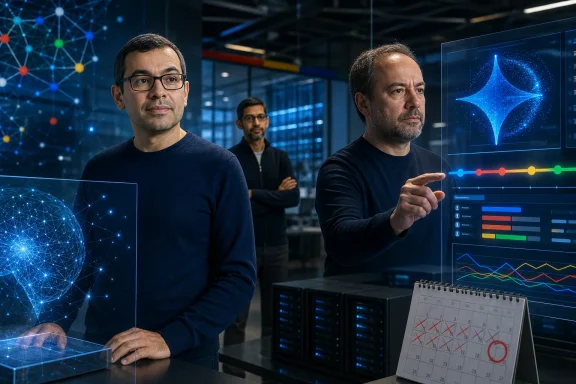 Koray Kavukcuoglu inherits the Gemini delivery problem
Kavukcuoglu takes over the work that matters most to customers, developers, and Google’s own product groups: Gemini model development, frontier research, and the teams behind Gemini’s consumer and developer offerings. Google’s internal message, as reported by Axios, casts his task in the language of speed and focus—delivering on an ambitious Gemini roadmap while moving toward AGI.The organizational reporting line is the telling detail. Hassabis was CEO of Google DeepMind; Kavukcuoglu is senior vice president reporting to Pichai. Google has not said that the title difference changes budgets, authority over research priorities, or approval rights for major model launches. Still, it places the operational leader of Google’s core AI unit more directly inside the parent company’s executive chain rather than under a standalone lab CEO.
That setup may reduce the distance between DeepMind, Google Cloud, Search, Android, Workspace, and the company’s broader product organization. It may also make Pichai more visibly responsible for whether Google turns research advances into reliable releases. A chief executive can delegate a missed delivery; a senior vice president reporting directly to the company CEO makes the escalation path much shorter.
For a company with a reputation for deep research and a growing need to ship competitive models on a predictable cadence, that distinction is material. Hassabis is retaining influence over AI direction. Kavukcuoglu now owns the organization that has to turn that direction into models people can use.
Gemini 3.5 Pro is the immediate credibility test
The reorganization arrives with Gemini 3.5 Pro still delayed. Alphabet’s investor presentation in June said Gemini 3.5 Pro was expected that month, while Gemini 3.5 Flash was already available. As of August 6, Axios and Fortune both report that the Pro release is months behind its intended timetable.Google has not publicly attributed the leadership change to the missed target. It has also not published a replacement availability date for Gemini 3.5 Pro in the reporting reviewed here. That absence is more important than the inevitable speculation around a management shuffle: customers cannot plan production migrations, capacity reservations, evaluation cycles, or agent deployments around a model that remains unshipped and undated.
Axios, citing company sources, reported that low morale was part of the reason behind the delay. That specific explanation has not been independently confirmed, and Google has not endorsed it. The confirmed issue is simpler: Google signaled a June arrival, and the flagship model did not arrive on that schedule.
The delayed model also changes how to read Pichai’s message that Google must “accelerate” and stay focused on the AI frontier. It is not a generic rallying cry. It is an acknowledgment that Google’s advantages—custom TPUs, global infrastructure, distribution through Search, Android, Workspace, Chrome, and Cloud, and the cash to sustain enormous training runs—do not automatically produce a timely frontier-model launch.
For Windows enthusiasts and IT teams, the immediate advice is restrained: do not treat this as a product migration event. Google has announced no retirement of Gemini applications, API endpoints, Vertex AI services, Workspace features, pricing plans, or enterprise support commitments. But teams evaluating generative AI for coding, document workflows, customer support, or knowledge retrieval should avoid writing deployment plans around Gemini 3.5 Pro until Google names a release date and publishes the model’s actual availability and limits.
Hassabis gains scope while giving up control of operations
Hassabis’s new portfolio is substantial. As Alphabet chief scientist, he is positioned to influence research and strategy beyond one operating unit. As chairman of Google DeepMind, he retains a formal leadership role at the lab he co-founded. His continued leadership of Isomorphic Labs also keeps him directly involved in Alphabet’s AI drug-discovery effort, a field closely tied to the AlphaFold work that earned Hassabis and John Jumper the 2024 Nobel Prize in Chemistry.Yet the company’s own framing leaves little ambiguity about the operational handoff. Hassabis said he was giving up day-to-day responsibilities to focus on the “big picture” and on what he sees as a potentially near-term transition toward AGI. That means the new roles should not be read as an extension of his CEO job under a different name.
Google has not explained how chairman and chief scientist authority will work in practice. It has not said whether Hassabis will have veto power over model releases, a dedicated research budget, direct control of specific teams, or formal authority over Kavukcuoglu’s roadmap. Those omissions leave a real governance question: when scientific ambition, safety judgment, and product deadlines collide, who makes the final call?
The answer appears to be more centralized than before. Hassabis will have influence across Alphabet; Pichai will have the executive leading DeepMind’s operational apparatus reporting to him directly. The arrangement could work well if it gives Hassabis room to pursue the scientific bets that made DeepMind distinctive while assigning product delivery to a leader already embedded in recent Gemini work. It will fail if the split creates two AI strategies—one optimized for research prestige and the other for release velocity.
Jeff Dean’s departure makes this more than a one-person transition
The Hassabis move coincided with a second major change: Jeff Dean is leaving Google after 27 years to co-found Discovery Loop with Google Senior Fellow Sanjay Ghemawat, DeepMind VP Oriol Vinyals, and Google Brain co-founder Quoc Le. Axios and Fortune report that Alphabet will be a founding investor and cloud-computing provider for the new public benefit corporation.Google says the Dean announcement and the Hassabis leadership transition were not connected. There is no evidence in the public record that they were coordinated as a single restructuring. But announcing them together has a compounding effect: Google DeepMind is simultaneously changing its operating leader and losing a group of people associated with foundational Google infrastructure and some of its most consequential AI research.
The Discovery Loop relationship is also more complicated than a conventional talent departure. Google is not simply losing Dean and his co-founders to a hostile competitor; it is financing the venture and providing cloud capacity. That gives Alphabet a continuing commercial relationship with a team whose expertise it evidently wants to remain close to.
What Google has not disclosed is equally relevant. There are no public details on Alphabet’s equity stake, the size or duration of its cloud commitment, whether Discovery Loop will receive access to proprietary Google research, or whether Google will have preferential rights to its technology. Without those terms, calling the venture either a clean spinout or a strategic extension of Google would be premature.
Google’s talent argument now has a higher burden of proof
The reshuffle follows other high-profile departures. Semafor reported in June that Noam Shazeer and John Jumper had left Google amid an exceptionally aggressive competition for AI researchers, even as Hassabis argued that DeepMind retained the industry’s broadest research bench. Axios has also reported additional departures from Gemini leadership and research ranks.Google’s counterargument is credible on its face. It retains extraordinary computing resources, custom chips, one of the world’s largest AI research organizations, profitable products to fund capital spending, and distribution channels that rivals cannot easily reproduce. A handful of exits does not erase those advantages.
But the burden has shifted from promising capability to demonstrating execution. Google needs to show that the new chain of command can ship the delayed Gemini 3.5 Pro, retain or replace elite researchers, and keep scientific work from being subordinated to short-term product pressure. Kavukcuoglu’s first meaningful scoreboard will not be an org chart or an internal memo. It will be the next Gemini release, its quality, its availability, and whether Google can state a delivery date and meet it.
References
- Primary source: Axios
Published: 2026-08-06T09:11:06.272204+00:00
Loading…
www.axios.com - Independent coverage: Fortune
Published: 2026-08-05T18:43:03+00:00
Loading…
fortune.com - Related coverage: deepmind.google
Loading…
deepmind.google - Related coverage: deepmind.google
Loading…
deepmind.google - Related coverage: theinformation.com
Loading…
www.theinformation.com - Related coverage: fastcompany.com
Loading…
www.fastcompany.com - Related coverage: relvehq.com
Loading…
relvehq.com - Related coverage: benched.ai
Loading…
benched.ai - Related coverage: axios.com
Google DeepMind CEO Demis Hassabis is stepping aside
oogle's AI organization is undergoing a profound change as the company struggles to keep pace with OpenAI and Anthropic.www.axios.com
- Related coverage: reutersconnect.com
Loading…
www.reutersconnect.com - Related coverage: investing.com
Loading…
www.investing.com - Related coverage: io.google
Loading…
io.google - Related coverage: semafor.com
DeepMind Chief Demis Hassabis says Google’s still winning AI talent | Semafor
Despite the departure of two top AI leaders that sent the company’s stock price down, Hassabis says Google is still on top.www.semafor.com - Related coverage: blog.google
Loading…
blog.google - Related coverage: wired.com
Loading…
www.wired.com - Related coverage: es.marketscreener.com
Loading…
es.marketscreener.com - Related coverage: fortune.com
Loading…
fortune.com - Related coverage: searchengineland.com
Loading…
searchengineland.com - Related coverage: sahmcapital.com
Loading…
www.sahmcapital.com - Related coverage: cbsnews.com
Loading…
www.cbsnews.com - Related coverage: commerce.senate.gov
Loading…
www.commerce.senate.gov - Related coverage: services.google.com
Loading…
services.google.com - Related coverage: winbuzzer.com
Google Reportedly Delays Gemini 3.5 Pro Over Coding Issues
Google has reportedly delayed Gemini 3.5 Pro after missing a June target as coding results fell short, leaving partner testing underway without a release date. winbuzzer.com
- Related coverage: eweek.com
Loading…
www.eweek.com - Related coverage: testingmodels.com
Loading…
testingmodels.com - Related coverage: androidcentral.com
Google Gemini AI: Gemini 3.5 Flash, Nano Banana, Live, best features, linked apps, and more | Android Central
From Gemini 3.5 Flash to all the Google apps that use Gemini, this guide will break down every key AI feature and whether you need to pay for it.www.androidcentral.com - Related coverage: itpro.com
Loading…
www.itpro.com