
Reports of Google Gemini failures on Tuesday, August 4 were real enough to merit caution, but the available record does not substantiate the claim that Gemini suffered a confirmed, multi-region system-wide outage. Sunday Guardian Live reported a sharp rise in Downdetector complaints involving the Gemini app, website, response generation, and “Automation & Workflows,” while Google had not declared an incident. A review the following day finds the same central limitation: there is user evidence of intermittent trouble, but no published Google postmortem, start time, affected-service list, or restoration notice for an August 4 Gemini incident.
That distinction is operationally important for anyone using Gemini alongside Windows desktops, Chrome, Android devices, Google Workspace, or browser-based automation. A public-report spike is a useful early warning that an issue may be wider than one machine or account. It is not proof that the fault sits in Google’s backend, nor does it establish which Gemini surfaces were affected.
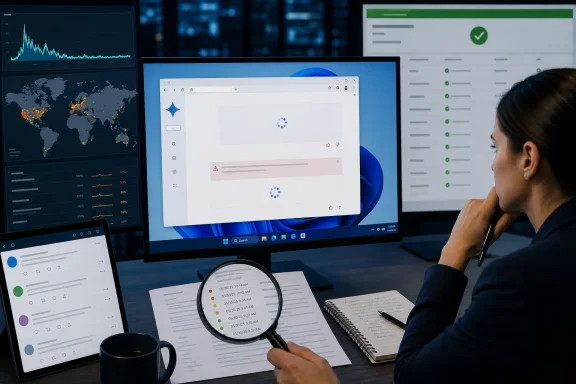
The submitted report says Downdetector showed 57% of complaints tied to the app, 32% to the website, and 8% to Automation & Workflows. Those figures total 97%, a small but telling reminder that the article did not preserve a complete snapshot of the tracker’s category breakdown or explain the missing share. It also did not give a complaint count, the time at which the graph peaked, a baseline, country-specific data, error codes, or screenshots of the observed surge.
Downdetector’s own Gemini pages make clear why those omissions matter. The service collects user submissions, and its issue categories include App, Automation & Workflows, Integrations, Login, Save/Sync, and Website. A user chooses the category when filing a report; the selection is not Google telemetry identifying the failed backend component.
The same category mix can also differ by country and change throughout the day. On the current UK Gemini page, for example, Downdetector reports no active broad problem while still displaying recent complaint categories split between Website, App, and Automation & Workflows. That is normal for a crowd-reporting service: it shows where users perceive a problem, not a root-cause analysis or a global availability measurement.
The article’s “multiple regions” wording rests on a map of reports, but maps of user complaints naturally cluster where Gemini has more users and where people are more likely to file reports. Without report volume, regional baselines, or confirmation from Google, it cannot establish that a single failure crossed regions or that every Gemini product was involved.
But it does rule out a stronger version of the claim. Google has not published a Workspace Gemini incident matching the reported app-and-web failure, and the original report itself acknowledged that Google had not confirmed a system-wide outage. There is no official timeline to establish duration, no listed mitigation, and no affected-customer definition.
Google’s recent public history shows what a confirmed Gemini incident looks like when the company decides it meets the bar for status reporting. On June 10, Google said Workspace customers using the Gemini app and the Gemini side panel were receiving “Something Went Wrong” errors; the incident lasted more than seven hours. On May 4, Google recorded elevated error rates in Gemini conversations that lasted more than four days. In February, it documented a separate problem in which conversation history disappeared from Gemini Web and mobile apps, while new chats continued to work.
Those records named the impacted product surfaces, described the observed symptom, stated whether a workaround existed, and gave customers an update cadence. None of that exists for the August 4 reports.
That mixed evidence is exactly what the Sunday Guardian Live report left unresolved. If the Gemini app, Gemini Web, and a named automation product had all been unavailable in a coordinated global event, one would expect a more consistent symptom set: a recognizable error message, a clear outage window, a status update, or reporting from multiple independent outlets capturing the same peak. No other outlet has reported a confirmed August 4 Gemini outage with the scope claimed in the submitted article.
The June 10 incident offers a useful contrast. Tom’s Guide and TechRadar independently tracked rapidly rising reports across countries, recurring error numbers such as 1076 and 1099, and then Google’s formal acknowledgement on the Workspace Status Dashboard. Even in that case, reporting initially had to distinguish between broad user complaints and what Google had actually confirmed.
For August 4, there is no equivalent chain of evidence. The published material offers a generic symptom list that could describe many common Gemini failures: a saturated service, a broken session, an account-specific limit, an extension failure, a browser problem, a rollout regression, or a regional network issue. It does not identify any of those causes.
For IT teams, treating that label as a confirmed Gemini automation outage would be a mistake. A failed task that calls Gemini may originate in the user’s Windows browser profile, a stale Google sign-in token, an OAuth consent or policy change, a connector, an API quota, a blocked endpoint, or the automation platform itself. The submitted report supplies no technical detail that separates those possibilities.
The recommended fixes in the article—refreshing, restarting the app, trying another browser, and signing out and back in—are harmless first-line checks. They are also generic consumer troubleshooting steps, not evidence that Google was restoring a known global incident. In a business setting, repeated sign-outs and profile changes can destroy the clues needed to distinguish a platform issue from a local authentication or configuration fault.
For a managed environment, the immediate test should be scope rather than repetition:
The outage report contains less evidence than its headline suggests
The submitted report says Downdetector showed 57% of complaints tied to the app, 32% to the website, and 8% to Automation & Workflows. Those figures total 97%, a small but telling reminder that the article did not preserve a complete snapshot of the tracker’s category breakdown or explain the missing share. It also did not give a complaint count, the time at which the graph peaked, a baseline, country-specific data, error codes, or screenshots of the observed surge.Downdetector’s own Gemini pages make clear why those omissions matter. The service collects user submissions, and its issue categories include App, Automation & Workflows, Integrations, Login, Save/Sync, and Website. A user chooses the category when filing a report; the selection is not Google telemetry identifying the failed backend component.
The same category mix can also differ by country and change throughout the day. On the current UK Gemini page, for example, Downdetector reports no active broad problem while still displaying recent complaint categories split between Website, App, and Automation & Workflows. That is normal for a crowd-reporting service: it shows where users perceive a problem, not a root-cause analysis or a global availability measurement.
The article’s “multiple regions” wording rests on a map of reports, but maps of user complaints naturally cluster where Gemini has more users and where people are more likely to file reports. Without report volume, regional baselines, or confirmation from Google, it cannot establish that a single failure crossed regions or that every Gemini product was involved.
Google’s published incident history does not record August 4
Google’s Workspace Status Dashboard, which maintains a public history for Gemini incidents affecting Workspace customers, does not list an August 4, 2026 event as of Wednesday, August 5. That absence should not be overread as proof that no consumer Gemini user had a problem: Google’s Workspace dashboard is specifically about services covered by Workspace status reporting, while the public Gemini app, Google AI Studio, API access, and feature rollouts can have different scopes.But it does rule out a stronger version of the claim. Google has not published a Workspace Gemini incident matching the reported app-and-web failure, and the original report itself acknowledged that Google had not confirmed a system-wide outage. There is no official timeline to establish duration, no listed mitigation, and no affected-customer definition.
Google’s recent public history shows what a confirmed Gemini incident looks like when the company decides it meets the bar for status reporting. On June 10, Google said Workspace customers using the Gemini app and the Gemini side panel were receiving “Something Went Wrong” errors; the incident lasted more than seven hours. On May 4, Google recorded elevated error rates in Gemini conversations that lasted more than four days. In February, it documented a separate problem in which conversation history disappeared from Gemini Web and mobile apps, while new chats continued to work.
Those records named the impacted product surfaces, described the observed symptom, stated whether a workaround existed, and gave customers an update cadence. None of that exists for the August 4 reports.
There is some independent evidence of slowness, not of a universal outage
Independent user discussion on Reddit on August 4 supports the narrower conclusion that some people encountered slow or failed Gemini requests. Users described delayed answers, web-version problems, inconsistent performance between the browser and Android app, and intermittent service in the United States. Other participants said their Gemini access was normal or had recovered by the time they posted.That mixed evidence is exactly what the Sunday Guardian Live report left unresolved. If the Gemini app, Gemini Web, and a named automation product had all been unavailable in a coordinated global event, one would expect a more consistent symptom set: a recognizable error message, a clear outage window, a status update, or reporting from multiple independent outlets capturing the same peak. No other outlet has reported a confirmed August 4 Gemini outage with the scope claimed in the submitted article.
The June 10 incident offers a useful contrast. Tom’s Guide and TechRadar independently tracked rapidly rising reports across countries, recurring error numbers such as 1076 and 1099, and then Google’s formal acknowledgement on the Workspace Status Dashboard. Even in that case, reporting initially had to distinguish between broad user complaints and what Google had actually confirmed.
For August 4, there is no equivalent chain of evidence. The published material offers a generic symptom list that could describe many common Gemini failures: a saturated service, a broken session, an account-specific limit, an extension failure, a browser problem, a rollout regression, or a regional network issue. It does not identify any of those causes.
“Automation & Workflows” is the least-supported part of the claim
The report’s reference to automation features deserves particular skepticism. “Automation & Workflows” is a Downdetector reporting label, not the name of a single Google Gemini product or an official diagnosis. Gemini can appear in several different places, including the Gemini app, Workspace side panels, Google AI Studio, developer APIs, browser features, and third-party products that call Google services. A complaint in that category does not tell administrators whether a Google-owned workflow service failed, an integration lost authentication, or an individual automation was blocked elsewhere in its chain.For IT teams, treating that label as a confirmed Gemini automation outage would be a mistake. A failed task that calls Gemini may originate in the user’s Windows browser profile, a stale Google sign-in token, an OAuth consent or policy change, a connector, an API quota, a blocked endpoint, or the automation platform itself. The submitted report supplies no technical detail that separates those possibilities.
The recommended fixes in the article—refreshing, restarting the app, trying another browser, and signing out and back in—are harmless first-line checks. They are also generic consumer troubleshooting steps, not evidence that Google was restoring a known global incident. In a business setting, repeated sign-outs and profile changes can destroy the clues needed to distinguish a platform issue from a local authentication or configuration fault.
What Windows users and admins should record during the next spike
A Gemini failure that affects an individual user should be handled as a local incident until the evidence shows otherwise. Before clearing browser data or reinstalling an app, capture the exact error text, local time and time zone, browser version, Windows build, account type, whether the failure occurs in a new private browser session, and whether the same prompt fails on another network.For a managed environment, the immediate test should be scope rather than repetition:
- Test Gemini Web with a separate account and a separate network, then compare the result with the affected managed account.
- Check whether the failure is confined to Gemini Web, the Android or iOS app, the Workspace side panel, Google AI Studio, or an API-based workflow.
- Preserve request IDs, HTTP status codes, browser console errors, and connector logs when an automation is affected.
- Watch Google’s Workspace Status Dashboard for an incident that actually names the service your organization uses.
- Keep a fallback workflow for time-sensitive drafting, coding, search, and automation tasks rather than assuming an AI assistant will remain available during a demand spike.
References
- Primary source: The Sunday Guardian
Published: 2026-08-04T17:09:03+00:00
Google Gemini Outage Today: Is Google Gemini Down? Users Report App, Website and AI Response Issues Across Multiple Regions | Google Gemini Downdetector Status
Google Gemini outage today leaves users reporting app, website and automation issues. Downdetector shows a spike in complaints as many ask if Google Gemini is down and when services will return.
sundayguardianlive.com
- Related coverage: downdetector.co.uk
Google Gemini down? Current problems and outages | Downdetector GB
Real-time problems and outages for Google Gemini. Is Google Gemini down? Here you see what is going on.downdetector.co.uk - Related coverage: downdetector.jp
Google Gemini down? Current problems and outages | Downdetector JP
Real-time problems and outages for Google Gemini. Is Google Gemini down? Here you see what is going on.downdetector.jp - Related coverage: google.com
History for Gemini | Google Workspace Status Dashboard
www.google.com
- Related coverage: downdetector.it
Google Gemini down? Current problems and outages | Downdetector IT
Real-time problems and outages for Google Gemini. Is Google Gemini down? Here you see what is going on.downdetector.it - Related coverage: downdetector.pl
Google Gemini down? Current problems and outages | Downdetector PL
Real-time problems and outages for Google Gemini. Is Google Gemini down? Here you see what is going on.downdetector.pl - Related coverage: dataconomy.com
Is Gemini down? Users report problems with Google Gemini
Users are reporting problems on Downdetector with Google Gemini, with multiple reports indicating that the AI assistant may be experiencingdataconomy.com - Related coverage: downdetector.fr
Google Gemini down? Current problems and outages | Downdetector FR
Real-time problems and outages for Google Gemini. Is Google Gemini down? Here you see what is going on.downdetector.fr - Related coverage: downdetector.se
Google Gemini down? Current problems and outages | Downdetector SE
Real-time problems and outages for Google Gemini. Is Google Gemini down? Here you see what is going on.downdetector.se - Related coverage: downdetector.com.co
Google Gemini down? Current problems and outages | Downdetector CO
Real-time problems and outages for Google Gemini. Is Google Gemini down? Here you see what is going on.downdetector.com.co - Related coverage: support.google.com
Gemini not working and erroring out - Gemini Apps Community
support.google.com
- Related coverage: downdetector.cz
Google Gemini down? Current problems and outages | Downdetector CZ
Real-time problems and outages for Google Gemini. Is Google Gemini down? Here you see what is going on.downdetector.cz - Related coverage: support.google.com
Gemini is not working - Gemini Apps Community
support.google.com
- Related coverage: manufacturedhomepronews.com
- Related coverage: services.google.com
Google_Workspace_750x96px_clr
Businesswoman shaking hands with client and smiling cheerfully in meeting roomservices.google.com
- Related coverage: tomsguide.com
Google Gemini was down — live outage updates and workarounds to try right now | Tom's Guide
Gemini users are reporting problems todaywww.tomsguide.com - Related coverage: techradar.com
Google Gemini recovering after outage that lasted for hours — here's what we know about the 'error 1076' outage | TechRadar
Tired of 'error 1076' and 'error 1099' messages yet?www.techradar.com - Related coverage: androidcentral.com
The Google AI Pro plan just got a quiet downgrade, here is the new deal | Android Central
Google is changing its AI Pro plan with a new credit-based usage system.www.androidcentral.com - Related coverage: time.com
- Related coverage: as.com
- Related coverage: thedailybeast.com
Massive Internet Outage Cripples Services for Google, Amazon, and More
More than 30 popular sites experienced simultaneous errors on Thursday.www.thedailybeast.com
- Related coverage: astrologyindigo.com
Daily Horoscope for Gemini Today, August 4, 2026 - Astrology Indigo
Daily Horoscope for Gemini Today, August 4, 2026. The Waning Gibbous Moon is in Aries. 21st. 65% Visibility.astrologyindigo.com - Related coverage: discuss.ai.google.dev
Page 149 - Google AI Developers Forum
Ask questions and get support from AI enthusiasts
discuss.ai.google.dev
- Related coverage: discuss.ai.google.dev
Page 182 - Google AI Developers Forum
Ask questions and get support from AI enthusiasts
discuss.ai.google.dev
- Related coverage: astrologyindigo.com
Gemini August 2026 Archives - Astrology Indigo
Daily Gemini Horoscopes based on the Moon for August 2026.astrologyindigo.com - Related coverage: cloud.google.com
Google Cloud latest news and announcements | Google Cloud Blog
Find Google Cloud's latest newest updates, announcements, resources, events, learning opportunities, and more in one handy location.cloud.google.com