
Google’s July 2026 AI announcements point to a single strategy more clearly than the company’s August 4 recap does: move generative tools out of standalone demos and into the places where people already search, create and consume media. The three items Google highlighted — a reconstruction of Pelé’s never-filmed 1959 goal, a redesigned Google Images experience with generation in AI Overviews, and Lyria 3.5 in Flow Music — are very different products. Their common thread is that Google is selling guided generation, where source material, prompts or interface constraints attempt to make synthetic output feel less arbitrary.
The most consequential change for ordinary users is the Google Search work. Google’s July 14 announcement said image generation would be added directly to AI Overviews using its Nano Banana model, while the desktop Google Images homepage becomes a personalized, browseable gallery in the United States, in English, over the following weeks. Android Authority and Android Central independently described the shift as a substantial redesign of Google Images rather than a routine anniversary refresh.
What Google did not announce is equally important: the new Image homepage and the in-search generator do not share the same availability terms. The Images redesign is initially limited to signed-in U.S. desktop users in English, while AI Overview image generation is promised for English-language markets that already support image creation in AI Mode. That creates two rollout gates, not one global Google Images upgrade — and it means many users will see neither feature immediately.
For 25 years, Google Images has largely been a retrieval product: type a query, find indexed material from other sites, and follow a result outward. The July redesign changes that model by putting a real-time, interest-tailored image gallery in front of the search box and preserving saved items as collection tabs.
That sounds cosmetic, but it changes what the service is optimized to do. A conventional search result begins with an explicit user request; a personalized gallery begins with Google’s estimate of what will hold the user’s attention. It moves Google Images a step closer to the visual discovery behavior associated with Pinterest, TikTok and social feeds, while retaining Google’s index of the open web underneath.
The addition of Nano Banana image generation to AI Overviews takes the next step: Search can now answer an image-seeking request with something that did not exist before the query. Google presents this as a practical answer to highly specific visual requests. In operational terms, it also puts generated images beside — and potentially ahead of — images published by photographers, retailers, documentation teams and other web publishers.
Google has not described how generated images will be visually separated from indexed results in every Search layout, how often image-generation prompts will trigger AI Overviews, or whether publishers can prevent their pages from appearing in the personalized gallery while retaining normal image-search indexing. Those details matter more than the anniversary messaging. For Windows users, the initial desktop-only scope means this is a browser experience, not a Windows app feature, and its practical behavior may vary substantially between a signed-in Edge, Chrome or Firefox session and a managed enterprise browser profile that blocks sign-in or third-party personalization.
The product boundary also remains awkward. Google calls the feature image generation in AI Overviews, but ties geographic eligibility to AI Mode’s existing image-creation support. That is a reminder that Google Search’s AI products are still governed by overlapping experiments, regions and account states. IT teams evaluating what employees can do from a corporate browser should test the actual tenant, country and language configuration rather than rely on the broad phrase “available in Search.”
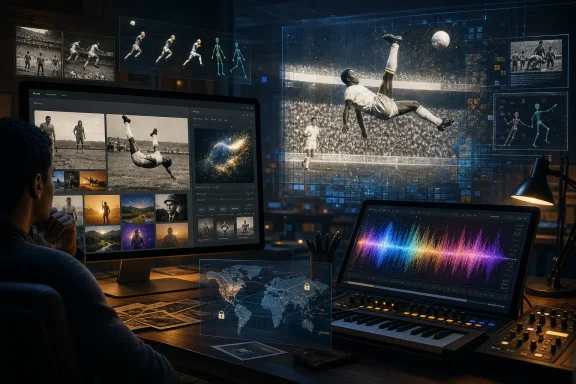
Google’s own production account is unusually specific about how it built the result. The team assembled nearly 2,000 historical records and more than 3,600 images, consulted historians, journalists, eyewitnesses, Pelé’s family and the Pelé Brand organization, and filmed a contemporary stunt performance at the stadium using period-appropriate uniforms and heavy leather footballs. It then used Veo, Gemini Omni and Nano Banana Pro alongside conventional visual-effects work.
Independent coverage by Forbes Brasil and other Brazilian outlets confirms the basic history and the partnership with Pelé’s rights holders. The key point, though, is that the output is an authorized, evidence-based visualization. It is not newly discovered footage, and it cannot establish the exact camera view, timing or body position of a play no camera recorded.
Google does acknowledge the technical difficulty. Its “Performance Control” workflow extracts the modern performer’s 3D geometry and motion, then uses that as an editable guide for video generation. Individual elements — the player, stadium, background and ball — can be separated and modified before traditional VFX handles tasks such as ball compositing, grain integration and color balancing. The team even passed the output through a filmout process to imitate the texture of 1950s cinema.
That hybrid approach is more credible than presenting a text prompt as archival restoration. It supplies physical choreography and historically informed references where generative video tends to fail: fast movement, consistent anatomy, object trajectories and period detail. But the project’s published methodology still stops short of a shot-by-shot provenance record. Google has not released a public mapping showing which eyewitness account, photograph, newspaper diagram or production decision supports each disputed movement in the finished sequence.
That missing documentation does not invalidate the film, now displayed at the Pelé Museum in Santos. It does define its status. Museums, broadcasters and Windows-based video teams using comparable AI-assisted restoration workflows should label such work as a reconstruction and retain the source archive, intermediate edits and model-output trail. Once an AI sequence has been graded, composited and given film grain, viewers cannot reliably determine which pixels arose from archive evidence, a stunt performance, a model generation or manual VFX.
The wording is significant because it identifies the familiar weaknesses of AI music rather than merely claiming higher fidelity. A usable song generator needs to maintain structure across sections, make vocals intelligible, follow lyrical phrasing and accept revisions without wandering away from the original idea. “Creative control” is the crucial promise, but it is also the least measurable one without examples of what a user can lock, edit, extend or regenerate.
Google had already put Lyria 3 and Lyria 3 Pro into public preview for developers through the Gemini API and Google AI Studio in March. The July Lyria 3.5 announcement, however, is framed around Flow Music rather than a broadly documented developer endpoint. Google’s July recap does not specify whether Lyria 3.5 is available through the Gemini API, Vertex AI, Google AI Studio, or only Flow Music; nor does it give a price, usage limit, supported countries or rights-management terms for material generated with the new model.
Those omissions draw a clear line between a model announcement and a deployable platform capability. Developers cannot plan production integration from a claim of improved vocals. Enterprises cannot set policy around generated music without knowing account eligibility, output rights, auditing options, retention practices and whether a feature is consumer-only. The earlier Lyria 3 developer preview is not proof that Lyria 3.5 inherits the same access model.
The company’s strongest work is where it shows the scaffolding. DeepMind’s Pelé film is persuasive because Google describes the historical research, live-action capture, 3D motion extraction and traditional effects behind the final sequence. Its weakest messaging is where it offers a product label — “creative control,” “browseable home,” “image generation in Search” — without the terms that determine whether a user can actually access, govern or reproduce the feature.
For now, the tangible rollout to watch is Google Images on U.S. desktop browsers and the staggered arrival of image generation in AI Overviews. The Pelé film is a compelling case study in how AI can visualize missing history without recovering it, while Lyria 3.5 remains a consumer-facing capability claim until Google publishes the access, pricing and developer details needed to make it operational.
What Google did not announce is equally important: the new Image homepage and the in-search generator do not share the same availability terms. The Images redesign is initially limited to signed-in U.S. desktop users in English, while AI Overview image generation is promised for English-language markets that already support image creation in AI Mode. That creates two rollout gates, not one global Google Images upgrade — and it means many users will see neither feature immediately.
Google Images becomes a discovery feed and a generator
For 25 years, Google Images has largely been a retrieval product: type a query, find indexed material from other sites, and follow a result outward. The July redesign changes that model by putting a real-time, interest-tailored image gallery in front of the search box and preserving saved items as collection tabs.That sounds cosmetic, but it changes what the service is optimized to do. A conventional search result begins with an explicit user request; a personalized gallery begins with Google’s estimate of what will hold the user’s attention. It moves Google Images a step closer to the visual discovery behavior associated with Pinterest, TikTok and social feeds, while retaining Google’s index of the open web underneath.
The addition of Nano Banana image generation to AI Overviews takes the next step: Search can now answer an image-seeking request with something that did not exist before the query. Google presents this as a practical answer to highly specific visual requests. In operational terms, it also puts generated images beside — and potentially ahead of — images published by photographers, retailers, documentation teams and other web publishers.
Google has not described how generated images will be visually separated from indexed results in every Search layout, how often image-generation prompts will trigger AI Overviews, or whether publishers can prevent their pages from appearing in the personalized gallery while retaining normal image-search indexing. Those details matter more than the anniversary messaging. For Windows users, the initial desktop-only scope means this is a browser experience, not a Windows app feature, and its practical behavior may vary substantially between a signed-in Edge, Chrome or Firefox session and a managed enterprise browser profile that blocks sign-in or third-party personalization.
The product boundary also remains awkward. Google calls the feature image generation in AI Overviews, but ties geographic eligibility to AI Mode’s existing image-creation support. That is a reminder that Google Search’s AI products are still governed by overlapping experiments, regions and account states. IT teams evaluating what employees can do from a corporate browser should test the actual tenant, country and language configuration rather than rely on the broad phrase “available in Search.”
Pelé’s goal is a reconstruction, not recovered history
Google DeepMind’s reconstruction of Pelé’s celebrated Gol da Rua Javari is the most technically interesting item in the July roundup — and the easiest one to misunderstand. Google says Pelé scored the goal against Juventus at São Paulo’s Rua Javari stadium on August 2, 1959, beating three defenders and the goalkeeper with consecutive sombreros without the ball touching the ground. The play was never filmed.Google’s own production account is unusually specific about how it built the result. The team assembled nearly 2,000 historical records and more than 3,600 images, consulted historians, journalists, eyewitnesses, Pelé’s family and the Pelé Brand organization, and filmed a contemporary stunt performance at the stadium using period-appropriate uniforms and heavy leather footballs. It then used Veo, Gemini Omni and Nano Banana Pro alongside conventional visual-effects work.
Independent coverage by Forbes Brasil and other Brazilian outlets confirms the basic history and the partnership with Pelé’s rights holders. The key point, though, is that the output is an authorized, evidence-based visualization. It is not newly discovered footage, and it cannot establish the exact camera view, timing or body position of a play no camera recorded.
Google does acknowledge the technical difficulty. Its “Performance Control” workflow extracts the modern performer’s 3D geometry and motion, then uses that as an editable guide for video generation. Individual elements — the player, stadium, background and ball — can be separated and modified before traditional VFX handles tasks such as ball compositing, grain integration and color balancing. The team even passed the output through a filmout process to imitate the texture of 1950s cinema.
That hybrid approach is more credible than presenting a text prompt as archival restoration. It supplies physical choreography and historically informed references where generative video tends to fail: fast movement, consistent anatomy, object trajectories and period detail. But the project’s published methodology still stops short of a shot-by-shot provenance record. Google has not released a public mapping showing which eyewitness account, photograph, newspaper diagram or production decision supports each disputed movement in the finished sequence.
That missing documentation does not invalidate the film, now displayed at the Pelé Museum in Santos. It does define its status. Museums, broadcasters and Windows-based video teams using comparable AI-assisted restoration workflows should label such work as a reconstruction and retain the source archive, intermediate edits and model-output trail. Once an AI sequence has been graded, composited and given film grain, viewers cannot reliably determine which pixels arose from archive evidence, a stunt performance, a model generation or manual VFX.
Lyria 3.5 raises the music model’s claims — but leaves the operating terms unclear
The third July announcement was Lyria 3.5, Google’s new music-generation model for Flow Music. Google says the update improves musicality, lyric writing, vocal quality and creative control. Android Central, reporting on the July 29 launch, likewise described Lyria 3.5 as an update aimed at more controllable generation in Flow Music.The wording is significant because it identifies the familiar weaknesses of AI music rather than merely claiming higher fidelity. A usable song generator needs to maintain structure across sections, make vocals intelligible, follow lyrical phrasing and accept revisions without wandering away from the original idea. “Creative control” is the crucial promise, but it is also the least measurable one without examples of what a user can lock, edit, extend or regenerate.
Google had already put Lyria 3 and Lyria 3 Pro into public preview for developers through the Gemini API and Google AI Studio in March. The July Lyria 3.5 announcement, however, is framed around Flow Music rather than a broadly documented developer endpoint. Google’s July recap does not specify whether Lyria 3.5 is available through the Gemini API, Vertex AI, Google AI Studio, or only Flow Music; nor does it give a price, usage limit, supported countries or rights-management terms for material generated with the new model.
Those omissions draw a clear line between a model announcement and a deployable platform capability. Developers cannot plan production integration from a claim of improved vocals. Enterprises cannot set policy around generated music without knowing account eligibility, output rights, auditing options, retention practices and whether a feature is consumer-only. The earlier Lyria 3 developer preview is not proof that Lyria 3.5 inherits the same access model.
The July releases share a control problem
Google’s three announcements have a recurring pattern. The Pelé project constrains model output with archives, a human performance and manual post-production. Google Images constrains it through Search context, account personalization and product availability rules. Flow Music promises that users will have more steering power over a generative model that has historically been difficult to direct precisely.The company’s strongest work is where it shows the scaffolding. DeepMind’s Pelé film is persuasive because Google describes the historical research, live-action capture, 3D motion extraction and traditional effects behind the final sequence. Its weakest messaging is where it offers a product label — “creative control,” “browseable home,” “image generation in Search” — without the terms that determine whether a user can actually access, govern or reproduce the feature.
For now, the tangible rollout to watch is Google Images on U.S. desktop browsers and the staggered arrival of image generation in AI Overviews. The Pelé film is a compelling case study in how AI can visualize missing history without recovering it, while Lyria 3.5 remains a consumer-facing capability claim until Google publishes the access, pricing and developer details needed to make it operational.
References
- Primary source: blog.google
Published: 2026-08-04T13:00:00+00:00
Google AI announcements from July 2026
Here are Google’s latest AI updates from July 2026blog.google - Related coverage: blog.google
Google DeepMind reconstructs Pelé’s famous “lost goal”
See how Google DeepMind AI technology reconstructed Pelé’s legendary 1959 lost goal at Rua Javari in our new mini-documentary.blog.google - Related coverage: androidauthority.com
Google gets its biggest visual search update in years — here’s what's changed
Google Images is dropping a personalized feed and letting you instantly generate custom AI art directly inside your search results.www.androidauthority.com - Related coverage: siliconreport.com
Google Images Redesigns Homepage, Adds In-Search AI Image Generation — Silicon Report
The update introduces a Pinterest-like browsable gallery and integrates a new text-to-image model, 'Nano Banana,' directly into AI Overviews, aiming to ...www.siliconreport.com - Related coverage: magica.com
How Google DeepMind reconstructed Pelé’s lost goal | Magica
Google rebuilt Pelé’s unfilmed 1959 goal with archives, actors, AI and VFX, but disclosed no fidelity test, cost or final-file provenance.magica.com - Related coverage: digitalmarketingdesk.co.uk
Google Revamps AI Overviews and Images
Google is upgrading AI Overviews with AI-powered image generation while introducing a redesigned Google Images homepage.digitalmarketingdesk.co.uk - Related coverage: deepmind.google
Publications — Google DeepMind
Explore a selection of our recent research on some of the most complex and interesting challenges in AI.deepmind.google - Related coverage: pplware.sapo.pt
Google recriou "o golo mais bonito" de Pelé, 60 anos depois
A Google recorreu à IA para recriar um golo lendário de Pelé que nunca chegou a ser captado por uma câmara.pplware.sapo.pt
- Related coverage: services.google.com
- Related coverage: ai.google
2154445294
Digitally generated image of abstract glass blue glowing futuristic digital data flowing and network structure. Innovation, AI, cloud technology, fintech technology and cybersecurity concepts. Clean design.ai.google
- Related coverage: techxplore.com
- Related coverage: androidcentral.com
Google Images turns 25: celebrate with a 'dynamic gallery,' Nano Banana in AI Overviews | Android Central
A birthday bash!www.androidcentral.com - Related coverage: tomsguide.com
Google Search will let you create AI images for free soon — here's how it works | Tom's Guide
For the 25th anniversary of Google Images, two major updates are coming: AI image generation in Google Search and a visual revamp of Google Imageswww.tomsguide.com - Related coverage: lemonde.fr
Google's AI Overview, now available in France, raises anticipation and concern
Publishers fear they could lose a significant portion of their web traffic with these tools, which are already available in other countries.www.lemonde.fr - Related coverage: techradar.com
Google I/O 2026 as it happened — Gemini Spark, Samsung XR glasses, and everything else announced at Google's giant software showcase | TechRadar
Google's opening keynote was jam-packed full of AI-related announcements — and we finally saw some smart glasseswww.techradar.com - Related coverage: forbes.com.br
Google Recria Gol Icônico de Pelé com Inteligência Artificial
Por meio das tecnologias mais avançadas do Google DeepMind, a equipe ficou encarregada de reconstruir o momento da forma mais fidedigna possível
forbes.com.br
- Related coverage: kaleidofield.com
Google DeepMind Reconstructs Pelé's Lost Goal With AI and Practical VFX | Kaleido Field
Google reconstructed Pelé's unfilmed 1959 Rua Javari goal using archival research, live-action performance capture, Veo, Gemini Omni, Nano Banana Pro and traditional VFX.kaleidofield.com - Related coverage: inteligenesis.com
Google DeepMind Reconstructs Pelé’s ‘Lost’ 1959 Goal Using AI - Alan Turing AI Library
DeepMind employs AI models and a novel reconstruction technique to recreate a historic soccer goal from eyewitness accounts, offering a new approach to preserving cultural heritage.www.inteligenesis.com - Related coverage: linkedin.com
Pelé’s Lost Goal, Rebuilt by AI
Google DeepMind reconstructs Pelé’s lost 1959 goal using eyewitness accounts, archive images, live action and AI to revive football history.www.linkedin.com
- Related coverage: stersoftware.com
Google DeepMind Recreates Pelé's Never-Filmed Goal With AI
Google DeepMind used generative AI video to recreate Pelé's legendary 1959 goal, never filmed live, showing how far AI video generation has come.stersoftware.com - Related coverage: poder360.com.br
Google recria com IA gol que Pelé considerava o mais bonito
Lance marcado em 1959 na Rua Javari nunca foi filmado e foi reconstruído com relatos, arquivos históricos e efeitos visuais. Leia no Poder360.
www.poder360.com.br
- Related coverage: services.google.com
lockup_Google_Cloud_140x24px_clr
LONDON, ENGLAND - MAY 30: Lucy Bronze of England celebrates with her teammates after scoring her team's second goal during the UEFA Women's Nations League 2024/25 Grp A3 MD5 match between England and Portugal at Wembley Stadium on May 30, 2025 in London, England. (Photo by Molly Darlington - The...services.google.com
- Related coverage: musicradar.com
“A fun, unique way to express yourself”: Google adds AI music creation app Lyria 3 to its Gemini assistant | MusicRadar
But questions remain over its trainingwww.musicradar.com - Related coverage: tomsguide.com
Biggest Google I/O 2026 announcements — Gemini Spark, Intelligent Eyewear glasses and more | Tom's Guide
Android, Gemini and an explosion of news featured at this year's I/O keynotewww.tomsguide.com