
Google has rolled out Lyria 3.5 in Flow Music, positioning improved vocals, lyric handling and tempo control as the main changes for its AI song-generation tool. The update matters less as a new model number than as a quality push toward more convincing finished tracks—particularly for Windows PC creators using browser-based music tools.
SQ Magazine first reported the July 29 launch, citing Google’s description of advances in musicality, lyrics, vocals and creative control. Google says Lyria 3.5 should follow prompts more closely, produce more natural melodic structures and deliver more emotionally nuanced vocals with improved pronunciation. The company did not publish benchmark results or a third-party listening evaluation alongside the announcement.
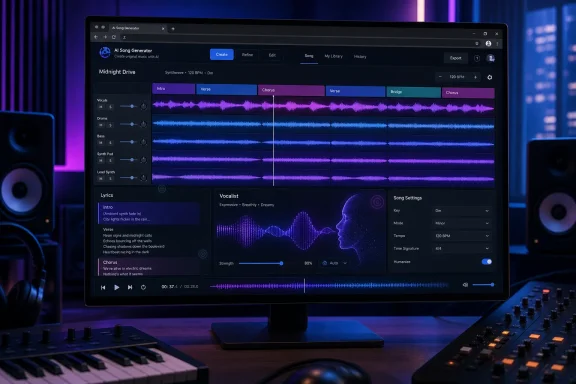
The practical improvement is the ability to direct how a track unfolds, rather than simply generating another variation from a text prompt. Google says Flow Music users can more easily steer tempo and duration, complementing the structured-song controls introduced with Lyria 3 Pro earlier this year.
Lyria 3 Pro extended output from short clips to tracks of roughly three minutes and added sections such as intros, verses, choruses and bridges. Google has not yet clarified whether Lyria 3.5 changes that maximum duration, which regions receive the update first, or whether a particular Flow Music subscription tier is required.
For creators, that leaves the sensible test unchanged: use a repeatable prompt, generate several versions, and compare vocal intelligibility, section transitions and adherence to specified tempo before moving a generated track into a video, podcast or game project.
That distinction is important for anyone distributing generated audio. A SynthID marker can help establish that a file originated from Google’s AI tooling, but it is not a complete solution for impersonation, rights clearance or upload fraud. A platform still needs effective matching, attribution and artist-profile safeguards once a track reaches a streaming service.
The immediate milestone is therefore not a benchmark score. It is whether Flow Music’s upgraded vocals hold up in real projects while Google provides clear availability, pricing and output-policy details for Lyria 3.5.
SQ Magazine first reported the July 29 launch, citing Google’s description of advances in musicality, lyrics, vocals and creative control. Google says Lyria 3.5 should follow prompts more closely, produce more natural melodic structures and deliver more emotionally nuanced vocals with improved pronunciation. The company did not publish benchmark results or a third-party listening evaluation alongside the announcement.
Better controls, but few hard limits
The practical improvement is the ability to direct how a track unfolds, rather than simply generating another variation from a text prompt. Google says Flow Music users can more easily steer tempo and duration, complementing the structured-song controls introduced with Lyria 3 Pro earlier this year.Lyria 3 Pro extended output from short clips to tracks of roughly three minutes and added sections such as intros, verses, choruses and bridges. Google has not yet clarified whether Lyria 3.5 changes that maximum duration, which regions receive the update first, or whether a particular Flow Music subscription tier is required.
For creators, that leaves the sensible test unchanged: use a repeatable prompt, generate several versions, and compare vocal intelligibility, section transitions and adherence to specified tempo before moving a generated track into a video, podcast or game project.
SynthID appears to remain part of the model family
The launch message’s lack of a fresh watermarking statement should not be read as confirmation that Lyria 3.5 output is unmarked. Google’s Lyria 3 model card explicitly covers Lyria 3 and subsequent versions, while Google’s current Lyria documentation says generated tracks are imperceptibly watermarked with SynthID.That distinction is important for anyone distributing generated audio. A SynthID marker can help establish that a file originated from Google’s AI tooling, but it is not a complete solution for impersonation, rights clearance or upload fraud. A platform still needs effective matching, attribution and artist-profile safeguards once a track reaches a streaming service.
A creative upgrade with an accountability gap
Google is selling Lyria 3.5 on subjective improvements—more realistic vocals, higher-quality lyrics and richer music—without publishing measurements that let creators compare it against Lyria 3 Pro or rival generators. That is normal for a consumer creative release, but it shifts validation to users and platform operators.The immediate milestone is therefore not a benchmark score. It is whether Flow Music’s upgraded vocals hold up in real projects while Google provides clear availability, pricing and output-policy details for Lyria 3.5.
References
- Primary source: SQ Magazine
Published: 2026-07-29T16:46:10+00:00
Google Lyria 3.5 Raises the Bar for AI-Generated Music
Google shipped Lyria 3.5 in Flow Music with better AI vocals, lyrics and tempo control, but named no benchmark, no pricing and no SynthID watermarking.sqmagazine.co.uk - Related coverage: deepmind.google
Lyria 3.5 — Google DeepMind
Lyria 3.5 is our most advanced music generation model. It helps you compose the songs you want to hear next.deepmind.google - Related coverage: blog.google
Use Lyria 3 to create music tracks in the Gemini app
Lyria 3 is now available in the Gemini app. Create custom, high-quality 30-second tracks from text and images.blog.google - Related coverage: ai.google.dev
- Related coverage: siliconangle.com
Google launches Lyria 3 music generation model - SiliconANGLE
siliconangle.com
- Related coverage: docs.cloud.google.com
Lyria | AI Music Generator | Gemini Enterprise Agent Platform | Google Cloud Documentation
Explore Lyria on Gemini Enterprise Agent Platform, a music generator that brings Google's music generation AI capabilities to application developers.docs.cloud.google.com