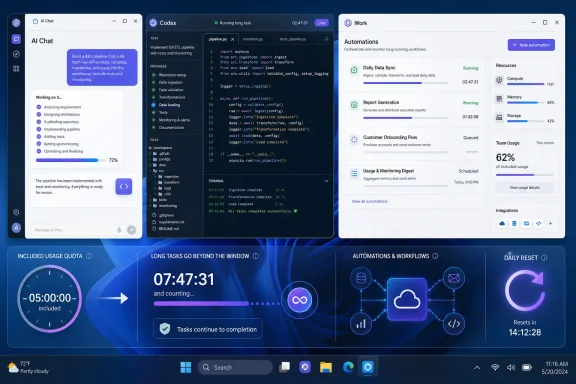
OpenAI has temporarily removed the rolling five-hour usage window for GPT-5.6 Sol workloads in Codex and ChatGPT Work on Plus, Pro, and Business plans, giving paid users more freedom to run demanding tasks without waiting for the short-term allowance to reset.
Separate weekly usage limits remain in place, so the change does not amount to unlimited GPT-5.6 access.
OpenAI product lead Tibo Sottiaux announced the adjustment on July 12 after what he described as two days of intense activity following GPT-5.6’s July 9 general release. As reported by
WinBuzzer and Yellow.com, OpenAI also distributed usage resets and introduced inference optimizations intended to stretch existing allowances further.
The distinction between the five-hour window and the weekly cap matters. Users can now concentrate more of their weekly capacity into a long coding, research, or agent-based session, but they can still exhaust that capacity before the week resets.
 OpenAI Removes the Short-Term Bottleneck
Codex and ChatGPT Work are designed for tasks that can run longer and consume considerably more compute than an ordinary chatbot exchange. Codex handles software-development work such as editing repositories, running commands, reviewing changes, and completing cloud tasks, while ChatGPT Work focuses on research and finished deliverables.
Usage from those products draws from a shared
agentic usage pool when both are available on an account. OpenAI’s support documentation says consumption varies according to the model, task complexity, session length, and whether work runs locally or in the cloud.
That variability made the five-hour restriction particularly visible after GPT-5.6 Sol arrived. A developer working across a large repository or an administrator asking Work to analyze a substantial collection of documents could hit the rolling limit even with weekly capacity still available.
Temporarily removing the five-hour window does not increase the published recurring weekly allocation. Instead, it changes when subscribers can spend that allocation. A user who previously had to divide work across several five-hour periods can now use more of the weekly pool in one sustained session.
This should be most useful for workloads that do not fit neatly into short interactive bursts, including repository migrations, multi-file refactoring, security reviews, documentation generation, and research involving multiple source files. It also reduces the chance that an active task will be interrupted solely because the short-cycle meter has expired.
The change applies to Codex and ChatGPT Work rather than conventional ChatGPT conversations or OpenAI API traffic. Standard ChatGPT model limits follow their own plan-dependent rules, while API customers continue to operate under API rate limits and usage-based billing.
Efficiency Gains Add Capacity Without Rewriting the Plans
Sottiaux said inference optimizations should provide users with about
10% more GPT-5.6 Sol usage from their existing allowance. OpenAI has not published a detailed technical breakdown of those optimizations, so claims that the improvement comes from lower token counts or any particular model-level change remain speculative.
In practical terms, the company expects the same allowance to support slightly more work. That improvement may be meaningful for frequent Codex users, although actual gains will vary because a small local edit, a long cloud task, and a multi-agent workflow do not consume equivalent amounts of capacity.
OpenAI has also been adjusting how its products account for context. According to Sottiaux’s updates detailed by
WinBuzzer, the company temporarily rolled a product context setting back from 372,000 to 272,000 tokens after discovering that the larger setting charged more quota than intended.
Those figures should not be confused with GPT-5.6 Sol’s full model context window, which OpenAI lists at 1.05 million tokens. The smaller numbers describe a product configuration used by Codex and related experiences, including how much context those products expose and account for during a task.
OpenAI plans to restore the 372,000-token product setting after additional work. Until then, users working with very large repositories or document collections may encounter a smaller effective context allocation inside the product even though the underlying model supports substantially more.
The company also reportedly reversed experiments involving reasoning-effort values and is correcting slightly excessive consumption from multi-agent operation at High and Extra High settings. Parallel agents can shorten elapsed time by dividing a problem among multiple workers, but that speed can come with a larger compute bill against the user’s allowance.
These corrections underline the difficulty of expressing agent usage as a simple message count. One instruction might trigger a brief response, while another could launch several workers, inspect thousands of lines of code, execute tools, and repeatedly revise an output.
Banked Resets Offer a One-Time Safety Valve
OpenAI initially issued a
banked reset to roughly 500,000 Codex and ChatGPT Work users. It subsequently expanded access to web and mobile redemption, addressed a reset-related bug, and said every account had received at least one reset as the affected audience grew to a company-stated seven million users.
A banked reset can be held until it is needed and then redeemed to replenish weekly usage. It is therefore more flexible than automatically resetting every account immediately, particularly for subscribers who had not yet consumed much of their allowance.
It is not, however, a permanent quota increase. Once redeemed, the reset provides a one-time refill; the account then returns to its normal allowance and renewal schedule.
OpenAI’s current Codex documentation already describes banked resets as something eligible users may see in their usage summary. Depending on the offer and plan, resets may also be associated with referral promotions, making it important for users to inspect the terms shown in their own account rather than assume every reset works identically.
Plus and Pro users who exhaust included agentic usage may also be offered paid credits. OpenAI says supported features including Codex, ChatGPT Work, and ChatGPT for Excel can draw from the same credit balance, with optional automatic top-ups available to eligible accounts.
For administrators, this mixture of included capacity, resets, and purchased credits complicates forecasting. A team can gain temporary headroom without receiving a durable increase in its baseline entitlement, while individual task costs remain dependent on workload complexity and model selection.
Capacity Controls Remain Part of the Product
The temporary relief arrives as AI providers continue experimenting with several forms of compute control. Google’s Gemini products retain short-cycle limits that refresh every five hours alongside weekly restrictions, according to Google’s published support information cited by
WinBuzzer.
Anthropic, meanwhile, has been using fixed-term promotions. Its expanded access to Claude Fable 5 and weekly Claude Code allowances set 50% above normal were extended through July 19, according to the same reporting.
These policies are not directly comparable. OpenAI has removed one timing restriction while retaining weekly constraints, Google combines short and weekly cycles, and Anthropic’s additional capacity is presented as a promotion with a defined end date. There is also no evidence in the announcements that OpenAI’s decision was made in response to either competitor.
The immediate consequence is simpler: eligible Codex and ChatGPT Work users can schedule intensive GPT-5.6 Sol sessions around the work itself rather than a five-hour clock. They still need to monitor the weekly meter, particularly when selecting higher reasoning levels, using large contexts, or launching parallel workers.
OpenAI has not specified when the five-hour window will return or whether its removal could become permanent. The next test will be whether the efficiency changes and corrected quota accounting let the company maintain the looser schedule once launch-period resets are exhausted and GPT-5.6 reaches the rest of its eligible accounts.