
Gizmochina’s report joins the two developments as evidence of a coordinated expansion beyond the browser. The record supports the broader direction, but it also exposes a meaningful gap between what is confirmed in ChatGPT today and what is being inferred from reports about the speaker. GPT-5.6 is rolling out now; the device is still an unannounced project whose specifications, price, and launch window could change.
For Windows users and administrators, the immediate change is the GPT-5.6 rollout. The hardware report is worth watching chiefly because it would create a new always-available endpoint for a service many organizations currently treat as an app, a web service, or a controlled browser workflow.
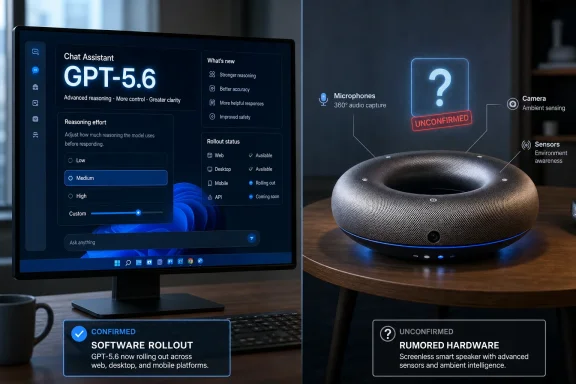 The speaker report has a real design, but no public product commitment
Bloomberg first reported in July that OpenAI’s debut device would be a mobile, screen-free smart speaker intended to act as a home AI companion. TechCrunch separately described that reporting, including the claim that the device could move through mechanical elements and connect to ChatGPT capabilities such as answering questions, messaging, media playback, and smart-home control.
The newer Bloomberg details reported this week are unusually specific for an unreleased device: a doughnut-like form roughly the size of a hockey puck, metal construction, a battery, microphones, speaker grilles, lights, a camera system, sensors, and moving parts meant to communicate responsiveness. Bloomberg’s sources also put the expected price above $300 and placed a potential launch in 2027.
Those details make this sound less like an Echo-style stationary speaker and more like a portable household device designed to be carried from room to room. The screenless approach matters. OpenAI appears to be betting that voice, ambient awareness, and physical feedback can replace the visual confirmation people expect from phones, tablets, and smart displays.
That is also the product’s hardest problem. A camera-and-microphone device designed to learn about its owner, respond to messages, and operate around the home would need unusually clear controls for microphone muting, camera disablement, local indicators, retained recordings, account sharing, and child access. None of those policies has been announced. OpenAI has not confirmed the form factor, shown a prototype, published privacy specifications, or said whether the device will require a ChatGPT subscription.
The pricing claim deserves the same caution. A $300 to $400 device would be priced above many mainstream smart speakers while omitting their display option. Its value would therefore depend on capabilities that ordinary voice assistants do not deliver reliably: durable personal context, useful proactive assistance, natural conversation, and trustworthy handling of sensitive household data. Bloomberg’s reporting suggests OpenAI sees the device as the first in a broader hardware line, but the company has not committed publicly to any product configuration or date.
GPT-5.6 Sol is real, but the rollout is narrower than the headline implies
OpenAI’s current GPT-5.6 documentation says GPT-5.6 Sol and a new reasoning slider are rolling out to eligible paid plans. Plus subscribers get Medium and High reasoning; Pro, Business, and Enterprise users can also receive Extra High, while Pro includes access to GPT-5.6 Sol Pro for difficult and longer-running tasks.
The practical feature is automatic routing. On supported paid plans, ChatGPT can shift an Instant request to Medium reasoning when it judges a prompt needs more work. Users can turn that behavior on or off, and can choose a reasoning level manually where their plan permits it.
This is a useful change, but it is not the same as “dynamic response length” in the ordinary sense. OpenAI describes dynamic reasoning allocation: more hidden work for harder requests, with a corresponding trade-off in latency and usage allowances. It does not promise that every answer will simply become shorter or longer in a more intelligent way.
OpenAI’s documentation also directly undercuts the claim that GPT-5.6 Luna currently gives Free and Go users unlimited text chats. Luna is becoming the default for Free and Go accounts as the rollout proceeds, but the company says access and limits remain dynamic. Its support page specifically states that Free users have limited GPT-5.5 Instant access in five-hour windows, while Go users can send up to 10 messages every five hours after enabling the Thinking option. The Think button itself is scheduled to arrive for Free and Go users starting next week, and OpenAI says it uses GPT-5.6 Luna rather than Sol.
There is another wrinkle administrators should note: GPT-5.6 Sol is not universally available merely because an organization pays for ChatGPT. Enterprise users may continue to see the older picker until controls reach their workspace, and Business and Enterprise administrators can govern model access. OpenAI also lists a specific minimum version for access through Codex mode in the Windows ChatGPT desktop app: version 26.707.30751. That requirement applies to Codex access, not normal ChatGPT chat, but it is the only concrete Windows client version stated in the new guidance.
The “68% fewer factual errors” claim does not match OpenAI’s GPT-5.6 record
The most consequential discrepancy in Gizmochina’s account is the assertion that GPT-5.6 Sol has “roughly 68% fewer factual errors.” OpenAI’s GPT-5.6 system card does not make that claim. Instead, the company says Sol makes slightly fewer factual errors than GPT-5.5 in a test set of de-identified conversations previously flagged by users as containing factual mistakes, and that it reproduces user-reported hallucinations significantly less often.
That evaluation is useful, but it is intentionally difficult and not a representative measure of everyday ChatGPT traffic. OpenAI explicitly warns that its error rates should not be read as typical production error rates. The company did not publish a 68% GPT-5.6 factual-error reduction in the material reviewed for this rollout.
The number may reflect a separate benchmark score or a conflation with a prior generation’s accuracy marketing. OpenAI’s 2025 GPT-5 developer announcement, for example, said GPT-5 made about 80% fewer factual errors than o3 on two named benchmarks. That is a different model comparison, a different methodology, and not evidence for a 68% reduction by GPT-5.6 Sol.
This is more than a numerical correction. Windows professionals evaluating ChatGPT for drafting scripts, explaining event logs, generating PowerShell, or researching configuration changes should treat GPT-5.6 Sol as an incremental improvement in factuality, not as a license to skip verification. OpenAI’s own system card retains that limitation, and its model documentation notes that safety checks may also affect legitimate cybersecurity and biological-security requests.
The safety claims need more precision
Gizmochina also says GPT-5.6 adds safeguards that block romantic roleplay, age-restricted content, and self-harm prompts for people under 18. OpenAI’s GPT-5.6 system card does document safety evaluations involving mental health, emotional reliance, self-harm, and other disallowed-content categories. Its general ChatGPT guidance says GPT-5.6 uses model-level protections, real-time checks, monitoring, and higher-risk request handling.
But OpenAI’s current GPT-5.6 product documentation does not spell out the reported under-18 restrictions as a newly launched, plan-wide GPT-5.6 feature. That distinction matters because a benchmark evaluating model safety is not the same thing as a published age-assurance policy, a parental-control system, or an account-level enforcement rule. OpenAI has not publicly explained how it would reliably determine that a specific ChatGPT user is under 18 for these controls.
For organizations, this is a reminder that model safeguards do not replace their own access policies. Schools, managed Windows environments, and businesses with younger users still need to decide whether ChatGPT access is permitted, which identity controls apply, whether conversation history is retained, and where regulated data is prohibited from being entered.
Hardware would turn ChatGPT into a new endpoint to govern
The speaker story is easy to read as a consumer-design curiosity because of its shape and alleged moving parts. The more consequential point is that OpenAI may be preparing to move ChatGPT from a deliberate, screen-based interaction into a device that is present in the room and potentially context-aware.
That changes the questions IT teams will eventually face. A Windows laptop running ChatGPT can be handled through browser policies, endpoint management, identity controls, and data-loss-prevention rules. A portable speaker with microphones, cameras, sensors, household mobility, messaging access, and smart-home control would sit outside many of those conventional controls unless OpenAI builds a credible enterprise-management layer around it.
There is no evidence yet that such a layer exists. There is also no public indication that the reported speaker will support Windows integration, Microsoft Entra identity, MDM enrollment, Teams, Copilot, enterprise ChatGPT workspaces, or any corporate compliance standard. Until OpenAI addresses those issues, the speaker is a consumer hardware report—not a deployable workplace platform.
The concrete change today is GPT-5.6’s gradual availability, with paid users receiving Sol’s reasoning controls and Free and Go users moving toward Luna. The doughnut-shaped device remains a reported 2027 ambition. If OpenAI wants it to become more than an expensive voice assistant with a camera, the company will need to publish the privacy, ownership, and management rules that its current leaks leave unanswered.
References
- Primary source: Gizmochina
Published: August 7, 2026 at 8:31 PM UTC
OpenAI's first hardware is taking shape as a doughnut-shaped speaker amid improvements in GPT-5.6 Sol - Gizmochina
These parallel moves highlight OpenAI’s dual approach: improving accessible AI tools while preparing premium hardware that puts its models more deeply into everyday life. www.gizmochina.com
- Related coverage: help.openai.com
GPT-5.6 in ChatGPT | OpenAI Help Center
Learn how GPT-5.6 Sol works in ChatGPT, which options are available by plan, and how usage limits and availability work. help.openai.com
- Related coverage: openai.com
Previewing GPT-5.6 Sol: a next-generation model | OpenAI
OpenAI previews GPT-5.6 Sol, a next-generation model with stronger capabilities in coding, science, and cybersecurity, paired with its most advanced safety stack. openai.com
- Related coverage: techcrunch.com
OpenAI's first hardware device is reportedly a screenless speaker that can move | TechCrunch
The device is weirdly described as involving "mechanical elements that can move on their own" and the Bloomberg report includes the detail that the device is designed to "feel like a companion and become a physical manifestation of OpenAI’s ChatGPT."techcrunch.com - Related coverage: news.bloomberglaw.com
OpenAI’s First Device Will Be Speaker Built as AI Companion (1)
OpenAI’s much-anticipated push into consumer devices is slated to begin with a mobile, screen-free smart speaker designed to be a new type of home computer for the AI era, according to people familiar with the matter.news.bloomberglaw.com
- Related coverage: help.openai.com
GPT-5.6 in ChatGPT | OpenAI Help Center
Learn how GPT-5.6 Sol works in ChatGPT, which options are available by plan, and how usage limits and availability work.
help.openai.com
- Related coverage: deploymentsafety.openai.com
GPT-5.6 System Card - OpenAI Deployment Safety Hub
GPT-5.6 is a new family of three models: Sol, our new flagship model; Terra, a capable lower-cost option; and Luna, our fastest and most cost-efficient model. The safeguards we have built for this launch—our most robust yet—are built to deliver these models safely and at scale, around the world.deploymentsafety.openai.com - Related coverage: deploymentsafety.openai.com
- Related coverage: help-lb.openai.com
Model Release Notes | OpenAI Help Center
 help-lb.openai.com
- Related coverage: openai.com
GPT-5.6: передовий рівень інтелекту, що масштабується відповідно до ваших амбіцій | OpenAI
Більше інтелекту з кожного токена, ефективніша продуктивність за долар і більше можливостей на вимогу для найскладніших завдань.openai.com - Related coverage: developers.openai.com
GPT-5.6 Sol Model | OpenAI API
 developers.openai.com
- Related coverage: techrepublic.com
OpenAI's Upcoming AI Device Explained
OpenAI is reportedly developing a portable screenless AI speaker with cameras, sensors, GPT-Live, and moving parts.www.techrepublic.com
- Related coverage: cdn.openai.com
- Related coverage: cincodias.elpais.com
- Related coverage: techradar.com
Relax, Apple, OpenAI and its rumored AI smart speaker plans are no threat to you, Siri, HomePods, robots, or any other part of your business | TechRadar
An AI-powered smart speaker? Seriously?www.techradar.com - Related coverage: windowscentral.com
OpenAI is rumored to debut AI-powered earbuds later this year | Windows Central
Chief Global Affairs Officer Chris Lehan has revealed that OpenAI is preparing to announce hardware in the second half of 2026.www.windowscentral.com - Related coverage: axios.com
- Related coverage: community.openai.com
- Related coverage: platform.openai.com

Delete an eval | OpenAI API Reference
platform.openai.com
- Related coverage: cdn.openai.com
- Related coverage: community.openai.com
Regression in Realtime API Model Behavior – Loss of Determinism with Structured Data - API - OpenAI Developer Community
Description: Since early January 2026, we’ve observed a significant and consistent regression in the behavior of the gpt-realtime model (including snapshot 2025-08-2), particularly when handling structured, factual data… community.openai.com
