
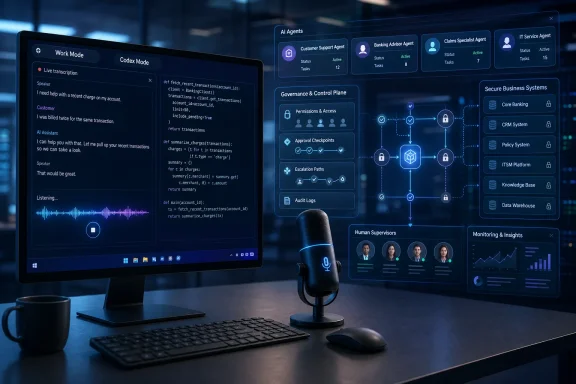
For Windows users, the immediate story is the arrival of conversational control inside the ChatGPT desktop app. Voice in Work and Codex turns the microphone into a live command layer for research, document creation, software development, and agentic tasks. For enterprises, the more consequential release is Presence: a managed platform designed to place governed AI agents in customer support, IT service, claims, procurement, HR, and other workflows where a mistaken answer can become a costly operational failure. OpenAI’s Work and Codex documentation describes Voice as a desktop capability on both Windows and macOS, while OpenAI’s Presence overview frames the latter as a product for high-volume, high-stakes deployments.
This is a meaningful shift. The industry has spent years treating voice AI as a hands-free search box, a dictation tool, or a novelty assistant. OpenAI is making a more ambitious bet: that natural, interruptible speech can become the control plane for software agents that perform actual work.
 Background: From Voice Queries to Voice-Orchestrated Work
The distinction begins with GPT-Live, OpenAI’s new generation of conversational voice models. GPT-Live-1 and GPT-Live-1 mini were introduced on July 8, 2026, as full-duplex models capable of listening and speaking at the same time. That architecture matters because it removes much of the awkward ceremony associated with older voice interfaces: waiting for an audible pause, being cut off while thinking, or starting over after the assistant mistook background sound for the end of a sentence. OpenAI says GPT-Live can make interaction decisions continuously—whether to keep listening, speak, pause, interrupt, or invoke a tool.
That represents an important technical and experiential change from both conventional speech pipelines and earlier AI voice systems. OpenAI describes its original ChatGPT Voice design as a chain involving speech recognition, a text model, and text-to-speech. The company says this arrangement created opportunities for latency and information loss. Its previous Advanced Voice Mode reduced some of that friction by handling audio more natively, but it still worked in discrete conversational turns. OpenAI’s technical overview argues that GPT-Live’s continuous full-duplex approach is designed specifically to address those limits.
The result is not merely faster answers. It is a model that can accommodate the natural disorder of human speech.
People pause. They revise instructions. They interrupt themselves. They speak over a response when they suddenly remember a critical constraint. In a workplace setting, those behaviors are not edge cases; they are the workflow. A developer describing a bug may remember a reproduction step halfway through. A project manager may need to redirect an agent before it begins gathering the wrong evidence. A support supervisor may need to intervene before an automated action reaches a customer.
Under the GPT-Live model, the voice layer can remain responsive while more demanding work occurs elsewhere. When a request requires web search, deeper reasoning, or agentic execution, GPT-Live can delegate that work to another model in the background and maintain the active conversation while results are prepared. At launch, OpenAI said GPT-Live used GPT-5.5 behind the scenes for those deeper tasks. OpenAI’s release notes describe this separation as a way to combine continuous audio interaction with evolving frontier-model capabilities.
That architectural decoupling is arguably the most important element of the release. The voice model does not have to become the best reasoning engine in the system. Instead, it becomes the real-time coordinator—the component that maintains a human conversation while other services search, reason, retrieve information, or run tasks.
GPT-Live Comes to the Windows Desktop Workflow
For the Windows audience, the practical implication is that ChatGPT Voice is no longer confined to ordinary chat. In the desktop application, users can select Work or Codex, activate Voice, grant the appropriate permissions, and speak their instructions while following the live transcript in the chat. OpenAI says users can naturally interrupt, start tasks, coordinate work, and use the tools available to the selected experience. The official Work and Codex guide confirms that Voice in these experiences is available for eligible accounts through the desktop app on Windows and macOS.
Work, Codex, and the role of permissions
Work is positioned as the environment for larger, multi-step knowledge tasks: researching a topic, analyzing materials, producing documents, spreadsheets, reports, presentations, or websites. Codex remains focused on software development tasks such as working with repositories, writing and debugging code, running tests, and using local developer tools. OpenAI’s product documentation distinguishes the two environments while treating Voice as a shared interface layer.
The capability is significant because voice can now serve as a live supervisory tool rather than a replacement for typing. A user can begin with an outcome—“review this repository, identify the likely regression, and outline a fix”—then interrupt to add constraints, request a new task, or change direction. That is closer to delegating work to a junior colleague than dictating a single prompt.
The boundaries, however, are equally important. Voice uses the tools and permissions assigned to the selected ChatGPT experience. Where computer context is enabled, the desktop app may require permissions such as microphone access, screen and audio recording access, and Accessibility access. OpenAI’s setup instructions make clear that Voice does not somehow bypass the platform’s existing access model.
That is a welcome design principle for enterprise IT teams. A natural-language interface becomes dangerous when it silently expands an agent’s authority. The practical value of voice control depends on the inverse: users should be able to speak fluidly while the system remains constrained by explicit permissions, role assignments, local access controls, and approved tools.
What makes full-duplex interaction useful
The headline feature—being able to interrupt the AI—may sound cosmetic until it is used in a work setting. In reality, interruption is a core part of effective collaboration.
Consider these scenarios:
- A developer tells Codex to investigate a failing test suite, then adds, “Stop—ignore the snapshot failures; focus on the authentication timeout.”
- An analyst asks Work to create a report, then remembers that the output must omit customer-identifying data.
- A project lead asks the system to summarize a meeting transcript, then corrects a misunderstanding before the agent launches a lengthy follow-on task.
- A user speaks through a multi-part request while the system provides brief acknowledgments rather than cutting in prematurely.
OpenAI says GPT-Live can listen and speak simultaneously, tolerate pauses better than a turn-based system, and decide several times per second whether to talk, wait, continue listening, interrupt, or use a tool. The GPT-Live announcement also says the system is better able to focus on the speaker amid traffic or nearby conversation.
The benefit is not that ChatGPT becomes more chatty. The benefit is that speech becomes less brittle.
Adoption is already operating at enormous scale
OpenAI says that more than 150 million people each week use ChatGPT through Voice and Dictation features. The company’s July 8 announcement makes that figure significant even if a substantial portion of usage is consumer-oriented. It means that the behavioral transition from tapping prompts to speaking naturally is already underway at a scale most workplace platforms would struggle to replicate.
GPT-Live-1 is becoming the default voice model for Go, Plus, and Pro customers, while GPT-Live-1 mini is the default for Free users. OpenAI’s availability details align with reporting from TechCrunch, which characterized the release as a replacement for the older Advanced Voice Mode experience rather than a minor refresh.
The caveat is that natural conversation is not the same as perfect conversation. TechCrunch reported that an OpenAI demo of live Hindi translation revealed a heavy American accent and phrasing that sounded unnaturally formal, while OpenAI itself acknowledges that some languages can still have non-native accents or fluency gaps. TechCrunch’s hands-on coverage and OpenAI’s own limitations section point to a familiar challenge: voice quality and cultural fluency are not interchangeable.
The Cost Question: Voice Is Becoming a Metered Work Interface
Enterprise adoption will be shaped as much by pricing mechanics as by conversational quality. The supplied rollout reporting states that ChatGPT Business workspaces include one hour of Voice in Chat, with additional use billed at five credits per minute, while Voice in Work and Codex is priced at roughly six credits per connected minute where flexible pricing applies. Startup Fortune’s report also notes that Work and Codex tasks initiated through voice continue to draw from the relevant shared agentic usage pool.
OpenAI’s own guidance confirms the core billing principle: connected Voice time is separately metered where flexible pricing applies, while tasks started through Voice consume from the same shared Work and Codex usage and credit pool as tasks started by other means. The Work and Codex Help Center page makes that distinction explicit.
This is more than a pricing footnote. It affects user behavior.
A short voice command that starts a high-value task could be extremely cost-effective. A team that leaves voice conversations active for hours while agents repeatedly investigate low-priority issues could create an unexpected consumption pattern. Voice makes interaction easier and more continuous; metered connected time makes that convenience visible on the bill.
The enterprise governance implications
Organizations evaluating Voice in Work or Codex should treat it as they would any other agentic productivity capability:
- Define which roles can use Work, Codex, and local context.
- Set meaningful permission boundaries for local files, tools, network access, and connected services.
- Establish cost observability before broad deployment, particularly for teams likely to hold extended conversational sessions.
- Create review standards for code, documents, analyses, and actions generated through spoken direction.
- Train staff to use interruption deliberately, correcting scope early rather than allowing a poorly framed task to run.
The best enterprise voice deployment will not be the one with the most natural synthetic voice. It will be the one where natural speech improves task steering without creating unmanaged permissions, unclear accountability, or uncontrolled usage costs.
Presence Is OpenAI’s More Serious Enterprise Product
If GPT-Live is the voice interface for knowledge workers, OpenAI Presence is the company’s effort to package AI agents for customer-facing and operational work. Presence launched on July 22, 2026, as a managed enterprise platform for building, deploying, operating, and continuously improving governed agents across voice and chat. OpenAI’s launch announcement describes the product as suited to customer support, outbound sales, billing, insurance claims, employee IT requests, procurement, and other high-value workflows.
The distinction from ordinary ChatGPT Voice must remain sharp. Presence is not simply a voice chatbot with a corporate knowledge base attached. It is a deployment model designed to connect systems, scope permissions, apply policies, simulate edge cases, evaluate behavior, route escalations, monitor real production outcomes, and introduce controlled updates over time. OpenAI’s Help Center documentation identifies these governance elements as core parts of the product.
Not a self-service product
Presence is available through a limited general availability program for eligible enterprise customers. It is not self-serve. OpenAI says deployments are led by its Forward Deployed Engineers and select global systems integrators. The official availability details underscore that access depends on customer fit, delivery capacity, and implementation readiness.
That deployment model is revealing. OpenAI is not only selling access to models; it is selling implementation capability.
This is how enterprise software actually gets bought in regulated or operationally sensitive sectors. A banking support agent, insurance claims assistant, or IT help-desk automation cannot be safely introduced through a generic “upload documents and go live” workflow. It must be scoped around specific outcomes, integrated with authoritative systems, tested against failure modes, and equipped with clear escalation paths.
OpenAI says a Presence agent receives only the knowledge and system access required for the assigned job. The customer determines what it may do independently, where approval is necessary, and when a human should take over. The Presence launch page presents those boundaries as a central design feature rather than a secondary compliance layer.
The elements enterprises actually need
Presence combines several capabilities that are often marketed separately in the AI-agent market:
- Approved instructions, standard operating procedures, and policy enforcement
- Scoped access to knowledge, APIs, and company systems
- Permitted actions, including retrieval, updates, and workflow completion
- Voice and chat channels
- Simulations and evaluations before deployment
- Guardrails, approval checkpoints, and escalation paths
- Session records, action histories, and quality signals
- Controlled rollout, monitoring, rollback, and iteration
OpenAI’s Presence documentation says deployments also include security, privacy, and legal review before staging and production release. That is a necessary reminder that “agentic AI” is not merely a model-quality problem. It is a systems, process, and governance problem.
The 75% Resolution Claim Deserves Attention—and Context
OpenAI’s strongest Presence proof point is its own English-language phone support channel, 1-888-GPT-0090. The company says Presence handles open-ended calls, verifies callers, uses account context, and takes approved actions. Within weeks, OpenAI says the system met or exceeded internal benchmarks used to judge frontline human-support quality and now resolves 75% of inbound issues without human assistance. OpenAI’s Presence launch post attributes the figures to its own production experience.
That is a meaningful operating claim, not just a polished demo. It suggests that Presence is being used against a real queue with customer variability, incomplete requests, and the need to interact with account context.
Still, the qualification matters: the 75% figure is self-reported by OpenAI, based on internal benchmarks and not presented as an independently audited industry metric. It should therefore be read as a strong indicator of OpenAI’s early operational results, not as a universally transferable benchmark for every company, support category, or regulated sector.
The company also reports that its Codex-powered improvement loop reduced human handoffs by 15 percentage points in 10 days. OpenAI’s account is particularly interesting because it points beyond first-day automation. The real difficulty in customer operations is not building an agent that succeeds against a clean test set. It is keeping the agent accurate when refund rules change, a website is redesigned, new products appear, unusual customer behavior rises, or a policy exception becomes common.
OpenAI’s proposed workflow is to use production sessions, escalations, and quality signals to identify gaps; have Codex investigate and suggest changes; test those updates against the current production version; and then approve controlled rollouts. The Presence launch material describes that process as an ongoing improvement loop.
That is the correct target. Enterprises do not need an AI agent that appears impressive on launch day. They need one that can be updated safely without turning every operational change into a new software project.
Banking, Support, Claims, and the Reality of High-Stakes Automation
OpenAI has named BBVA, SoftBank, and IAG as enterprises working with Presence. BBVA is exploring AI-powered voice support for everyday banking needs in Mexico; SoftBank is testing Japanese-language customer conversations; IAG is looking at support during demand spikes associated with severe weather and natural disasters. OpenAI’s Presence announcement positions these as examples of how the platform could be adapted to different industries and channels.
These are not easy environments.
A consumer asking about a locked account, a disputed charge, an insurance claim, a delayed service, or a benefits question may be stressed, impatient, or confused. The organization may have legal obligations, internal approval rules, inconsistent historical data, and strict identity-verification requirements. A fluent voice agent does not solve these problems by itself.
In fact, a more natural voice can create a new risk: users may overestimate the system’s competence because it sounds confident, attentive, and human-like. This makes escalation design especially important. The agent must know when not to proceed. It must be able to communicate that boundary clearly, carry structured context forward to a human representative, and avoid forcing the customer to repeat the entire interaction.
OpenAI says Presence includes human escalation paths with structured context, as well as testing, monitoring, approval steps, and rollback processes. The Help Center overview suggests the company understands that a human handoff is not necessarily a failure. In high-risk workflows, it is often the safety mechanism that protects the customer and the business.
Safety, Privacy, and the Limits of Natural Conversation
OpenAI has also emphasized safety work around GPT-Live itself. The company says it expanded testing to audio-native evaluations and assessed areas including self-harm, psychosis and mania, emotional reliance, violence, and sexual content. It also says real-time safeguards can steer unsafe responses, provide additional safety messaging, or end a conversation in higher-risk situations. OpenAI’s GPT-Live safety section describes these controls as protections designed specifically for live voice interaction.
For enterprise deployments, the risk picture broadens beyond conversational safety. Organizations must account for:
- Identity verification before an agent discusses or changes account information.
- Consent and disclosure requirements for AI-mediated calls.
- Data minimization, especially when voice contains personal, financial, health, or employment information.
- Access control for tools that can change records, issue refunds, reset accounts, or disclose data.
- Auditability of agent decisions, tool calls, and escalations.
- Model drift and policy drift as business rules change.
- Bias and language-quality variation across customers, accents, dialects, and regions.
Presence does not eliminate these obligations. Its value lies in making them part of the deployment itself rather than expecting every enterprise to assemble the same governance framework from scratch.
The Strategic Meaning for Windows and Enterprise AI
For Windows users, Voice in Work and Codex could become an unusually practical feature. The desktop is where files, browsers, repositories, terminals, business documents, and internal tools converge. A natural speech layer is most useful when it can guide that rich work environment without forcing users to abandon keyboard, mouse, and screen-based review.
For enterprise buyers, Presence is the more strategically important launch. It places OpenAI in direct competition with the platforms and integrators selling AI automation into customer operations—not only model providers, but enterprise workflow vendors, contact-center AI specialists, and ecosystem-led agent platforms. The company is effectively arguing that models alone are insufficient. Enterprises need deployment expertise, operational controls, evaluations, integrations, and accountability.
That argument is difficult to dispute.
GPT-Live demonstrates that conversational AI can become less rigid, more interruptible, and more suitable for active work. Presence acknowledges the harder truth: an AI agent that touches customers or internal systems must be governed, monitored, and continuously improved. The voice is the visible part. The policies, permissions, tests, records, escalation rules, and human review are what will determine whether the technology earns a place in serious enterprise operations.
