

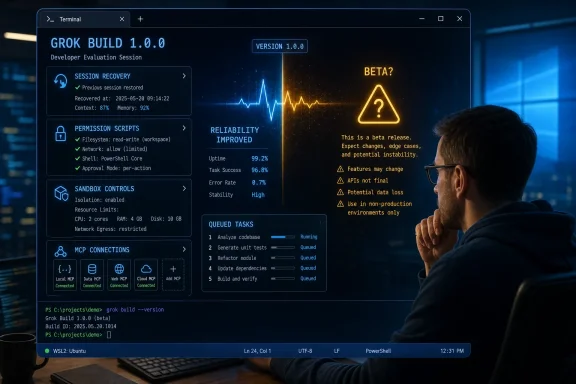
That distinction is more than semantic for Windows developers and IT teams. A coding agent that can edit files, invoke shells, run background tasks, and connect to external Model Context Protocol tools needs dependable session state and permission behavior before its more ambitious automation features can be trusted. Grok Build 1.0.0 improves those fundamentals. It does not, on the public record, establish a new quality bar for the underlying model or a new enterprise support tier.
Pasquale Pillitteri’s August 7 report says Elon Musk announced “Grok Build V1.0” on X. xAI’s changelog independently confirms that 1.0.0 was released on the same date. But xAI’s original May launch post still describes Grok Build as an “early beta,” and neither the changelog nor the public GitHub repository contains a corresponding declaration that beta has closed. Until xAI says that explicitly, administrators should read 1.0.0 as a substantial CLI release rather than a contractual stability milestone.
Grok Build 1.0.0 fixes the failures that interrupt agent work
The actual changelog is unusually revealing about where Grok Build had been rough. Its headline items are not a new planning system, a new model, or a new agent capability. They are fixes for the points where a terminal agent can leave a developer with an incomplete action, an unclear prompt, or a broken recovery path.
The release adds short summaries of each agent’s previous-turn work to dashboard rows, alphabetizes extensions, and makes Skills sections collapsible. It moves /feedback into a dedicated report box instead of turning the normal prompt into a feedback field. Automatic theme detection now works through SSH and inside tmux, a modest quality-of-life change that matters when the tool is used from remote Linux hosts rather than a local desktop terminal.
More consequentially, xAI says 1.0.0 fixes lost queued messages caused by rapid “send now” actions; prevents cancelled tasks from restarting the model in the background; restores codebases without hanging on large or shallow Git repositories; and limits remote resume to conversation recovery unless the user explicitly passes --restore-code. The release also improves error rendering, showing API failures as clean banners rather than raw JSON.
Those changes point to a product maturing around control surfaces. Developers give coding agents authority gradually: first read access, then edits, command execution, and occasionally unattended work. An agent that loses a queue entry, misstates a permission script, or restarts after cancellation undermines that progression even if its code suggestions are strong.
Two fixes deserve especially close attention in managed environments:
- Permission prompts now display the complete script, with long Bash bodies expandable through
Ctrl+F. - Sandboxed sessions now start successfully in directories containing many deny-glob matches.
The first is a governance improvement. A permission prompt that truncates the command being approved is not a meaningful approval mechanism. The second matters for repositories that use exclusion patterns to keep build artifacts, generated content, credentials, or sensitive directories out of an agent’s reach. xAI describes the fix, but it does not document the upper limit, the relevant deny-glob syntax, or whether all Windows filesystem edge cases have been tested.
The 1.0 number applies to the terminal harness, not the coding model
Grok Build has two parts that can be easily conflated. The public GitHub repository contains the Rust-based terminal UI, agent runtime, tool implementations, workspace integration, configuration handling, MCP support, sandboxing, and related client infrastructure. That is the component moving from 0.2.120 to 1.0.0.
The model behind API calls remains separately identified by xAI as grok-build-0.1. xAI’s developer documentation lists it as a text-and-image model with a 256,000-token context window. Its listed U.S. API pricing is $1.00 per million input tokens and $2.00 per million output tokens, with cached input priced lower.
In practical terms, installing Grok Build 1.0.0 should improve how the terminal client presents permissions, tracks sessions, handles prompts, renders output, and survives common interruptions. It should not be assumed to change the model’s coding accuracy, context limit, token pricing, or benchmark position. xAI has not paired the 1.0.0 CLI release with a new Grok Build API model announcement.
That separation also changes how teams should evaluate the upgrade. If a pilot failed because the agent mishandled terminal state, session recovery, long output, or review workflows, 1.0.0 addresses directly relevant problems. If the pilot failed because the model made incorrect architectural choices or produced weak patches, the changelog supplies no evidence that the release changes those results.
Windows installation is supported; Windows source builds are not a first-class target
xAI publishes prebuilt Grok Build binaries for Windows, macOS, and Linux. Its documented Windows bootstrap path uses PowerShell, and the official repository also points to an npm package, @xai-official/grok, as an alternative distribution route. Enterprise documentation says the npm option avoids reliance on xAI’s shell-script installer host and its fallback binary CDN.
The Windows position becomes less straightforward when the source tree is involved. The same public repository states that macOS and Linux are supported build hosts, while Windows builds are “best-effort” and “not currently tested” from the published tree. That means a Windows user can reasonably use the vendor-provided binary, but a Windows organization should not assume it can reproducibly compile, patch, and validate its own supported 1.0.0 executable from the open repository.
For enterprises, that is the relevant divide. The Apache 2.0 license permits local use and modification, and xAI says Grok Build can be configured to work with local inference. But source availability does not automatically create a supported Windows build pipeline. Before standardizing on Grok Build, a Windows platform team should test its actual deployment route: PowerShell installer, npm distribution, proxy behavior, authentication flow, endpoint allowlisting, and rollback procedure.
xAI’s enterprise deployment guide identifies cli-chat-proxy.grok.com and auth.x.ai as core endpoints for standard operation. It also says that remote session sync and sharing use code.grok.com; blocking that host keeps sessions local-only and removes share links. That provides a useful control point for organizations that want the CLI but do not want remote session synchronization enabled by default.
The open-source repository remains a transparency channel, not a community project
xAI opened Grok Build’s source code in mid-July and describes the public repository as a periodically synchronized view of its internal monorepo. The repository includes a SOURCE_REV file that identifies the internal revision represented in the tree, an approach that gives auditors a snapshot but not a live public development process.
The project’s contribution policy is unusually direct: external pull requests and unsolicited patches are not accepted. xAI says the public tree exists for source transparency and local builds under Apache 2.0, while the company develops the software internally. The GitHub project currently has no GitHub Releases page for packaged versions, either.
That leaves an important operational consequence. The public source tree is valuable for security review, configuration inspection, and local experimentation, but GitHub is not the canonical release-management channel for the installed CLI. xAI’s changelog and distribution endpoints are. Administrators who need a fixed artifact, a signed internal package, a documented rollback target, or a tested Windows build should create those controls in their own deployment process rather than infer them from the presence of public source code.
What to do before rolling out Grok Build 1.0.0
Grok Build 1.0.0 is worth testing for organizations already using the tool, particularly where the prior pain points were interrupted sessions, unreliable cancellation, inaccurate permission context, or difficult operation over SSH. The fixes are concrete and target workflows that developers encounter repeatedly.
But a 1.0.0 version should not substitute for a pilot. Test the exact configuration that will be allowed in production: whether API-key or account authentication is used, whether session synchronization is permitted, which MCP servers can be attached, what paths sandbox rules exclude, and whether background tasks may execute commands without repeated review. Confirm that the complete-script permission prompt appears as expected in the terminals your developers actually use, including Windows Terminal, PowerShell, SSH sessions, and tmux-hosted remote shells.
The release establishes that xAI has promoted Grok Build’s CLI to version 1.0.0. Its own release notes establish meaningful reliability work. What remains absent is the announcement that would matter most to cautious adopters: an explicit statement that beta is over, along with defined support, compatibility, and release-management commitments. Until that arrives, the right interpretation is a better agent shell—not a blank check to treat autonomous coding work as production-safe.