
Windows Central highlighted the project after modder xoxor4d released version 1.4.2 on August 12. The GitHub release confirms that update adds an option to render low-detail map sections across Liberty City, fixes stuck sun and moon behavior, and updates the custom RTX Remix runtime to address issues with DLSS Frame Generation above 2x. Those are practical maintenance changes, not a wholesale visual overhaul delivered in a single patch.
What players see in showcase footage is the product of several layers working together: xoxor4d’s compatibility mod, NVIDIA’s RTX Remix runtime, a required base Remix mod, and, in many demonstrations, additional texture, material, reshade, weather, or camera modifications. The result can look extraordinary. It also means that screenshots and RTX 5090 benchmark videos should not be treated as evidence that the base download will deliver the same experience on an ordinary gaming PC.
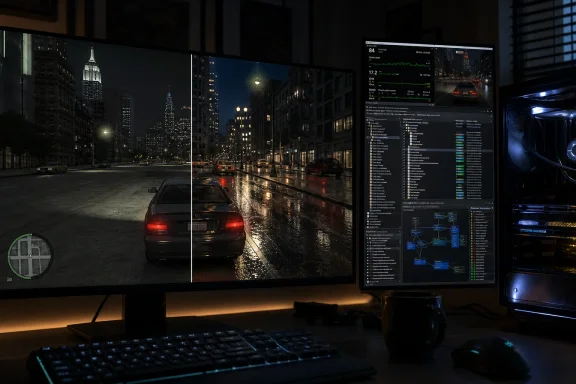 Version 1.4.2 improves the machinery behind the lighting
The GTA IV project exists to make a game that was never designed for NVIDIA RTX Remix work with it. RTX Remix was built primarily for classic DirectX 8 and DirectX 9 games using older fixed-function rendering pipelines. GTA IV uses a more complicated arrangement, which is why xoxor4d’s release includes a custom runtime, an ASI loader, and a tailored fork of the long-running FusionFix project.
The mod’s own documentation is more restrained than the “GTA 6 leak” framing. It explicitly says the package is not a remaster; it is a compatibility layer that lets GTA IV use Remix, along with a baseline mod and the GTAIV-AutoPBR material package. Physically based rendering, or PBR, is the material system that lets surfaces respond more plausibly to light—wet asphalt, painted metal, glass, concrete, and vehicle panels can all look substantially different when the lighting model changes.
Version 1.4.2 is a relatively focused update. The new always-draw-lowest-LOD option is off by default, which is sensible: it may help reduce visible gaps in the city at a distance, but rendering more of Liberty City can also add work. The release also updates Remix components for newer DLSS Frame Generation behavior, a telling sign that the mod is still tied closely to the evolving NVIDIA stack rather than being a static graphics pack.
That ongoing work is the real story. NVIDIA opened RTX Remix to modders in January 2024 and later open-sourced both the runtime and the Creator Toolkit. The GTA IV compatibility project demonstrates why that matters: community developers can build game-specific workarounds where a general-purpose renderer cannot simply attach itself to an older game and behave perfectly.
The compatibility list is narrower than “GTA IV on PC”
Players need Grand Theft Auto IV: The Complete Edition version 1.2.0.59. That is the version xoxor4d identifies as supported, and it is available through Steam and Rockstar’s launcher. The project’s troubleshooting documentation says some 1.2.0.4x installations have reportedly worked, but they are not actively supported.
That distinction matters for anyone returning to a years-old retail copy, a heavily modified install, or an archive of legacy GTA IV patches. GTA IV’s PC history includes compatibility fixes, downgrades, mod loaders, command-line tweaks, and old graphics modifications that frequently overlap in the same game directory. Installing an RTX Remix layer over an existing mod collection without checking those components is an easy way to produce crashes, missing assets, or a game that launches with broken lighting.
The current installer is designed to reduce some of that work. It prompts users to select GTAIV.exe, offers the custom FusionFix fork, downloads the required base Remix mod, and can optionally install AutoPBR. The base mod is mandatory; without it, the compatibility mod does not function correctly. AutoPBR is optional, but it is one of the pieces that changes the look materially by converting many original materials into approximate PBR equivalents.
The project also advises Steam users to remove custom GTA IV launch arguments before installation. That is a small instruction with outsized value. Longtime GTA IV players often carry forward launch parameters intended to address old memory, display, or performance problems, and those arguments can conflict with a new rendering pipeline.
Windows Central’s suggested pairing with Warcaco’s 4K Textures Graphics Mod is therefore best understood as an additional experiment, rather than part of the official RTX Remix compatibility release. A high-resolution texture pack may improve close-up surface detail, but it also increases VRAM use, storage requirements, loading pressure, and the number of possible interactions with other installed mods.
Path tracing is only part of the performance equation
The visual gain comes from replacing much of GTA IV’s original static, baked-looking lighting behavior with path-traced illumination. In broad terms, path tracing simulates light traveling through a scene and bouncing between surfaces, producing more natural indirect light, reflections, shadow transitions, and emissive lighting. It is computationally expensive even in modern games designed around it.
In GTA IV RTX Remix, though, GPU horsepower is only one limiting factor. The project documentation warns that players will likely encounter a CPU bottleneck because the game is rendering large numbers of detailed meshes. It also cautions that the overhead comes from the way RTX Remix intercepts the game’s draw calls. A frame-rate collapse in a dense part of Liberty City may therefore reflect the CPU and the game’s geometry handling as much as the cost of path tracing.
The mod includes a blunt but useful workaround: batch files that assign two CPU cores to GTA IV and reserve the remaining cores for Remix, plus another option for a half-and-half split. It is an unusual installation detail, but it reveals the practical tradeoff. This is not merely a shader replacement that sits quietly on top of the original game. Two distinct workloads—the 2008 game and a contemporary rendering runtime—are competing for system resources.
Players should begin conservatively:
- Use the current Complete Edition build and test the compatibility mod before adding texture packs, reshades, or traffic and visual overhaul mods.
- Enable performance overlays and evaluate busy daytime, rain, nighttime, driving, and dense city scenes instead of relying on an early-game indoor benchmark.
- Treat DLSS and Frame Generation as tools for improving perceived smoothness, not proof that the CPU-side stutter and scene complexity have disappeared.
- Keep a clean backup of the GTA IV folder, especially if the installation already contains FusionFix, ENB, DXVK, Reshade, or older ASI-based mods.
The release does include an in-game F4 menu for compatibility and debug settings, while the Remix interface uses Alt+X. Those controls matter because the correct response to a graphical defect may be a setting change rather than another mod download. The project’s maintenance work has already addressed issues such as shadow pop-in, sky rendering, weather blending, emissive light flicker, and first-spawn invisibility.
A strong technical showcase, but no substitute for a finished remaster
NVIDIA has used RTX Remix to promote projects such as Portal with RTX and Half-Life 2 RTX, but GTA IV illustrates a different use case: a community maintainer adapting a notoriously uneven PC port to a modern graphics renderer. The fact that it works at all is an achievement, especially given GTA IV’s age and dense open-world geometry.
It is also why expectations need to stay grounded. The author says there are “obvious drawbacks” and unsupported behavior because Remix is being adapted to a game with a complex rendering path. The mod can deliver striking lighting and materials, yet it cannot rewrite GTA IV’s mission scripting, animation systems, streaming behavior, original asset quality, or CPU-era engine design. A dramatic before-and-after image can hide all of those limits.
The timing gives the project extra attention. Rockstar Games has set Grand Theft Auto VI for November 19, 2026, but its announced launch platforms are PlayStation 5 and Xbox Series X|S. There is no announced PC release date from Rockstar. For PC players, GTA IV RTX Remix is therefore not a literal stopgap until a PC version of GTA VI arrives; it is a way to revisit Liberty City with modern rendering features while Rockstar’s next game remains console-only on the published schedule.
For now, version 1.4.2 is worth trying for players who enjoy PC modding and have the hardware patience to match. Install it on a clean GTA IV: The Complete Edition setup, measure performance before piling on 4K assets, and expect ongoing updates. The mod’s strongest claim is not that it turns GTA IV into GTA VI. It shows that an 18-year-old DirectX-era game can still be meaningfully reshaped when the renderer, compatibility layer, and mod community are all still moving forward.