
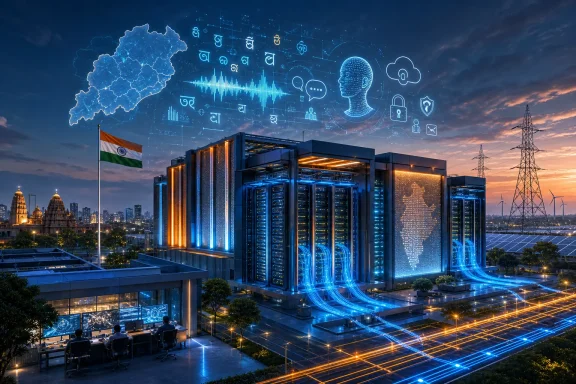
 Overview: A Major Bet on India’s AI Infrastructure
HCLTech plans to establish its first AI Data Center at the upcoming Odisha Sovereign AI Park in Bhubaneswar through a three-way collaboration with Indian AI company Sarvam and the Government of Odisha. The announced capital outlay is ₹14,257 crore, a figure that includes financial assistance from the state government.
The project arrives as India’s technology sector shifts its attention from experimental generative AI deployments toward a more difficult question: where will the compute, data controls, models and operational expertise needed for production-grade AI actually reside?
For HCLTech, the answer is increasingly clear. The company is positioning itself beyond the traditional IT services role of integrating third-party cloud platforms and software. It wants to participate in the entire AI stack, from data-centre infrastructure and GPU-powered computing through to enterprise applications, managed services and sector-specific AI implementations.
For Odisha, the agreement is an opportunity to accelerate an ambition that has been building throughout 2026. The state has been advancing plans for sovereign AI capacity that can support public services, local industry, research institutions, startups and national-scale workloads. The HCLTech-Sarvam partnership gives that effort an enterprise delivery partner with global reach.
The announcement also coincides with a separate HCLTech commitment to build a 5,000-seat Global Technology Center in Bhubaneswar. Operations at that facility are expected to begin by 2028, creating a more complete picture of HCLTech’s strategy: infrastructure, engineering talent, enterprise service delivery and AI deployment capabilities concentrated in the same regional ecosystem.
What HCLTech Has Actually Announced
The language around artificial intelligence infrastructure can quickly become inflated, so it is important to separate confirmed details from future aspirations.
HCLTech has confirmed that it plans to set up an AI Data Center in the Odisha Sovereign AI Park. The facility will be developed in partnership with Sarvam and the Odisha government, with a proposed capital outlay of ₹14,257 crore.
The project is intended to support:
- Sovereign AI and data infrastructure
- AI services for public-sector and private-sector organizations
- Sector-specific AI applications
- Multilingual AI-based services
- Local developer ecosystem growth
- Large-scale training and inference workloads
- Government requirements around data control and digital sovereignty
HCLTech’s role is expected to draw on its broader capabilities across AI infrastructure, cloud, engineering, enterprise technology platforms, cybersecurity and managed services. Sarvam is expected to bring its Indian AI models and full-stack AI capabilities, particularly in areas related to Indian languages, voice, translation and public-service-oriented AI applications.
The Odisha government’s participation matters just as much as the corporate partnership. A data centre of this size requires more than capital expenditure. It needs land, power, grid stability, regulatory support, fibre connectivity, water and cooling planning, physical security, local talent pipelines and long-term economic incentives.
The Important Qualification: This Is a Planned Investment
The ₹14,257 crore number is substantial, but it should be understood as a planned capital outlay, not proof that all of the money has already been deployed or that the facility is operational.
No public announcement accompanying the project has established:
- A final commissioning date for the AI Data Center
- The number or model of GPUs to be installed
- The data centre’s initial or ultimate IT load
- The precise capacity allocated to model training versus inference
- The mix of public, private and government customers
- The project’s phased construction timeline
- The exact value and structure of Odisha’s financial assistance
- Whether hardware procurement will be concentrated with one accelerator supplier or distributed across several platforms
Those omissions are not unusual for a project at the memorandum-of-understanding stage. Still, they are material. The long-term value of an AI data centre depends on execution details that extend far beyond a headline investment figure.
Why “Sovereign AI” Is the Core of the Deal
Sovereign AI has become one of the technology industry’s most frequently used phrases, but it can mean different things depending on who is using it.
At its strongest, sovereign AI describes a country’s or region’s ability to develop, host, govern and deploy AI systems under domestic legal, operational and strategic control. It does not necessarily mean every component is locally manufactured. Rather, it focuses on control over where sensitive data is processed, who operates the infrastructure, how models are governed and whether critical AI services can continue without excessive dependence on foreign platforms.
In India, the idea has particular significance because AI systems will increasingly be used in government operations, financial services, healthcare, public welfare, education, manufacturing, telecommunications and critical infrastructure. These sectors often handle sensitive personal, commercial or state data that organizations may be reluctant—or legally constrained—to move across jurisdictions.
A successful sovereign AI stack generally requires several layers working together:
- Compute infrastructure
High-performance servers, accelerated computing, storage, networking and data-centre operations capable of supporting AI training and inference. - Data governance
Clear control over data residency, access, security, retention, auditability and lawful processing. - Foundation models
Large-scale models designed to understand local languages, cultural context, administrative systems and domain-specific use cases. - Developer tools and applications
APIs, model customization, retrieval systems, workflow automation, security controls and interfaces that turn models into usable services. - Operational capability
Teams able to run the infrastructure, harden systems, monitor performance, control costs and support enterprise deployments over years rather than months.
The Odisha project is significant because it seeks to join all five layers. HCLTech brings infrastructure and enterprise operational experience. Sarvam brings the model and AI application layer. Odisha supplies policy support, local anchoring and public-sector demand.
That is a more complete proposition than simply renting GPU instances from a global hyperscaler.
Sarvam’s Role: Indian Models and Multilingual AI
Sarvam’s involvement is central to the project’s sovereign AI claim. The company has positioned itself around building AI capabilities that work across India’s linguistic diversity and can be deployed in environments where local control, affordability and population-scale access matter.
This focus is especially relevant for Odisha. A state-level AI programme cannot be designed solely around English-language interfaces and urban enterprise workflows. If AI is to be used for citizen services, education, skilling, public information, agriculture, industrial safety and grievance systems, it must work reliably across local languages, speech patterns and low-friction communication channels.
Sarvam’s existing public direction has emphasized:
- Indian language AI
- Speech-to-text and text-to-speech tools
- Translation capabilities
- Document digitization
- Enterprise APIs
- Government and public-service applications
- Foundation models tuned for Indian contexts
The potential benefits are substantial. A multilingual system could allow residents to interact with digital services by voice rather than forms, provide translations across Odia and other Indian languages, assist frontline workers with documentation, and make government information more accessible.
However, multilingual AI creates its own demanding technical and policy challenges. Performance cannot be measured only by benchmark scores in English. For a public-facing system, accuracy has to hold up across dialects, code-switching, noisy audio, varied literacy levels and specialized terminology.
A system that translates a casual conversation reasonably well may still fail in a high-consequence setting such as healthcare guidance, benefit eligibility or legal documentation. The project’s credibility will therefore depend on transparent testing, human escalation paths, security controls and meaningful accountability when automated outputs are wrong.
Why Odisha Has Become an AI Infrastructure Contender
Odisha’s AI push is not appearing out of nowhere. The state has already been developing a broader sovereign AI capacity strategy with Sarvam, including earlier plans around an AI-optimized facility and public-sector applications.
Its appeal is grounded in several practical advantages.
Power Availability Matters More Than Marketing
AI data centres are power-intensive by design. Modern accelerated computing clusters can consume enormous amounts of electricity, especially when thousands of GPUs are operating continuously for large-model training or serving high-volume inference requests.
Odisha’s industrial base, power ecosystem and economic profile give it a plausible foundation for energy-intensive digital infrastructure. Yet the opportunity comes with a caveat: available power is not the same as clean power, resilient power or economically competitive power.
For a project associated with sovereign AI and long-term national capacity, the quality of the energy strategy will matter. The most credible roadmap would include:
- Redundant grid connections
- High-voltage transmission planning
- On-site backup capability
- Renewable energy procurement
- Battery storage where economically viable
- Energy-efficiency targets
- Transparent reporting on power usage effectiveness
- Cooling systems suited to local climate conditions
Without that discipline, an AI data centre can become an expensive power consumer whose economics deteriorate as demand grows.
A Natural Fit for Industrial AI
Odisha’s industrial sectors could offer real-world AI use cases beyond chatbots and content generation. Mining, metals, logistics, heavy industry and workforce development all create opportunities for computer vision, predictive maintenance, safety monitoring, supply-chain optimization and multilingual worker support.
That makes the proposed facility more strategically interesting than an isolated AI compute campus. If the compute, models and enterprise services are linked to local industrial problems, the project could generate reference deployments that HCLTech and Sarvam can later scale across India and internationally.
Potential industrial use cases could include:
- Computer vision for hazardous-site monitoring
- Equipment failure prediction
- AI-assisted inspection workflows
- Document intelligence for procurement and compliance
- Multilingual technical knowledge assistants
- Training and skilling tools for field workers
- Demand forecasting and logistics optimization
- Automated reporting for environmental, safety and governance processes
The key is that these systems must be deployed with rigorous human oversight. Industrial AI should augment safety and operational decision-making, not create opaque automation that managers trust without understanding its limitations.
The HCLTech Strategy: From Services Provider to Full-Stack AI Participant
The announcement follows HCLTech’s stated move into a more comprehensive full-stack AI market strategy. This is an important shift for a global technology services company.
For decades, large IT services providers have been vital to enterprise modernization. They have implemented ERP systems, managed infrastructure, migrated workloads to cloud platforms, developed applications and operated service desks. Generative AI changes the economics of that model because clients increasingly want reusable platforms, intelligent automation and AI-native operating capabilities rather than labor-intensive customization alone.
Building or partnering around AI infrastructure gives HCLTech several strategic advantages.
Tighter Control of the AI Delivery Chain
If HCLTech can provide compute capacity, model access, AI engineering, enterprise integration and managed operations, it can reduce dependence on a fragmented set of third parties.
That does not eliminate reliance on external hardware and software suppliers. AI accelerators, networking, storage and server components remain globally sourced. But it can give HCLTech more control over the customer experience, security posture, pricing structure and service-level commitments.
A Differentiator for Regulated Customers
Banks, insurers, healthcare organizations, government agencies and critical-infrastructure operators often need stronger assurances around data location and operational control than a generic public-cloud deployment can provide.
An India-based AI data centre combined with domestic models and enterprise implementation services could appeal to organizations looking for:
- Controlled data residency
- Dedicated or isolated AI capacity
- Custom model tuning
- Compliance-oriented deployment patterns
- Auditable operational processes
- Local support and managed services
- Integration with legacy systems
This could be especially relevant for companies operating mixed environments, where sensitive workloads stay on controlled infrastructure while lower-risk workloads use public cloud services.
A Better Story Than “AI Consulting” Alone
Enterprise buyers have become more skeptical of AI transformation messaging that does not include hard infrastructure, data readiness and cost planning. HCLTech’s Odisha initiative offers a more tangible narrative: it is not merely advising clients to use AI but investing in the capacity required to run it.
That is a strength. It also raises the bar. Once a company owns or anchors a major AI infrastructure initiative, customers will expect enterprise-grade performance, capacity availability, security, uptime and predictable economics.
The 5,000-Seat Global Technology Center Changes the Equation
HCLTech’s separate agreement to establish a 5,000-seat Global Technology Center in Bhubaneswar may prove just as important as the data centre itself.
AI infrastructure has limited value without the people who can design systems around it. Enterprises need data engineers, cloud architects, model operations specialists, security analysts, software developers, industry consultants and support teams. A local technology center can create the services layer that turns raw compute into delivered outcomes.
The pairing of the two projects suggests a deliberate flywheel:
- The data centre supplies AI compute capacity.
- Sarvam provides models and AI capabilities.
- HCLTech delivers integration, engineering and operations.
- The Global Technology Center develops talent and service capacity.
- Odisha gains an expanding technology ecosystem.
- Enterprises receive a potential alternative to fully offshore AI infrastructure.
This is the logic of an AI hub rather than a standalone server facility.
Still, the target of operational commencement by 2028 underscores that this is a multi-year programme. Job creation, local skill development and global delivery capability will take time to mature. The state and company will need to invest in education partnerships, internships, specialist training and research collaboration if they want the center to become more than a large office footprint.
The Infrastructure Risks That Cannot Be Ignored
The project’s upside is significant, but a responsible assessment must also acknowledge the risks.
GPU Supply and Technology Dependency
India can host AI infrastructure domestically while still relying heavily on foreign-designed accelerators, networking hardware and semiconductor supply chains. That does not invalidate the sovereign AI goal, but it does limit the degree of end-to-end technological independence.
The availability, price and export eligibility of advanced AI chips can materially affect project timelines. A large data-centre investment can be delayed if accelerator shipments, high-bandwidth memory, advanced networking equipment or power systems become constrained.
The project’s resilience will depend on procurement strategy, vendor diversity, lifecycle planning and the ability to adapt workloads across hardware generations.
The Economics of AI Compute
Training large foundation models is expensive. Inference can also become costly at scale, particularly for real-time voice, multimodal systems and high-volume enterprise usage.
The ultimate success of the Odisha AI Data Center will not be measured by rack count or construction spending. It will be measured by utilization. Idle GPU capacity is financially damaging, while oversubscribed capacity leads to disappointing customer experiences.
To sustain the business case, HCLTech and its partners will need a clear workload pipeline across:
- Government services
- Large enterprises
- Managed AI platforms
- Startup and developer access
- Research institutions
- Industry-specific solutions
- Model training
- Production inference
A balanced mix matters. Training workloads can consume huge bursts of capacity, while inference can generate steadier demand. Designing for both without underutilizing expensive equipment is a difficult operational problem.
Data Security and Model Governance
A sovereign AI project will attract sensitive workloads precisely because it promises control. That means it must meet a higher standard for cybersecurity and governance.
The operating model should address:
- Identity and access management
- Tenant isolation
- Encryption in transit and at rest
- Secure data ingestion
- Model access controls
- Audit logging
- Incident response
- Supply-chain security
- Vulnerability management
- Red-team testing
- AI output monitoring
- Data retention and deletion policies
For government services, these controls cannot be treated as a later add-on. They are core product requirements.
Water, Cooling and Environmental Impact
AI data centres consume not only power but also cooling resources. The exact cooling design for the Odisha facility has not been publicly detailed, which means the water and environmental implications remain unclear.
That uncertainty deserves attention. High-density AI clusters often require advanced cooling designs because traditional air cooling may become inefficient as rack power rises. Direct-to-chip liquid cooling, rear-door heat exchangers and other approaches can improve thermal management, but each introduces operational complexity.
A project of this scale should ultimately be evaluated on more than investment size. Its environmental performance, energy sourcing, water stewardship and community impact will matter to its long-term legitimacy.
What This Means for Enterprise IT and Windows Environments
For Windows-focused organizations, the relevance may not be immediately obvious. AI data centres evoke images of Linux clusters, Python frameworks and massive GPU farms. In practice, enterprise AI adoption remains deeply connected to Windows Server, Microsoft Active Directory, SQL Server, endpoint management, Microsoft 365, Azure hybrid services and line-of-business applications.
Most organizations will not replace their existing environment with a pure AI stack. They will integrate AI capabilities into the systems they already run.
A sovereign AI platform could support enterprises that want to keep sensitive Windows-based workloads under tight local governance while connecting them to approved AI services. Typical architecture patterns could include:
- Windows Server applications calling governed AI APIs
- SQL Server data pipelines feeding retrieval-augmented generation systems
- Microsoft 365 workflows using enterprise AI services under controlled policies
- Active Directory or Entra-based identity integration
- Security information and event management platforms monitoring AI access
- .NET applications using local-language AI, translation or speech services
- Azure Arc-style hybrid management approaches for distributed environments
The crucial issue is interoperability. Enterprises will expect AI systems to integrate with their identity systems, data classifications, endpoint controls, audit requirements and established business applications. A powerful model is not enough if it cannot be operationalized safely in a mixed Windows, Linux, cloud and on-premises environment.
The Broader Significance for India’s AI Market
The Odisha announcement points to a larger transformation in India’s AI market.
The first phase of generative AI adoption was dominated by experimentation. Companies tested chatbots, coding assistants, summarization tools and knowledge-search applications. Many of those pilots have produced useful results, but they have also exposed weaknesses in data quality, governance, cost control and integration.
The next phase will reward organizations that can make AI dependable infrastructure rather than a collection of isolated demos.
That is why investments in sovereign AI infrastructure are gaining momentum. They address questions that cannot be solved by prompt engineering alone:
- Where is the data processed?
- Who controls the model and the platform?
- How are costs managed at scale?
- Can systems support local languages and public-service needs?
- What happens if a global platform changes pricing or access terms?
- Can regulated industries meet compliance obligations?
- Are domestic developers able to build on reliable compute capacity?
HCLTech, Sarvam and Odisha are attempting to provide a practical answer to those questions. The initiative is ambitious because it recognizes that AI competitiveness is not only about developing a compelling chatbot. It is about building the infrastructure, institutions and talent necessary to operate AI as a national and enterprise capability.
Conclusion: Ambition Is Clear; Delivery Will Define the Outcome
HCLTech’s proposed ₹14,257 crore investment in an AI Data Center at the Odisha Sovereign AI Park is one of the most consequential enterprise AI infrastructure announcements in India’s current technology cycle. It combines a global IT services company, a domestic AI model provider and a state government in a partnership designed to move beyond cloud consumption toward sovereign AI infrastructure.
The project’s strongest feature is its integrated design. HCLTech supplies enterprise-scale delivery and operational expertise. Sarvam brings Indian AI models and multilingual capabilities. Odisha contributes an enabling policy environment and a strategic location for a regional AI ecosystem.
Its biggest risks are equally clear: capital intensity, hardware dependence, capacity utilization, environmental impact, security requirements and the difficulty of translating AI rhetoric into reliable public and private-sector systems.
The most meaningful test will come after the MoU stage. A credible rollout will require transparent milestones, resilient energy planning, secure data governance, practical developer access, measurable local talent creation and real applications that improve services for enterprises and citizens.
If those pieces come together, Bhubaneswar could become more than the site of a large AI data centre. It could become a significant proving ground for how India builds, governs and deploys AI on its own terms.
