
Nvidia’s Spectrum-X Ethernet Photonics switches and Broadcom’s 51.2Tbps Bailly platform are moving from demonstrations toward production deployments, marking a significant step for co-packaged optics in AI data-center networks. TrendForce reported this week that Nvidia has begun shipping its next-generation CPO switch to selected partners, while Broadcom continues limited shipments of Bailly systems.
For Windows-focused enterprises, the immediate change is not on the desktop. It is in the infrastructure beneath Azure-scale AI services, private GPU clusters, and increasingly the Windows Server environments used to host AI-adjacent applications. The networking fabric is becoming a harder constraint on GPU utilization, power budgets, and cluster expansion.
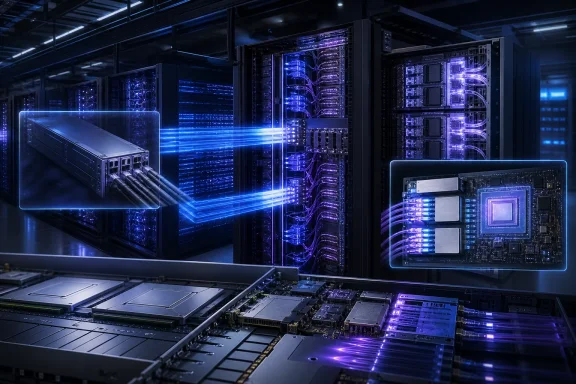
Co-packaged optics, or CPO, mounts optical engines next to the switching ASIC rather than relying on removable optical transceivers at the front of the switch. That shortens high-speed electrical paths, a growing problem as networks push toward 200Gb/s-per-lane signaling and aggregate switch bandwidth beyond 50Tbps.
Nvidia has positioned Spectrum-X Ethernet Photonics as part of its Vera Rubin platform and says the CPO-based switches are now in production. The company claims its photonics approach improves power efficiency and deployment speed versus conventional transceiver-based networks; those are vendor figures, but the fundamental appeal is clear: less electrical loss and less power spent moving data between enormous numbers of accelerators.
TrendForce says Nvidia’s design is developed with TSMC and uses the foundry’s COUPE advanced-packaging approach. Its reported 400Tb/s switching capacity would put the product squarely in the fabric required for million-GPU-scale AI installations rather than conventional enterprise switching closets.
That distinction matters. A production-capable design is not automatically a production-scalable supply chain. CPO requires the optical engine, switch ASIC, package substrate, fiber attachment, thermal solution, and test process to work together as a single product. A yield issue in one part can strand the entire assembly.
TrendForce identifies three practical constraints: optical-engine yields, silicon-photonics manufacturing capacity, and advanced-packaging availability. Those are familiar bottlenecks to anyone tracking AI hardware, but CPO concentrates them in a device that is more difficult to rework than a switch using pluggable optics.
The near-term implication is that CPO will remain concentrated in hyperscalers, GPU cloud providers, and large private AI factories. Most Windows Server administrators will not be ordering CPO switches soon, but they may consume services built on them—or operate the Windows-based application, identity, storage, and management layers around those clusters.
TrendForce previously estimated CPO penetration in AI data-center optical communications at only about 0.5% in 2026. The move by Nvidia and Broadcom therefore signals an important manufacturing transition, not a wholesale replacement of pluggable optics. Whether CPO becomes a mainstream AI-networking component now depends less on switch bandwidth than on whether the industry can manufacture its photonic and packaging components at predictable yields and volumes.
For Windows-focused enterprises, the immediate change is not on the desktop. It is in the infrastructure beneath Azure-scale AI services, private GPU clusters, and increasingly the Windows Server environments used to host AI-adjacent applications. The networking fabric is becoming a harder constraint on GPU utilization, power budgets, and cluster expansion.
The optical engine moves beside the switch silicon
Co-packaged optics, or CPO, mounts optical engines next to the switching ASIC rather than relying on removable optical transceivers at the front of the switch. That shortens high-speed electrical paths, a growing problem as networks push toward 200Gb/s-per-lane signaling and aggregate switch bandwidth beyond 50Tbps.Nvidia has positioned Spectrum-X Ethernet Photonics as part of its Vera Rubin platform and says the CPO-based switches are now in production. The company claims its photonics approach improves power efficiency and deployment speed versus conventional transceiver-based networks; those are vendor figures, but the fundamental appeal is clear: less electrical loss and less power spent moving data between enormous numbers of accelerators.
TrendForce says Nvidia’s design is developed with TSMC and uses the foundry’s COUPE advanced-packaging approach. Its reported 400Tb/s switching capacity would put the product squarely in the fabric required for million-GPU-scale AI installations rather than conventional enterprise switching closets.
Broadcom’s Bailly remains an early-volume product
Broadcom’s Bailly is a 51.2Tbps Ethernet CPO platform built around its Tomahawk 5 switch silicon and eight 6.4Tbps silicon-photonics optical engines. Broadcom had previously described the product as production-ready, but TrendForce’s latest assessment indicates shipments remain limited rather than broad-volume.That distinction matters. A production-capable design is not automatically a production-scalable supply chain. CPO requires the optical engine, switch ASIC, package substrate, fiber attachment, thermal solution, and test process to work together as a single product. A yield issue in one part can strand the entire assembly.
TrendForce identifies three practical constraints: optical-engine yields, silicon-photonics manufacturing capacity, and advanced-packaging availability. Those are familiar bottlenecks to anyone tracking AI hardware, but CPO concentrates them in a device that is more difficult to rework than a switch using pluggable optics.
AI clusters—not office networks—will set the pace
Nvidia and Broadcom are pursuing CPO because conventional copper traces and pluggable modules become increasingly costly in power and signal integrity at extreme bandwidths. The technology is most compelling in scale-out AI fabrics, where tens of thousands of GPUs and accelerators must exchange training or inference data without leaving expensive compute idle.The near-term implication is that CPO will remain concentrated in hyperscalers, GPU cloud providers, and large private AI factories. Most Windows Server administrators will not be ordering CPO switches soon, but they may consume services built on them—or operate the Windows-based application, identity, storage, and management layers around those clusters.
TrendForce previously estimated CPO penetration in AI data-center optical communications at only about 0.5% in 2026. The move by Nvidia and Broadcom therefore signals an important manufacturing transition, not a wholesale replacement of pluggable optics. Whether CPO becomes a mainstream AI-networking component now depends less on switch bandwidth than on whether the industry can manufacture its photonic and packaging components at predictable yields and volumes.
References
- Primary source: Telecompaper
Published: 2026-07-29T05:36:00+00:00
Nvidia and Broadcom ramp up CPO switch production - Trendforce - Telecompaper
Nvidia and Broadcom have begun moving co-packaged optics (CPO) switches into volume production, with optical engine yields, silicon photonics capacity and advanced packaging emerging as potential constraints on market expansion, according to analysts TrendForce. Nvidia has started shipping its...www.telecompaper.com - Related coverage: investor.nvidia.com
NVIDIA Corporation - NVIDIA Vera Rubin Ramps Into Full Production to Power Agentic AI Factories Worldwide
News Summary: NVIDIA Vera Rubin is ramping into full production, with Taiwan’s top server makers and global supply chain leaders manufacturing Vera Rubin-based systems at scale — fueling AI labs, cloud providers and hyperscalers to build tomorrow’s intelligence. Vera Rubin delivers the POD-scale...investor.nvidia.com