

The apparent conflict is more than a semantic footnote. It shows the gap between an executive-level AI partnership announcement and the operational reality of rolling out tools across a conglomerate with hundreds of subsidiaries, separate IT estates, and business units that handle everything from rail and power infrastructure to healthcare and industrial systems.
Fortune’s reporting makes clear that Hitachi’s Americas IT organization is treating AI access as a controlled, use-case-by-use-case decision rather than an all-access entitlement. For Windows administrators and enterprise architects, that is the more consequential policy: workers may hear that the company has made a global AI commitment, but access, model choice, data permissions, budgets, and workflow integrations remain decentralized.
Hitachi’s Anthropic pledge does not look like a universal desktop rollout
In May, Hitachi and Anthropic announced a strategic partnership intended to strengthen Hitachi’s Lumada 3.0 business initiative. Hitachi said it would deploy advanced AI, including Anthropic’s Claude models, across all business processes for its global workforce, establish a Frontier AI Deployment Center spanning North America, Europe, and Asia, and develop 100,000 AI professionals.
That public statement is difficult to square cleanly with Krishnapillai’s description to Fortune of an organization that has not deployed one enterprise-wide AI product to every employee. The most plausible reading is that Hitachi is pursuing broad organizational AI adoption without standardizing on one end-user assistant or granting every employee identical access.
Those are very different programs. A company can embed Claude in development work, customer solutions, internal platforms, and selected workflows while still letting business units choose among Microsoft Copilot, Google Gemini, Anthropic tools, and specialized applications. It can also provide an approved AI capability globally without exposing all workers to the same interface, data sources, agents, or token allotments.
Hitachi has not publicly explained the boundary between the May partnership’s “all business processes” language and the Americas CIO’s “no one solution” policy. Nor has it specified which Anthropic products are available to ordinary employees, whether Claude access is direct or mediated through internal applications, or whether the global rollout has reached all subsidiaries. Those omissions leave the practical scope of the deployment unresolved.
For IT teams, the distinction is familiar. A global vendor agreement is procurement. An enterprise-wide deployment means identity integration, tenant configuration, data-loss-prevention policies, audit logging, support ownership, license allocation, and a defensible answer when a regulated business unit asks which model processed its data. Hitachi appears to be much further along on the first than the second.
The three-bucket model puts governance ahead of uniformity
Krishnapillai described three AI categories to Fortune: general productivity assistants for tasks such as email and meeting-note summarization and translation; job-specific tools selected with business leaders; and developer-focused AI, where Hitachi works closely with Anthropic.
The general-productivity category includes Microsoft Copilot and Google Gemini, according to Fortune. That alone makes a blanket AI standard unlikely. Copilot is most valuable where work already lives in Microsoft 365, Teams, Outlook, SharePoint, and Windows-managed endpoints. Gemini has different strengths and administrative dependencies in Google Workspace environments. Creative, sales-intelligence, and engineering products introduce still more vendors, connectors, retention rules, and data paths.
A diversified manufacturer and services group also cannot sensibly apply one risk profile to every department. Translation of a routine internal email, for example, is a different exposure from summarizing a customer contract, searching engineering records, generating marketing material, or writing code for a system tied to rail operations or power infrastructure. Treating those workloads as interchangeable would simplify procurement, but it would also flatten distinctions that security, legal, and operational teams need to preserve.
Krishnapillai’s policy gives business-unit managers responsibility for their teams’ AI use and spending. That transfers some of the decision-making away from a central technology office, but it creates a clear operational requirement: Hitachi needs a reliable inventory of approved tools, users, data connections, consumption, and accountable owners. Without it, a decentralized strategy becomes a collection of separate subscriptions and unmanaged browser sessions.
The company’s concern over token consumption is therefore more than a finance issue. Metered AI services turn what used to be a fixed per-seat software conversation into a variable operating-cost problem. A developer agent that repeatedly reads repositories, calls tools, generates code, runs tests, and retries failed tasks can consume far more compute than an employee using a chat assistant to summarize an email.
EY’s latest U.S. AI Pulse survey supports that caution. It found that 98% of surveyed senior leaders at organizations using token-priced AI said usage and related costs had caused them to reconsider their approach, while only 64% said their organization actively monitored token use with clear budgets and guardrails. Hitachi is placing controls at the point where many enterprises are only beginning to discover they need them.
Appian solves a data-access problem, not the AI-governance problem
The technical core of Hitachi’s internal AI effort is not a frontier model. It is data access.
Krishnapillai told Fortune that the company had customer information distributed across more than 150 CRM systems, including Salesforce, SAP, and Microsoft products. That is credible in the context of Hitachi’s acquisition history and scale: its fiscal 2024 disclosures reported 618 consolidated subsidiaries and roughly 283,000 employees, while the company’s 2026 materials place its workforce around 280,000. Fortune’s reference to 607 subsidiaries may use a different date or operating definition, but neither Hitachi nor Fortune explains the difference.
Hitachi acquired GlobalLogic in a deal valued at $9.6 billion including assumed debt, and it took control of ABB’s Power Grids business in 2020 before later acquiring the remaining stake. Those transactions added valuable digital and energy capabilities, but acquisitions also tend to preserve overlapping customer, finance, sales, identity, and operational systems for years. The resulting fragmentation is exactly the condition that makes a polished AI assistant underperform: the model may be capable, but the information it needs is incomplete, inconsistent, inaccessible, or governed by conflicting permissions.
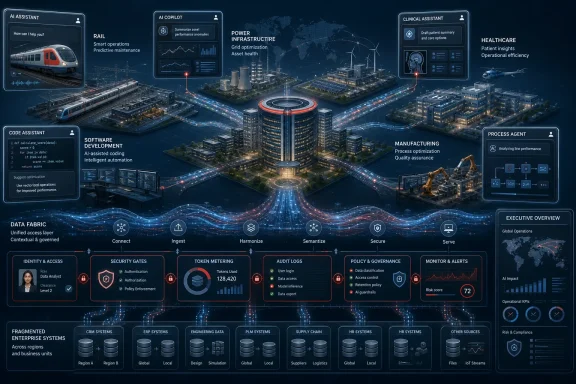
Hitachi selected Appian to create a data fabric over those existing systems rather than migrate everything into a new central database. In practical terms, that means creating a common layer for finding, combining, and using data while the underlying systems remain in place. For sales and marketing, the immediate objective is to assemble proposals and identify cross-sell opportunities without manually chasing records across multiple platforms.
The reported business benefits need careful reading. Fortune says Hitachi and Appian reported a 40% efficiency gain for sales and marketing alongside a 20% operating-cost reduction. Appian’s own published case material uses different metrics: it says the program is expected to deliver a 20% reduction in operating expenses, a 60% improvement in time to market, and greater sales productivity. An Appian World presentation goes further, describing proposal delivery accelerated by 60%, four-times-faster time to market, and development-speed improvements.
Those are vendor-reported and, in Appian’s language, partly expected outcomes—not independently audited results. The 20% operating-expense figure is consistent across the materials, but the 40% efficiency claim and the 60% time-to-market claim measure different things. Readers should not treat them as interchangeable proof of a single, verified productivity number.
The approach itself makes strategic sense. A data layer can reduce the pressure for a disruptive consolidation project and provide a more usable foundation for retrieval-augmented generation, reporting, and workflow automation. But it also expands the importance of identity and authorization design. A system that makes scattered data easier to discover can create a larger exposure if it fails to enforce the existing access boundaries from each source system.
Agentic AI is where Hitachi’s decentralization gets harder
Appian CEO Matt Calkins told Fortune that a data fabric can make Hitachi more ready for autonomous agents because agents may need to find information in places a conventional workflow did not anticipate. That is the sales pitch for agentic AI: give software the ability to reason across systems, select tools, retrieve data, and complete multi-step work.
It is also the point where a general-purpose AI strategy becomes an identity-and-control problem.
An assistant that drafts a proposal from documents is one thing. An agent that can search CRM systems, query ERP data, access document repositories, create records, trigger approvals, or communicate externally holds a different level of authority. NIST’s recent work on AI agents has focused heavily on identity, authorization, evaluation, monitoring, and audit trails for precisely this reason: agent systems act through tools and data connections rather than merely returning text.
Krishnapillai’s stated plan to find software that monitors the creation of AI agents is a sensible starting point, particularly if Hitachi wants to avoid duplicate agents built separately by different subsidiaries. But an inventory alone is insufficient. A useful agent-governance system must show who owns each agent, which model and version it uses, what data it can read, what systems it can alter, what credentials it holds, which human approved it, and whether it can invoke other agents or external services.
Hitachi says it is still in the early stages of autonomous AI and is prioritizing security, data protection, and privacy first. That restraint is appropriate for a company whose portfolio includes critical infrastructure and industrial operations. The company’s declared ambition to become more autonomous should be judged against concrete controls, not the number of agents it announces.
Windows and Microsoft 365 teams should expect selective AI access
For Windows-focused IT departments, Hitachi’s model is a reminder that Microsoft Copilot will increasingly be one approved option inside a broader AI portfolio rather than the company’s universal AI layer. Where a business unit has Microsoft 365 E3 or E5, Entra ID, Purview, Intune, and SharePoint already embedded in daily work, Copilot may be the natural productivity choice. That does not automatically make it the right tool for coding, creative generation, engineering analysis, multilingual operations, or agentic automation.
The operational question is whether each AI tool inherits the enterprise’s security model cleanly. Admins should be looking for conditional-access coverage, tenant boundaries, data classification behavior, eDiscovery and retention implications, connector inventories, API permissions, usage reporting, and budget controls before expanding access. In a multi-vendor environment, the cost of duplicating those controls across platforms can erase some of the productivity gain that justified the tools.
Hitachi’s public message is therefore less a rejection of enterprise AI than an admission that its deployment will remain uneven by design. The company has committed to Anthropic at global scale, relies on Appian to make fragmented data usable, and permits Microsoft Copilot, Google Gemini, and specialized applications where business units can justify them.
The unresolved issue is whether Hitachi can turn that collection of choices into one enforceable operating model. Until it can reconcile broad AI promises with a complete view of access, data, spending, and agent authority, “no one solution” will remain both its strategy and its central management problem.