
AV6UK600 code.For buyers who have spent years waiting for foldable phones to become less experimental and more practical, the timing is deliberate. Samsung has just used its July Unpacked event to launch a three-device Galaxy Z lineup, including its first Ultra-branded Fold, while Honor is using price, battery capacity, thinness, and ecosystem flexibility to argue that its flagship deserves a place on the same shortlist. Samsung confirmed the Galaxy Z Fold8 Ultra, Galaxy Z Fold8, and Galaxy Z Flip8 at its London event on July 22.
That makes the Honor Magic V6 promotion more than a routine voucher code. It is a direct attempt to reset the value conversation around high-end foldables at the very moment consumer interest is peaking.
 Background: A Foldable Market Becoming More Competitive
The premium foldable phone market has traditionally rewarded familiarity. Samsung has the longest and most visible history with Galaxy Z Fold devices in the UK, a mature retail footprint, strong carrier relationships, and a broad ecosystem spanning phones, tablets, watches, PCs, earbuds, and televisions.
That ecosystem advantage remains meaningful. A customer who already uses Samsung Notes, Galaxy Buds, a Galaxy Watch, SmartThings devices, and a Samsung tablet has fewer reasons to switch brands than a first-time foldable buyer. The friction is not merely financial; it is tied to habits, cloud services, accessories, support arrangements, and everyday device workflows.
But foldables are no longer competing only on novelty. Buyers increasingly compare them as portable productivity machines: devices that must operate as a normal phone when closed, a capable small tablet when open, a camera when travelling, and a multitasking screen for work, study, messaging, streaming, and remote collaboration.
Samsung’s July launch reflects that more mature market. The company positions the Galaxy Z Fold8 Ultra as its first Ultra model within the Galaxy Z range, with an 8-inch internal display, a 4.1mm unfolded profile, a 215g weight, a 5,000mAh battery, and Snapdragon 8 Elite Gen 5 for Galaxy silicon. Samsung’s product overview frames the device around AI-assisted multitasking and a premium large-screen experience.
Honor, meanwhile, is attacking the same space with a different equation: competitive flagship hardware plus a far more dramatic upfront discount. That is an important distinction in a category where the sticker price remains one of the biggest obstacles to mainstream adoption.
The Honor Magic V6 Deal: What the £600 Saving Includes
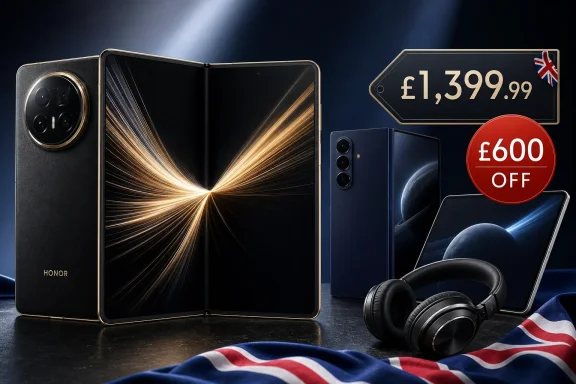
The key figure is straightforward: Honor’s Magic V6 is being offered at £1,399.99 rather than £1,999.99. The offer is not described as one flat price cut applied without conditions. Instead, the deal consists of two parts:
- £500 off automatically
- An extra £100 off after email registration and use of the
AV6UK600promotional code - A choice of included gift packages, reported to include either a projector, an Honor Pad 10 tablet, or an Honor Choice AI note taker, alongside Honor headphones according to Creative Bloq
The combination matters. A £600 reduction is substantial on its own, but a large bundle can materially change the total value proposition for someone who genuinely needs a tablet, audio accessory, or compact presentation device. The important word is genuinely. A free item has value only if it replaces something a buyer would otherwise purchase.
The Real Cost Is the Checkout Cost
A good foldable deal should always be assessed at checkout rather than at the headline level. Promotional structures can involve selected storage variants, specific colours, limited stock, eligibility restrictions, trade-in assumptions, or short validity periods. The reported Magic V6 offer is compelling because it appears to apply a large direct reduction, but buyers should still confirm the final configuration, code acceptance, gift selection, delivery estimate, and warranty terms before committing.
This is especially important because a phone discounted from £1,999.99 to £1,399.99 is still a £1,400 purchase. The promotion makes the Magic V6 considerably more accessible than its nominal list price, but it remains a flagship foldable rather than a budget handset.
There is also a broader market lesson here. When flagship devices routinely launch near or above £2,000, the list price often becomes less meaningful than the effective street price. Consumers should compare what they will actually pay, what is included, what support they receive, and whether their chosen retailer provides a simple route for repairs or returns.
Why the Timing Matters Against Samsung’s Galaxy Z Fold8
Honor’s discount has landed immediately after Samsung’s major foldable announcement, when attention is naturally focused on the Galaxy Z Fold8 and Galaxy Z Fold8 Ultra. That places the Magic V6 in a highly favourable position for buyers who want the foldable form factor but do not consider Samsung’s ecosystem a non-negotiable requirement.
Samsung’s newest models are not minor revisions. The standard Galaxy Z Fold8 has a redesigned form factor built around a 5.5-inch cover screen and 7.6-inch main display, while its 4:3 internal layout is positioned for video, games, reading, and web browsing. Samsung says the device weighs 201g and uses a 4,800mAh battery rated for more than 26 hours of video playback. Samsung’s Galaxy Z Fold8 overview also emphasizes AI-powered video and productivity features.
The Galaxy Z Fold8 Ultra pushes further into flagship territory with its 8-inch display and slim 4.1mm unfolded chassis. Independent reporting says the Ultra has a 3,000-nit peak brightness rating, a 200MP main camera, a 50MP ultra-wide camera, a 10MP telephoto lens, and a 5,000mAh battery. What Hi-Fi’s early coverage describes the Ultra as Samsung’s brightest Galaxy phone to date and highlights its updated hinge and display hardware.
Honor therefore faces a formidable rival. It is not trying to persuade buyers that Samsung has stood still; it is trying to show that a different flagship foldable can offer comparable ambition at a much lower effective price.
A Discount Does Not Automatically Make It the Better Phone
The Magic V6 promotion should not be treated as proof that the Honor is universally superior. Samsung retains clear advantages for users deeply invested in Galaxy services, those who value familiar One UI software, or those who want the reassurance of Samsung’s established foldable support infrastructure.
The more precise conclusion is that the £600 Honor discount creates a much stronger value-versus-price case. It changes the question from “Is Honor as good as Samsung?” to “Which trade-offs matter enough to justify a potentially much higher spend?”
That is a healthier and more practical way to compare premium devices.
Honor Magic V6 Hardware: Thin, Bright, and Battery-Focused
The Honor Magic V6 is clearly designed to eliminate some of the historic complaints about foldables: excessive thickness, middling battery life, conspicuous creases, weak durability perceptions, and disappointing cameras.
Honor lists a 7.95-inch internal display and a 6.52-inch external display, both with LTPO variable refresh rates from 1Hz to 120Hz. The company rates the larger internal panel at up to 5,000 nits peak brightness and the cover display at up to 6,000 nits, while both are promoted with 4,320Hz PWM dimming and a claimed 1.5% screen reflectivity. Honor’s UK Magic V6 page presents those figures as part of its display and eye-comfort credentials.
Those are eye-catching specifications, but prospective buyers should interpret peak-brightness figures carefully. Peak brightness is typically measured under specific test conditions and may apply only to a small portion of the panel for a limited period. It is useful for outdoor legibility and HDR content, but it does not mean the screen will remain at its peak figure in ordinary daily use.
Battery Capacity Is a Serious Selling Point
Perhaps the Magic V6’s most persuasive specification is its 6,660mAh silicon-carbon battery. Honor says the device has received a TÜV Rheinland 24-hour battery-life evaluation under continuous large-screen use, while also supporting 80W wired and 66W wireless Honor SuperCharge. Honor’s official specifications and claims place battery endurance at the centre of the device’s pitch.
On paper, this is a powerful answer to a longstanding foldable concern. Large folding displays consume significant power, and the additional mechanical and space constraints of a hinge make large batteries harder to fit than they are in conventional slab phones.
A larger battery could be particularly valuable to users who treat a foldable as a work device: running multiple apps, responding to messages, managing documents, reviewing PDFs, streaming video on trains, or using hotspot connectivity. Battery capacity is not equivalent to battery life, of course, because performance depends on brightness, signal strength, background activity, apps, thermal conditions, and usage patterns. Still, the raw capacity gives Honor a credible platform for its endurance claims.
A Very Slim Chassis—With Foldable Caveats
Honor says the Magic V6 measures 4.0mm unfolded, 8.75mm folded, and weighs 219g. The company’s UK product page describes it as thinner and lighter than traditional flagship smartphones when folded.
The 4.0mm unfolded figure is highly competitive. Samsung’s Galaxy Z Fold8 Ultra is listed at 4.1mm unfolded and 215g, illustrating how tightly contested the top end of foldable engineering has become. Samsung’s launch coverage confirms those Ultra dimensions.
However, ultra-thin foldables deserve practical scrutiny. The dimensions of the handset are only part of the ownership experience. Most users will install a case, and a case can add noticeable bulk to the hinge side. The folded device also needs to feel stable, balanced, and comfortable during one-handed messaging; numbers alone cannot establish that.
Durability Claims: Encouraging, but Read the Fine Print
Durability is one of the most sensitive areas in any foldable phone purchase. The Magic V6 has an impressive published specification sheet: Honor claims IP68 and IP69 dust and water resistance, a hinge tested for 500,000 folds, and an SGS-certified “imperceptible crease.” Honor’s reliability section also describes a 2,800MPa steel-shielded hinge structure and reinforced ultra-thin glass.
These claims are encouraging because they address real risks:
- Hinge longevity over years of daily opening and closing
- Water exposure from rain, spills, or accidental drops
- Dust ingress, which has historically been more difficult for foldables to manage
- Screen damage from pressure, grit, nails, and everyday objects
- Crease visibility, which affects both perceived quality and long-term usability
The caveat is that laboratory test figures should not be confused with a lifetime guarantee. A 500,000-fold test is an indication of a durability target under controlled conditions, not a promise that every device will perform identically after years of use. Likewise, water-resistance ratings do not make a phone invulnerable to all forms of water damage, particularly after damage, wear, or third-party repair.
The most valuable durability measure for buyers is therefore not just the specification. It is the complete ownership package: warranty coverage, accidental-damage protection, repair availability, parts lead times, and the clarity of the manufacturer’s support process.
Honor’s global launch communication has previously paired the Magic V6 with “Worry-Free” quality assurance and crack-protection bundles in some markets, although those specific benefits and their availability differ by region. Honor’s global launch announcement makes clear that regional bundles vary, so UK buyers should avoid assuming that an overseas package will apply locally.
Cameras, AI, and the Productivity Argument
A foldable must now prove itself beyond the screen. Honor equips the Magic V6 with a 64MP periscope telephoto camera, along with what it calls an AI colour engine and multi-camera image-fusion system. Honor’s product page positions the telephoto hardware around image stabilisation, colour rendering, and low-light work.
Camera quality ultimately depends on more than megapixel counts. Sensor size, lens quality, image processing, shutter response, motion handling, HDR tuning, portrait separation, and video stabilisation determine whether a device produces dependable images. Foldables also face a physical challenge: their thin bodies leave less room for large imaging modules than the thickest conventional camera flagships.
Samsung’s Galaxy Z Fold8 Ultra counters with a 200MP main camera, 50MP ultra-wide camera, and 10MP telephoto setup, plus the company’s ProVisual Engine processing and Nightography-oriented video features. What Hi-Fi’s launch report says the Ultra’s camera system is designed to bring the Fold line closer to Samsung’s mainstream flagship imaging experience.
AI Features Need Practical Limits
Both brands are making AI central to their foldable propositions. Honor promotes Fast-Flex split-screen controls, Gemini-powered cross-app actions, AI suggestions, and an AI meeting agent. Honor’s Magic V6 software overview describes these features as a way to open documents, find files, launch applications, receive contextual recommendations, and manage meeting information.
Samsung is similarly framing the Fold8 range around AI multitasking. Its Galaxy Z Fold8 Ultra includes tools such as Gemini Notebook for turning source materials into summaries, presentation slides, podcasts, quizzes, and other formats. Samsung’s overview also describes contextual Multi Window prompts and agentic workflows.
The opportunity is obvious: a larger folding display can make AI results more useful because the user can see the source material, generated response, and adjacent app windows at once. But there are risks as well:
- AI summaries can omit context or contain errors.
- Cross-app actions require careful permissions management.
- Cloud-based processing may raise privacy considerations for work documents or recordings.
- Some features may depend on an account, internet connection, regional availability, or subscription tier.
- Not every AI tool benefits from a larger screen; some are simply faster ways to perform existing tasks.
For Windows users who rely on a phone as a companion device rather than a replacement PC, these capabilities are most valuable when they reduce friction: receiving a file, reviewing it, making a quick edit, sharing it, and returning to a desktop workflow without unnecessary steps.
The Apple Interoperability Angle Is Unusual
One of Honor’s more distinctive pitches is cross-ecosystem compatibility. The company says the Magic V6 can connect with iPhone, iPad, AirPods, Apple Watch, and Mac hardware, including file transfers, notification sharing, and dual-screen Mac workflows through Honor Share. Honor’s global launch announcement also says the handset works with Quick Share for app-free transfers between Android and compatible Apple devices.
This is a strategically intelligent feature set because many technology households are mixed. A Windows PC owner may use an Android phone but have AirPods; a Mac user may need an Android work handset; a family may share files across iPhone and Android devices. Platform boundaries rarely align perfectly with how people actually buy devices.
Still, interoperability claims should be tested against the buyer’s specific devices and workflows. “Works with” does not necessarily mean full feature parity with first-party hardware. Apple services in particular can impose limitations on third-party integration, and support can vary by software version, region, and accessory generation.
The best reason to value Honor’s cross-platform approach is not that it will recreate an Apple ecosystem experience. It is that it may reduce the penalty for choosing an Android foldable in an otherwise mixed-device environment.
Who Should Consider the Magic V6 Promotion?
The Honor Magic V6 deal is strongest for buyers who meet several of the following conditions:
- They want a book-style foldable phone rather than a compact flip phone.
- They are not locked into Samsung’s services or accessory ecosystem.
- They value battery capacity, rapid charging, and a thin design.
- They prefer a direct upfront saving to a higher-priced device with incremental hardware advantages.
- They can make practical use of the included gift bundle.
- They are comfortable buying from Honor directly and have reviewed the warranty and support terms.
The device is especially appealing to someone upgrading from a conventional flagship phone who wants a tablet-like screen for reading, documents, video, web browsing, and split-screen work—but who considers £2,000 an unreasonable threshold.
Who May Be Better Served by Samsung
Samsung remains the more natural choice for established Galaxy users. The Galaxy Z Fold8 Ultra’s premium hardware, 8-inch display, slim design, high-end camera system, and Galaxy AI features make it an obvious destination for buyers who want the newest Samsung foldable experience regardless of price. Samsung’s Fold8 Ultra announcement makes clear that it is intended as the company’s top-tier foldable.
The standard Galaxy Z Fold8 may also be the more sensible Samsung option for users who prefer a lighter device and the new 7.6-inch internal display proportions. Samsung says the Fold8 weighs 201g, making it its lightest Galaxy Z Fold to date. Samsung’s official Fold8 details show that the company is offering two very different interpretations of the book-style foldable concept.
The broader point is that a £600 Honor discount should not force an artificial winner. It should force a more disciplined comparison.
The Bottom Line: Honor Has Turned Price Into a Flagship Feature
The Honor Magic V6 promotion is notable because it reshapes the UK foldable market at precisely the right moment. Samsung has just injected fresh excitement into the category with the Galaxy Z Fold8 Ultra and Galaxy Z Fold8, but Honor has answered with a reduction large enough to make consumers reassess what premium foldable ownership should cost.
At £1,399.99 after the reported £600 saving, the Magic V6 presents a serious alternative for buyers who want a 7.95-inch folding display, a large 6,660mAh battery, rapid wired and wireless charging, flagship Snapdragon hardware, a 64MP periscope camera, and ambitious durability credentials without paying the full £2,000-class list price. Creative Bloq’s offer breakdown confirms the discount structure and gift bundle, while Honor’s UK product information outlines the hardware claims behind it.
The offer does not erase Samsung’s ecosystem strength, software familiarity, or premium Fold8 Ultra hardware. What it does is make the Honor Magic V6 impossible to dismiss as an outsider. In a rapidly maturing foldable phone market, aggressive pricing may be as important as a thinner hinge, a brighter panel, or another AI feature—and Honor has made that point with unusual force.
