
That distinction changes the buying decision. A nontechnical business owner who needs a booking tool has a different problem from a Windows developer maintaining a multi-repository .NET or React application, even if both describe their work as “vibe coding.” Hostinger’s article correctly recognizes the split, but its overall winner is the company’s own managed builder, and the pricing comparison beneath it smooths over the cost and lock-in differences that matter after the first prompt.
The most useful conclusion is simple: pick the operating model before picking the AI model. Decide whether you want a platform to own hosting, identity, data, deployment, and billing for you, or whether you want AI inside an environment where your team still owns those engineering decisions.
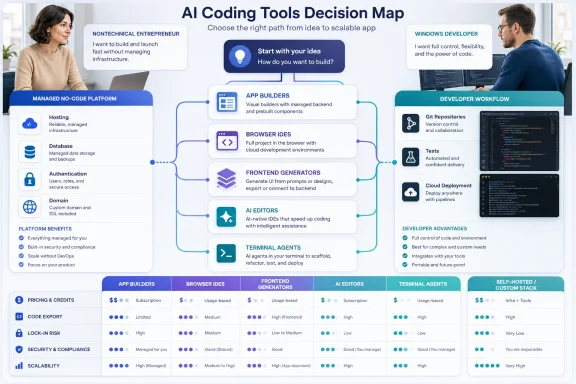 The nine products are really five different product categories
Hostinger Horizons and Base44 are managed, prompt-first application platforms. Their attraction is obvious: the platform supplies the database, authentication, hosting, and deployment path, so a user can go from a text description to a live web app without setting up a local development environment, cloud account, or CI/CD pipeline.
That makes them appropriate for internal tools, lightweight customer portals, prototypes, and small operational apps where time-to-launch matters more than infrastructure flexibility. It also means the service is doing much more than generating code. It is becoming the application’s control plane: the place where domains, deployment, data services, user accounts, usage limits, and in some cases code export are administered.
Lovable, Bolt.new, and Replit sit in the middle. They can generate working applications quickly, but they expose more of the development environment and code. Lovable emphasizes web-app generation and GitHub synchronization; Bolt.new runs a development environment in the browser; Replit is a full cloud workspace with an AI agent, editor, databases, publishing, collaboration, and metered cloud services.
v0 by Vercel belongs in a narrower category. It is especially useful for React and Next.js teams that want interface generation compatible with their existing stack. Calling it a full replacement for a general-purpose application platform would be a mistake: a polished React interface is not the same thing as a production backend, a data model, authentication policy, payment workflow, observability plan, and security review.
Cursor and Windsurf are AI-native IDEs for people who already work in source code. They make the most sense when a developer needs an agent to understand a repository, edit multiple files, run tests, use a terminal, and work alongside established tools such as Git, package managers, linters, and issue trackers. The output is not an opaque hosted project by default; it is a change set in a codebase the developer can inspect.
Claude Code is different again. Anthropic positions it as a terminal-based coding agent that can work through a Claude Pro or Max subscription, direct API billing, or enterprise cloud platforms. It does not try to be a visual app builder. Its advantage is that it can participate in existing command-line workflows and automation, but that is also why it is a poor first tool for someone whose requirement is “make me an app and publish it.”
The comparison’s central weakness is treating these as near substitutes. They are not. An AI builder can remove setup; an AI editor can remove keystrokes; neither removes the responsibility for operating software.
The “starting price” column hides the actual billing model
Hostinger’s article warns that credit-based tools can become expensive during iteration, then presents its own Horizons plan as a comparatively simple £5.99-per-month starting point. Its current Horizons pricing page does show an Explorer tier at that figure, with 30 AI credits per month. But the price is not a measure of unlimited app-building capacity, and it is not directly comparable to a developer-tool subscription with metered model use.
The same issue appears across the list. Cursor Pro costs $20 per month, but Cursor’s own documentation says that includes $20 of agent usage priced against model inference, plus unspecified bonus capacity; users who go beyond the included amount can purchase more usage. Cursor is therefore more predictable than a wholly open-ended cloud bill, but it is not the flat, unlimited agent plan the comparison’s closing advice implies.
Replit’s current pricing similarly makes its $20 Core headline contingent on annual billing. Its month-to-month Core plan is higher, and the included credits are shared across AI work and paid services such as publishing, storage, databases, and network use. Replit explicitly describes Agent work as effort-based pricing, meaning a difficult build or repair can cost materially more than a small edit even before the deployed application starts consuming resources.
Bolt.new is unusually candid about one of the cost drivers: larger projects consume more tokens because the system must synchronize project context with the AI. Its $25 Pro plan includes a token allowance rather than unlimited work. Lovable’s $25 Pro plan also uses credits, and those credits can cover building, hosting, and AI features inside an app. Base44’s $20 monthly Starter tier is likewise a credit allowance, not a simple all-you-can-build subscription.
The better rule is to compare each service using three numbers rather than one:
- The subscription fee pays for access and a defined allocation, not necessarily for unlimited agent work.
- The cost of a successful build can be different from the cost of running it after users arrive.
- The cost of fixing AI-generated errors can consume the same credits as adding features.
This is where the “vibe coding” label can be misleading. The first version of an app is often cheap. The expensive phase begins when requirements change, an integration fails, the data model needs to be redesigned, or a real customer starts relying on the system.
Hostinger’s own plan details undercut one claim in its comparison
There is a more concrete discrepancy in Hostinger’s Horizons entry. The article says every Horizons plan bundles a free domain and professional email, while Hostinger’s current plan page says the Explorer tier includes one mailbox and hosting but does not include a free domain. The free domain begins with the higher Starter plan.
That may sound minor, but it affects the article’s core pitch: that Horizons is the lowest-friction route from an idea to an app on a custom domain. An Explorer customer can still build and host a project, but the promised domain bundle is not part of the entry plan listed beside the recommendation.
The article is right that bundled hosting, SSL, a CDN, storage, authentication, and deployment reduce early operational work. However, SSL only encrypts traffic between a browser and the service; it does not establish that an application’s authorization rules, database access controls, API endpoints, payment logic, or generated dependencies are secure. For a public-facing app, those are the parts that determine whether a prototype can safely become a business system.
The article also calls out “vibe coding security features” in v0’s description without identifying the controls, threat model, or responsibility boundary. Vercel can provide a capable deployment environment, but the security of generated application logic remains a development and review problem. OWASP’s guidance on web application risks has not been repealed by natural-language code generation.
Code export is useful, but it is not a complete exit strategy
Hostinger emphasizes its bundled environment; Lovable promotes GitHub synchronization and code ownership; Bolt.new highlights exportability and its self-hosted bolt.diy project; Replit gives builders direct access to code in the browser. Those are meaningful differences, especially for teams that expect a professional developer to take over after an MVP proves demand.
But exported source code is only one part of migration. A serious exit plan also requires a clear answer for where the production database lives, how data is exported, how secrets are managed, which authentication provider owns customer identities, what third-party services the generated app depends on, how deployments are reproduced, and whether logs and backups can move with the application.
Base44 and Horizons offer convenience by keeping more of those components together. That is a reasonable trade for a small internal app. It is less attractive when the application holds customer data, processes payments, or becomes a core business service. In that scenario, a platform’s code-export button should be treated as the beginning of a migration assessment, not proof that migration will be painless.
Windsurf illustrates another version of this risk. Hostinger’s comparison notes uncertainty after Cognition acquired Windsurf, and that concern is factual rather than speculative: Cognition announced the acquisition in July 2025 after Google hired Windsurf’s chief executive, co-founder, and several researchers through a separate licensing-and-talent deal. Cognition has continued to market and deploy Windsurf, including enterprise work with Cognizant, but the episode is a reminder that an AI coding tool’s roadmap, data practices, support model, and product identity can change rapidly.
For developers, that argues for retaining ordinary engineering escape hatches: local Git clones, reproducible builds, documented secrets, portable databases, automated tests, and deployment configurations that do not exist only inside an AI vendor’s chat history.
The sensible shortlist depends on what must survive the prototype
Hostinger Horizons and Base44 are credible options for a nontechnical user who wants a small application online with minimal setup and accepts a managed platform relationship. Lovable is stronger when the objective is a web MVP that a developer may later inherit. Bolt.new and Replit work well for users who want browser-based building but still expect to see, inspect, and alter the implementation.
For existing development teams, Cursor, Windsurf, and Claude Code should be evaluated as engineering tools rather than app-building services. Cursor’s repository-aware workflow fits developers who want a VS Code-like environment; Windsurf remains a plausible alternative for teams that prefer its agent workflow and persistent context; Claude Code is for organizations comfortable giving a terminal agent tightly governed access to real repositories and commands.
v0 is the specialist choice for teams already committed to the React, Next.js, Tailwind, and Vercel path. Its component quality can save substantial interface work, but it should be paired with a deliberate backend and data architecture rather than treated as a complete application factory.
The most important decision is therefore not whether an AI can generate a booking system, CRM, dashboard, or marketplace in minutes. Most of these products can produce a convincing first draft. The decision is whether the team can inspect, test, secure, budget for, deploy, and recover the application after the AI’s first draft becomes something people actually depend on.
References
- Primary source: Hostinger
Published: April 17, 2026 at 3:16 PM UTC
Best AI for vibe coding: 9 top tools compared
Compare the best AI tools for vibe coding, including Hostinger Horizons, Cursor, and Replit. Find the right tool for your workflow.www.hostinger.com - Related coverage: hostinger.com
Best AI for vibe coding: 9 top tools compared
Compare the best AI tools for vibe coding, including Hostinger Horizons, Cursor, and Replit. Find the right tool for your workflow.www.hostinger.com - Related coverage: techradar.com
I've tested and ranked the 10 best vibe coding tools in 2026 | TechRadar
From great all-rounders like Hostinger Horizons to dedicated tools such as OutSystems, I've tested and listed the 10 best vibe coding tools.www.techradar.com - Related coverage: techcrunch.com
Cognition, maker of the AI coding agent Devin, acquires Windsurf | TechCrunch
Cognition is acquiring Windsurf days after Google DeepMind hired its CEO and research leaders, and months after OpenAI offered to buy it.techcrunch.com - Related coverage: itpro.com
OpenAI's plan to acquire AI coding startup Windsurf ended in disaster – here’s how the deal fell apart | IT Pro
Cognition has confirmed plans to acquire Windsurf just days after a rumored $3 billion buyout attempt by OpenAI fell through.www.itpro.com
