
Federal News Network first reported the initiative on July 28, describing Mia as an internal tool for House staff rather than a public-facing chatbot. Bice said existing House AI work already includes schedule management, bill summarization and floor-activity monitoring; Mia would bring that experimentation closer to a shared, connected platform.
For Windows administrators and enterprise IT teams, the important detail is not the assistant’s branding. It is the familiar modernization pattern: deploy an AI interface over fragmented, high-value institutional data, then establish enough access control, data quality, auditing and user trust to make its answers operationally useful.
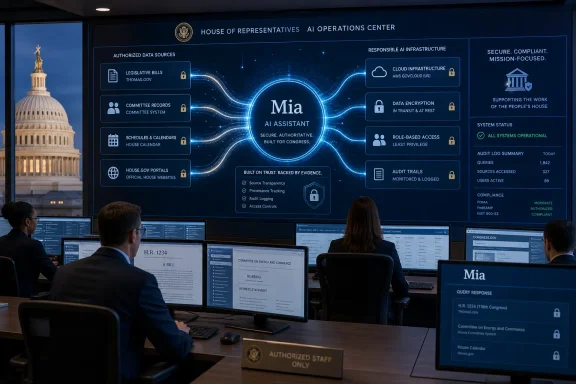 Congress Wants AI Access Without Losing Authoritative Records
The modernization drive follows a House hearing on legislative-data access, where members and staff described a growing gap between authoritative data systems and the way staffers and constituents expect to search, analyze and follow legislation.
House Clerk staff recommended a data-first approach built around user research, consistent navigation and phased delivery rather than a one-time rebuild. With more than 600 public sites under House.gov, the plan also calls for a clearer public front door that can direct users to the correct authoritative source without requiring them to understand the House’s internal structure.
That is the crucial distinction for any AI layer over legislative information. A tool that summarizes bills or tracks floor action must preserve provenance: users need to know which version of a bill, committee action, calendar entry or Congressional Research Service document informed an answer. Otherwise, a fast interface risks becoming a new source of ambiguity.
Bot Traffic Is Already Stress-Testing Congress.gov
The Library of Congress is facing the external side of the same problem. According to testimony covered by Federal News Network, Congress.gov received 16 million visitors driven by AI bot traffic in April, then 22 million visits in a single day in mid-June.
The traffic surge affected site performance and led the Library to add a human-verification check. The measure reportedly blocked about 98% of incoming requests on one day, but Library officials do not want to shut out AI access permanently. Instead, they are seeking $2.4 million to move the Congress.gov web application to the cloud.
That creates a practical warning for public-sector web teams: AI-driven consumption is not simply ordinary search traffic at a larger scale. It can impose sustained automated demand on services designed around human browsing, while also raising questions about rate limits, structured APIs, caching, bot verification and equitable access to public data.
The Funding Decision Will Define the Real Project
Mia remains a funding request, and the proposal must clear the House Appropriations Legislative Branch Subcommittee and the full House Appropriations Committee through the Modernization Initiatives Account. PRISM, by contrast, has secured funding, according to Bice’s office.
The next test is whether the House treats Mia as a standalone assistant or as part of a governed data platform. The former can produce quick demonstrations. The latter is harder—but it is what determines whether an AI answer about legislation is merely convenient or dependable enough for congressional work.
