
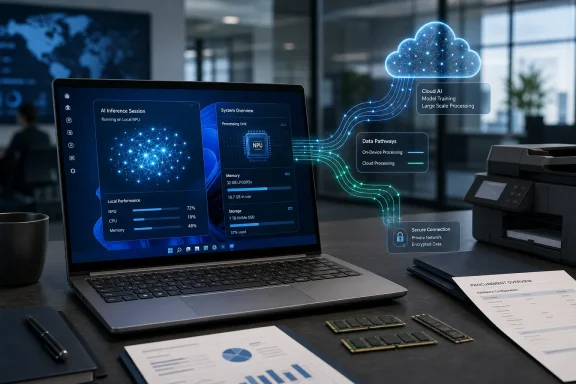
The more useful reading is that HP’s product mix is changing quickly as manufacturers use neural processing units, higher-spec memory configurations, and premium Windows hardware to position the PC as a place for inference: running a trained model locally rather than sending every request to a remote service. For Windows administrators and developers, the practical shift is significant. It can reduce latency, allow some applications to function offline, and keep selected inputs on the endpoint. It does not remove the need to decide which models, data, updates, and controls belong on the device.
HP’s May 27 earnings results confirm the 44% shipment-mix number and make clear why the company is leaning into it. Personal Systems revenue rose 13% year over year to $10.2 billion during the quarter, while total unit shipments fell 7%. Higher-priced systems, repricing, and mix—not a broad increase in PC volumes—did much of the financial work.
That distinction is missing from the simpler “AI PC demand is surging” story. HP is selling a larger proportion of AI-capable machines, but the company has not publicly disclosed how many users are regularly using local AI features, how many enterprise buyers deploy approved on-device models, or how much of the mix reflects a Windows 11 refresh rather than a deliberate edge-AI strategy.
 HP’s 44% measure is a shipment mix, not an edge-AI adoption rate
The metric comes from HP’s own fiscal second-quarter reporting, and was corroborated in coverage by CRN and UC Today. It measures the share of HP’s compute shipments that the company categorizes as AI PCs during a three-month period ending April 30, 2026. It does not measure the installed base, active use of an NPU, or the number of workloads moved from cloud infrastructure to endpoints.
That is more than semantic hair-splitting. A company can buy thousands of NPU-equipped Windows notebooks because the systems are the available refresh configuration, satisfy a tender requirement, or deliver better battery life, webcam effects, and security features. Those devices may never run a custom local language model. Conversely, older PCs with suitable GPUs can still run many local models through CPU or GPU acceleration without meeting the marketing definition of an AI PC.
HP is projecting that AI PCs will make up 60% to 70% of its shipments in fiscal 2027 and more than 70% by fiscal 2028. Those are vendor forecasts, rather than market-wide deployment data, but they indicate where the supply pipeline is going. The effect for IT buyers is straightforward: the choice may soon be less about whether to buy an AI PC and more about whether to pay for hardware capabilities that the organization has not yet decided to use.
Surjoodeen’s argument to ITWeb TV—that African organizations have particular reasons to favor local processing because of connectivity costs, availability, latency, security, and data sovereignty—is credible as an architecture consideration. But it still needs to be tested workload by workload. A locally generated meeting summary, transcription, OCR result, or semantic search query has very different compute, governance, and audit requirements from an agent that needs current enterprise data and access to multiple business systems.
Windows has the pieces for local inference, but deployment remains the missing layer
Microsoft’s Windows AI documentation now describes a more concrete local-AI stack than the broad “AI PC” label suggests. Windows ML can run ONNX models on CPU, GPU, or NPU hardware, while Windows AI APIs and Microsoft Foundry on Windows provide routes for applications to use built-in or downloadable models locally. Microsoft also documents local language-model options, including hardware-specific acceleration and offline inference once a model has been downloaded.
That is the development platform story. It gives software makers a way to target varied endpoint hardware without hard-coding an application to one NPU vendor. For enterprise teams, it also means a local-AI project does not have to be confined to the narrow class of Copilot+ PCs. Hardware performance, supported APIs, and model size will differ substantially, but Windows ML can dispatch supported workloads to the available CPU, GPU, or NPU.
The operational story is more demanding. Moving inference to the edge means that model files may have to be downloaded, cached, versioned, updated, and removed across a fleet. A local model can avoid sending its prompts to a cloud inference endpoint, but that does not automatically make the surrounding application private. Telemetry, retrieval data, document sources, plug-ins, agent actions, logging, and cloud fallback paths need their own review.
Administrators should also avoid treating the NPU as a universal accelerator. Whether a task runs efficiently on an NPU depends on the model, the runtime, the available execution provider, memory capacity, and the application’s implementation. Some current Windows AI features require Copilot+ hardware; others can use a GPU or CPU. Developers should perform capability detection, provide a fallback path, and measure quality and latency on the systems they actually support rather than rely on a TOPS number from a procurement sheet.
The component squeeze may shape the PCs buyers are offered
Surjoodeen told ITWeb TV that HP has diversified its supply chain and can shift among sourcing options to preserve product availability. HP’s corporate earnings call supports the broader point that the company is actively managing component pressure: executives said memory and storage costs increased sequentially in the quarter and were expected to rise further through the second half of fiscal 2026.
CRN reported that HP’s response includes repricing, product reconfiguration, qualifying lower-cost components, managing existing inventory, and emphasizing higher-margin systems. These are ordinary manufacturer countermeasures, but they change the purchasing environment for business customers. A device’s published configuration may remain familiar while available RAM, SSD, display, processor, or delivery options shift under pressure from component costs and supply planning.
The submitted report goes further, tying the global AI boom to shortages and disrupted availability on South African shelves. HP’s public financial materials do confirm increasing memory and storage costs and discuss potential supply constraints, but they do not quantify a South Africa-specific shortage, name models affected locally, or identify the availability impact for channel partners. That local claim currently rests on the ITWeb TV interview; no independent public reporting found in this review establishes its scale.
For procurement teams, that means taking the supply-chain message as a warning to validate, not as proof of a crisis. Ask resellers which configurations are physically allocated, whether quoted pricing has an expiry period, what substitutions may be made, and whether a replacement SKU still meets image, driver, encryption, docking, and warranty requirements. A nominally equivalent laptop is not necessarily equivalent once it hits an Autopilot deployment, a Windows 11 hardware baseline, or a standardized peripheral estate.
Print’s role in “the edge” is mostly a strategic definition
The ITWeb TV discussion also folds HP’s print business into the edge-computing narrative, even as print revenue faces a structurally difficult market. HP reported Printing revenue of $4.2 billion for the quarter, flat year over year, while total print hardware units declined 7%. Consumer Printing revenue fell 10%; Commercial Printing was flat.
Calling printers part of the edge is technically defensible. A networked multifunction device is an endpoint that can capture, process, route, and protect documents close to where they originate. But it should not obscure HP’s financial reality: print is not the growth engine represented by the company’s AI PC and advanced-compute ambitions.
For IT departments, the relevant connection is security and workflow control rather than generative AI branding. Print fleets already sit at a sensitive intersection of identity, document retention, scanning, cloud storage, firmware management, and network segmentation. If vendors attach more AI-assisted document processing to those devices, organizations will need to establish where documents are analyzed, how data is retained, what model or service processes it, and whether the result can be audited.
Buy the capability only with a workload behind it
The strongest case for edge AI is specific: short, repetitive, latency-sensitive or privacy-sensitive inference tasks that can run well on the hardware already being deployed. Examples include local transcription, image or document classification, OCR, semantic search over approved local content, accessibility features, and small language models that do not need fresh internet-scale knowledge.
The weakest case is buying a fleet solely because it carries an AI PC badge. HP’s 44% shipment figure shows that those badges are becoming a normal part of the commercial PC market, particularly during the Windows 11 replacement cycle. It does not show that endpoint AI has displaced cloud AI, settled the economics of agentic workloads, or solved enterprise governance.
Organizations renewing Windows hardware should treat the NPU as a capability to inventory and test. The immediate consequence of HP’s rising AI-PC mix is that more of that hardware will arrive by default; the strategic decision is whether IT has a secure, supportable local workload ready for it.