
Notebookcheck tested HP’s 16-ap1931nr model with 32 GB of DDR5 memory, a 1 TB SSD, a 2560×1600 240 Hz IPS screen and a 115 W GeForce RTX 5070 Laptop GPU. Its most useful finding is not the Valorant branding. The 9955HX3D makes this an unusually CPU-heavy mainstream machine, posting 36,580 points in Cinebench R23 multi-core—well ahead of the prior Omen 16 Notebookcheck compared with its Ryzen 9 8940HX.
For competitive games that pursue very high frame rates, that is a meaningful upgrade. For Windows users considering it as an all-purpose premium gaming notebook, however, the review reinforces a more complicated buying case: HP has put a desktop-class CPU ambition into a chassis that still carries several of the old Omen 16’s compromises.
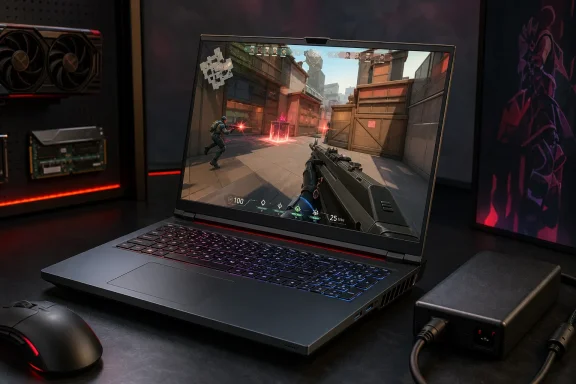 The 9955HX3D is the part that changes the equation
Notebookcheck’s numbers broadly support the central claim that the Ryzen 9 9955HX3D is the unusual component here. In Cinebench R23 multi-core, the tested HyperX OMEN 16 reached 36,580 points, compared with 27,145 points for the earlier HP Omen 16 configuration in its comparison chart. That is roughly a 35 percent uplift in a sustained CPU rendering test, although the two laptops do not share identical hardware or power profiles.
It also puts the machine close to several laptops carrying Intel’s Core Ultra 9 290HX Plus. Notebookcheck found the HP only slightly behind the Alienware 16X Aurora with that Intel processor in its broader CPU-performance rating. In other words, this is not a themed machine relying on a cosmetic surcharge to distract from an ordinary processor; its CPU is genuinely near the top of the performance stack for this class.
That is particularly relevant to Valorant. Riot’s shooter can become CPU-limited when a player is trying to feed a 240 Hz panel at very high frame rates, especially at competitive settings where GPU load is intentionally reduced. A strong CPU will also help in simulation-heavy games, compiling code, local virtual machines and some content-creation workloads. The 16-core, 32-thread processor therefore gives the OMEN 16 a broader practical role than its themed exterior suggests.
But high CPU performance does not automatically make a well-balanced gaming laptop. Notebookcheck ran its benchmarks in the OMEN Gaming Hub’s Unleashed mode with discrete graphics selected. Those are appropriate conditions for establishing maximum performance, but they also reveal the cost of extracting it from this chassis: the system consumes far more power than a portable machine should if it is expected to spend much time away from a wall outlet.
HP’s launch graphics specification does not match the shipping SKU
HP’s May 26 announcement said the Valorant Limited Edition would be available with a GeForce RTX 5070 carrying 12 GB of GDDR7 memory. The current HP and HyperX product listing for the sole U.S. configuration, SKU DD6P8UA#ABA, specifies an RTX 5070 Laptop GPU with 8 GB of GDDR7, and Notebookcheck identifies the tested 115 W GPU as an 8 GB part as well.
That is not a minor wording issue. Buyers should use the retail specification—not the launch announcement—when deciding what they are purchasing. The shipping U.S. Valorant model tested by Notebookcheck is an 8 GB RTX 5070 laptop, paired with a 1600p display.
The distinction matters most outside the game printed on the lid. Valorant does not need enormous graphics memory to run well, and the GPU should have no difficulty serving that title at the panel’s native resolution. More demanding recent games at 2560×1600, particularly with high-resolution texture settings or ray tracing, place more pressure on an 8 GB graphics-memory budget. The processor gives this notebook plenty of headroom in CPU-bound games, but it cannot compensate for a GPU constraint in graphics-bound workloads.
Tom’s Guide reached a similar practical conclusion in its separate August review. It found the RTX 5070 configuration delivered smooth results in the intended shooter, but its 1080p benchmarks in demanding games were much more modest: 44 fps in Assassin’s Creed Shadows at Ultra High, 33 fps in Black Myth: Wukong at Cinematic, and 35 fps in Cyberpunk 2077. Reducing settings improved results, but that is precisely why the CPU-and-display combination should not be read as a guarantee of native-resolution, maximum-settings performance in every AAA release.
HP has not explained the difference between its original 12 GB launch language and the 8 GB specification on the product currently offered to U.S. buyers. Until it does, shoppers should treat 8 GB as the confirmed configuration for the listed model.
The screen is a stronger asset than the omitted G-Sync badge
The display is where HP made a defensible allocation of the budget. Notebookcheck measured an average brightness of 545 nits, near-full sRGB coverage, and fast gray-to-gray transitions. It also found no PWM flickering during brightness control, a practical point for users sensitive to display flicker during long work or gaming sessions.
Those results align with Tom’s Guide, which measured 525 nits and praised the panel’s brightness and perceived smoothness. The screen is IPS rather than OLED, so it cannot deliver OLED-class contrast or black levels. Notebookcheck also measured only 73 percent DCI-P3 coverage, which makes it less compelling for color-managed video or photo work aimed at the wider P3 gamut.
There is a less obvious omission: no G-Sync support. Notebookcheck confirmed that the panel lacks both G-Sync and HDR, describing the latter as a consequence of middling black levels. Variable refresh support may still be enough for many users, but buyers expecting the full Nvidia display feature set should not infer it from the RTX badge alone.
This is a sensible display for fast competitive play, where brightness, response behavior and refresh rate carry more weight than contrast. It is less ideal for anyone cross-shopping OLED-equipped 16-inch systems for single-player games, movies or wide-gamut creative work. HP chose a panel optimized for speed and outdoor usability rather than a premium all-round visual experience.
Performance mode turns the laptop into a stationary system
The biggest limitation is mobility. Notebookcheck measured just 3 hours and 54 minutes of Wi-Fi web browsing and 1 hour and 18 minutes under load from the 83 Wh battery. Tom’s Guide recorded even shorter figures under its methodology: 2 hours and 42 minutes for web surfing and 90 minutes in its PCMark 10 gaming test.
Different test suites routinely produce different numbers, but both outlets point to the same conclusion: do not buy this as a laptop meant to sustain a workday away from AC power. It can travel, but it is not designed to be used like an ultraportable.
Notebookcheck’s power testing explains why. The system drew roughly 239 W while running Cyberpunk 2077 at 1080p Ultra and reached as high as 269 W under combined stress. Its included 280 W adapter is necessary infrastructure, not an optional accessory. The adapter itself weighs almost 1.9 pounds, while the laptop weighs about 5.4 pounds, bringing the real carrying load to well over seven pounds before a mouse, headset or other peripherals.
Noise follows the same pattern. Notebookcheck measured average gaming fan noise at 43.4 dB(A) in Balanced mode, 49.7 dB(A) in Performance mode and 54.7 dB(A) in Unleashed mode. It reported that fan noise could spike during ordinary browsing or streaming in the more aggressive profiles. Tom’s Guide likewise called the machine surprisingly loud and flagged the hot power brick.
The operational advice is straightforward: use Balanced mode for everyday Windows work, streaming and lighter games; reserve Unleashed mode for plugged-in sessions where maximum CPU performance matters; and expect to use a headset when gaming at the machine’s louder presets. That is not a failure of the cooling system—the notebook maintained strong CPU results—but it is a quality-of-life cost that belongs in the purchase decision.
The chassis remains practical, not newly engineered
Notebookcheck describes the 2026 HyperX OMEN 16 as a modest evolution of the 2025 Omen 16 rather than a clean-sheet redesign. The port placement and basic chassis remain familiar, while the revised keyboard adds larger arrow keys and a cleaner layout. The machine retains a useful serviceability advantage: two SODIMM slots and two M.2 SSD slots, allowing memory and storage expansion rather than locking owners into the shipped capacity.
That makes the laptop more attractive to Windows gamers who expect to maintain it for years. The 1 TB SSD is adequate at purchase, but modern game installations can erase that margin quickly; a second M.2 slot is materially more valuable than a themed finish once the library grows.
There are still small corners cut. The keyboard uses zone-based RGB lighting rather than per-key RGB, despite HP’s competitive-gaming positioning, and Notebookcheck calls the dark finish a fingerprint magnet. Those are not decisive issues, but they clarify the product’s priorities: the money went toward CPU performance, a bright 240 Hz display and expansion capability, rather than premium input hardware or a more elaborate lighting system.
HP launched the model at $3,049.99 in May. Its current HyperX store listing shows it at $2,249.99, an $800 reduction, and Notebookcheck used the same $2,250 street price in its review. That lower price is the one that makes the configuration more coherent. At the original figure, the 8 GB RTX 5070, short battery life and older chassis design were difficult to overlook; at $2,249, the unusually fast Ryzen 9 9955HX3D, bright 1600p panel and upgradeable internals carry more weight.
The HyperX OMEN 16 Valorant Edition is therefore best understood as a high-performance, mostly stationary Windows gaming system with a portable form factor—not a premium all-round laptop made better merely by a themed skin. Buyers who prioritize high-refresh esports play and CPU-heavy work should take it seriously, but they should buy the confirmed 8 GB configuration on its current price and measured behavior, not HP’s more generous launch-era specification.