

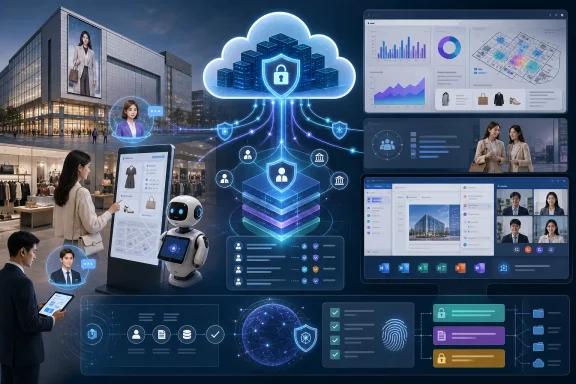
The immediate practical significance is the security work. Hyundai FutureNet is planning to place AI agents and Microsoft 365 tools closer to the group’s internal knowledge, marketing, data and retail operations; doing that safely depends far more on identity, permissions and data classification than on the underlying model selected. Microsoft’s own documentation warns that Copilot respects existing Microsoft 365 permissions, meaning it can amplify long-standing oversharing problems rather than correct them.
Cho Won-woo is also known publicly as Willy Cho, a naming detail that has caused some confusion in English-language Microsoft material. The Korea Times reported his appointment as Microsoft Korea CEO in 2023, while Microsoft’s own 2024 and 2026 Korean AI coverage refers to him as Willy Cho. They are the same executive, not evidence of a leadership change tied to this deal.
This is an expansion of an existing Azure AI footprint
The new agreement is being presented as an AI transformation partnership, but Hyundai FutureNet is not starting from a blank slate. Microsoft said in December 2024 that Hyundai FutureNet, the Hyundai Department Store Group’s ICT subsidiary, had already implemented a retrieval-augmented generation, or RAG, solution along with marketing and data-analytics systems built on Azure OpenAI Service.
That prior deployment changes how to read the MOU. The deal is less a first experiment with generative AI and more a move to formalize and broaden an existing Microsoft-based program across a retail group with multiple internal data sources, customer-facing channels and operating companies. A RAG system retrieves relevant internal information at query time before a model generates an answer; that makes it useful for retail data that changes frequently, such as store hours, pop-up events, inventory-adjacent information, product data and campaign material.
Hyundai Department Store has already supplied a visible consumer-facing example. Its AI shopping assistant, HEYDI, initially served foreign visitors and used store-specific information to recommend stores, restaurants, pop-ups and shopping routes. Hyundai Department Store’s own announcement said the service averaged 9,000 monthly uses during its first three months for foreign customers, roughly 2.5% of foreign purchasing customers.
Microsoft later said HEYDI had surpassed 80,000 monthly AI-curation interactions, up from 9,000 at launch, and gave the service a customer-satisfaction score of 4.51. Those larger figures come from Microsoft’s March 2026 customer-case material and have not been independently audited, but Hyundai’s direct account of HEYDI’s launch and early adoption confirms that the group already has a production retail AI service rather than merely a proof of concept.
The next phase described by Technology Record points toward purpose-built agents for retail. The announcement does not identify any initial agents, deployment dates, business units, model choices, transaction authority or whether agents will be customer-facing, employee-facing, or both. That omission matters. An assistant that finds a product or prepares a store associate’s briefing has a much narrower risk profile than an agent that can update customer records, issue offers, modify merchandising data or make supply-chain decisions.
Governance will determine whether Copilot is useful or risky
The MOU’s most consequential commitment may be the proposed AI security and governance framework. Retail groups collect and process a complicated mix of employee documents, customer data, vendor information, promotions, pricing, store operations and, in some cases, purchase history and location signals. Hyundai Department Store has said it intends to enrich HEYDI with online and offline purchase history, cart data and location information to improve personalisation, raising the stakes for access control and data-retention decisions.
Microsoft 365 Copilot works within a user’s existing access permissions. In plain terms, it should not grant a user access to a file they are prohibited from opening; however, if a SharePoint site, Teams channel or document library has been over-permissioned for years, Copilot can make those materials easier to discover and summarize. Microsoft explicitly identifies overshared or poorly governed content as a risk that can affect Copilot results.
For Hyundai FutureNet, the practical sequence should therefore run in the opposite direction from a flashy agent launch: inventory the data, reduce stale access, classify sensitive material, decide which sources agents may retrieve, log use, test for prompt injection and establish approval boundaries for actions. The agreement says the partners will establish a framework for safe AI use, but it does not disclose whether the group will use Microsoft Purview sensitivity labels, data-loss-prevention policies, access reviews, tenant restrictions, agent inventories or a dedicated internal review board.
Those implementation details are where the security claim will either become credible or remain branding. Microsoft now offers a Copilot security dashboard for data protection, compliance and oversharing, as well as a broader Security Dashboard for AI that can surface agents and applications across Copilot, Microsoft Foundry and some third-party services. The latter is still in public preview, according to Microsoft’s current documentation, so a large enterprise should avoid treating a unified dashboard as a substitute for mature controls and operational review.
The fact that Hyundai FutureNet has put governance alongside adoption is encouraging, particularly compared with employee-led AI rollouts that begin with broad access and discover data problems afterward. Yet an MOU is a statement of intent, not a completed technical control. Neither Hyundai FutureNet nor Microsoft Korea has publicly specified a timetable, investment amount, number of Microsoft 365 seats, governance milestones, data-residency arrangement or metrics by which the program will be judged.
Retail agents need reliable operational data, not generic chat
The retail-AI portion of the agreement is stronger on ambition than on product definition. Hyundai FutureNet and Microsoft Korea say their specialist teams will jointly develop “next-generation” agents for retail, but the announcement does not say whether those tools will operate through Copilot Studio, Microsoft Foundry, custom Azure services, or a combination of platforms.
That distinction will matter to IT administrators. A conversational assistant grounded in approved store and catalog data can improve discovery and reduce routine enquiries. An agentic system that takes multi-step actions across internal systems requires a different discipline: scoped credentials, approvals for consequential tasks, audit trails, retrieval-source testing, error handling and a way to stop or roll back actions when data is stale or a model produces a bad recommendation.
HEYDI illustrates why retail agents can have value without receiving broad operational authority. Hyundai’s description of the service emphasizes contextual recommendations based on real-time operational information: a shopper can ask about a specific store, restaurant, exhibition, pop-up or gift, and receive an itinerary or recommendation relevant to that location. Its integration with Hyundai’s online commerce operation also demonstrates an important commercial boundary: guidance can lead toward a purchase without the AI itself becoming the final system of record for price, stock or payment.
The partnership may eventually extend that same pattern internally. Store associates could search current promotions and product knowledge; marketing teams could assemble campaign insights; customer-service teams could retrieve approved policies; planners could query operational data. Those are plausible uses, but they remain inferences from the companies’ existing Azure AI work and the limited description of the MOU, not announced products.
Microsoft gains a reference customer for Korea’s retail-agent push
For Microsoft, the agreement is strategically useful because Hyundai Department Store Group can show a chain from Azure OpenAI experimentation to a branded customer service, then to Microsoft 365 adoption and enterprise agents. Microsoft has spent 2026 pushing what it calls “frontier transformation” in Korea, with its latest enterprise messaging focused on scaling agents, employee productivity and governance rather than isolated generative-AI pilots.
The Hyundai FutureNet deal also expands Microsoft’s role from cloud provider to implementation and governance partner. That can give the group a more consistent platform across customer experience, internal productivity and AI development, but it also concentrates substantial operational AI work around Microsoft’s Azure, Microsoft 365 and Foundry stack. The MOU does not say whether Hyundai FutureNet will preserve model portability, multi-cloud options or independent controls for non-Microsoft tools.
For Windows and Microsoft 365 administrators, the useful signal is concrete: an enterprise Copilot expansion should be treated as an information-governance project first and a deployment project second. Hyundai FutureNet’s public plan acknowledges that sequence, but its value will be measured by the controls it implements before retail agents receive access to sensitive group data.
The first milestone worth watching is not another partnership announcement. It is whether Hyundai FutureNet publishes the initial retail-agent use cases, the boundaries on what those agents can access or do, and evidence that its governance framework has been applied across the Microsoft 365 rollout rather than drafted alongside it.