

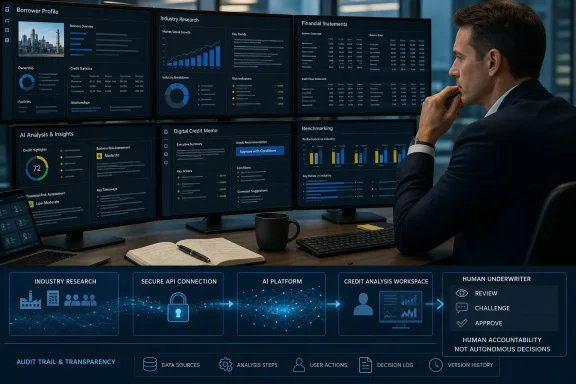
The important change is not that IBISWorld data can now be accessed electronically. IBISWorld already sells API-based access to structured industry reports and says commercial banks use those feeds in credit-risk and CRM systems. This partnership moves the research from a reference system into an AI agent’s working context, where it can influence the narrative a lender sees during underwriting. That is a workflow integration, not evidence that credit decisions have become autonomous.
Neither company says Lama AI will make final approval decisions, set pricing, or replace a bank’s credit policy. Lama AI’s own platform materials describe its credit assistant as generating explainable, policy-aligned narratives for underwriters, while its document and financial-analysis features turn borrower material into structured data. IBISWorld’s role appears to be supplying external industry signals—the market conditions, ratios, operating trends, segment mix, major players, and risks that an analyst would otherwise retrieve and interpret manually.
For lenders, the promise is straightforward: less time hunting through reports and more consistent industry context across deals. For IT, risk, and credit-governance teams, the real question is narrower and more consequential: whether the resulting AI-generated explanation preserves the source, date, classification, and reasoning well enough for a human underwriter and an auditor to challenge it.
IBISWorld data becomes an underwriting input
According to IBISWorld, its standard industry reports combine analyst-written research with government databases, industry-specific sources, industry contacts, and proprietary statistics. Its public documentation also makes clear that some granular figures are estimated where timely underlying data is incomplete. For example, IBISWorld describes using Census growth rates, major-company trends, and other assumptions to estimate some product-level or industry data.
That does not make the information unsuitable for commercial lending. Industry benchmarking has long been part of credit work, particularly for small and midsize businesses whose financial performance has to be assessed against peers rather than only against public-market comparables. IBISWorld also sells segment benchmarking that splits industries by employee count, a distinction that can be more useful to a community-bank lender assessing a 15-person contractor than a broad industry average covering national firms.
But it changes the character of an AI-generated credit memo. A memo may now combine borrower financial statements, bank-proprietary data, policy rules, and IBISWorld’s outside research into one recommendation or narrative. Each of those sources has a different update cycle, quality profile, and applicability to the borrower. A restaurant operator may be classified under one primary industry while deriving a meaningful share of revenue from catering, wholesale products, or real estate holdings; a one-click industry match is not the same thing as an analyst establishing the borrower’s actual risk drivers.
IBISWorld’s announcement says Lama AI will surface relationships between borrower-specific information and broader industry trends that a credit team may not otherwise identify. That may help find overlooked issues, such as margin pressure in a borrower’s sector or a mismatch between the company’s performance and size-specific peer benchmarks. It also means an underwriter needs to be able to see which relationship was inferred, which source data supported it, and whether the borrower’s facts actually fit the industry model.
The announcement leaves the control details unanswered
The companies do not identify a launch date beyond the announcement, name a bank already using the integration, disclose the price, or say whether existing IBISWorld and Lama AI customers receive the capability under their current contracts. No other outlet had reported those implementation details at publication time.
More materially, the announcement does not say which IBISWorld fields Lama AI receives, whether a lender can restrict the AI to approved report sections, or whether the platform displays the originating report and publication date alongside a generated conclusion. It does not explain how Lama AI handles revisions to an IBISWorld outlook after a loan package has been drafted, or whether historical snapshots are retained with the loan file.
Those are not cosmetic product questions. They determine whether a bank can reconstruct why an AI-assisted credit memorandum said, for example, that an industry was contracting, that a borrower’s margin was below peers, or that a particular business condition represented a material risk. A lender that cannot trace those statements back to a dated source and a specific borrower fact has gained speed while making review and audit harder.
Lama AI says it has more than 100 pre-built integrations and a REST-based architecture. That should make the IBISWorld connection technically plausible without a wholesale replacement of a lender’s core system or existing loan-origination stack. Yet an API connection alone does not settle data-governance questions: banks will still need to determine what borrower information is sent into the AI workflow, whether it is retained, who can access it, and how the integration behaves when source data is unavailable or classified ambiguously.
For Windows administrators and enterprise IT teams, this looks like a cloud application integration rather than a desktop deployment. The announcement names no Windows client, on-premises component, Active Directory design, or endpoint requirement. The practical work will be identity integration, role-based access, API credential management, logging, retention, vendor-risk review, and ensuring that generated artifacts land in the lender’s system of record rather than a disconnected AI workspace.
Faster credit memos still require a human challenge process
Lama AI’s marketing says its platform can turn a borrower package into a decision-ready credit memo in minutes and describes its AI as “context-aware and explainable.” That is a useful design goal, but it is not the same as independently demonstrated accuracy. IBISWorld and Lama AI have not published validation results for this integration, such as error rates in industry classification, false-positive risk flags, underwriting-cycle reductions, or comparisons between AI-assisted and conventional credit outcomes.
The partnership announcement also claims the integration can improve the “accuracy” and “consistency” of credit decisions. That claim should be read as a vendor objective, not an established outcome. A research feed can make an underwriting process more consistent if the institution defines which benchmarks matter and how they should be used; it can make results less consistent if the AI selects different facts or interpretations from one similar loan to the next without an enforceable policy layer.
The Federal Reserve, OCC, and FDIC replaced the long-standing SR 11-7 model-risk guidance with revised interagency guidance in April 2026. The new guidance emphasizes risk-based model governance tailored to an institution’s size, complexity, model inventory, and model usage; the Federal Reserve says it is expected to be most relevant to organizations with more than $30 billion in assets under its supervision. Even where the guidance is not directly aimed at a smaller lender, its core discipline is familiar: document the model’s purpose, establish controls, validate performance, and subject outputs to effective challenge.
A bank adopting the IBISWorld-Lama AI integration should therefore treat the AI’s industry summary as an input to underwriting, not as a self-authenticating conclusion. The credit-policy owner should decide whether the tool may recommend a risk grade, merely identify issues for review, or draft narrative only. Compliance and model-risk teams should define when a generated memo must show its supporting source material, and credit administration should test whether similarly situated borrowers receive comparable analysis.
Explainability is the product requirement that matters most
Commercial lending does not escape explainability simply because the borrower is a business. The Consumer Financial Protection Bureau’s ECOA resources make clear that the statute protects both individuals and businesses seeking credit, and Regulation B includes notice requirements for adverse actions. The precise obligations and timing can vary with the type and size of business-credit request, but a lender still needs a defensible account of the reason for an unfavorable action.
The CFPB has repeatedly warned that creditors cannot rely on complex algorithms if those systems prevent them from providing specific and accurate adverse-action reasons. The present partnership does not say Lama AI is deciding credit or issuing adverse-action notices. Still, when an AI-generated industry assessment becomes part of the rationale for declining an application, reducing a requested amount, demanding more collateral, or changing terms, the bank must be able to distinguish the actual principal reason from a convenient but vague description such as “industry risk.”
That makes provenance the central test for this product. A well-run implementation should let an underwriter open the underlying IBISWorld datum, see its publication or refresh date, understand whether it was analyst-verified or estimated, and record why it did—or did not—affect the credit decision. The system should also preserve the version of the analysis used when the decision was made, rather than silently substituting a later revision.
IBISWorld and Lama AI have announced a potentially useful way to reduce a stubborn manual task in commercial underwriting. They have not yet shown the operational evidence that it improves credit decisions, nor have they disclosed the controls banks will need to rely on it in examinations and disputes. Until those details emerge, the sensible deployment is AI-assisted industry research with human accountability, backed by source-level audit trails and policy controls that keep recommendations separate from decisions.