
That is a direct answer to the concern raised after the layoffs, but it is not a detailed recovery plan. Stratton also told Windows Central that MachineGames will remain committed to id Tech and that the two Bethesda studios will collaborate more closely on their shared “tech stack.” Microsoft has not published staffing numbers, an id Tech development roadmap, or the specific organizational structure behind that collaboration.
For PC players and administrators watching Microsoft’s gaming retrenchment, the important change is the public commitment itself: id Tech remains an active internal platform rather than an engine Microsoft is quietly winding down in favor of a third-party standard. The unresolved question is whether the remaining teams have enough time, engineering depth, and production support to sustain that decision through another large game cycle.
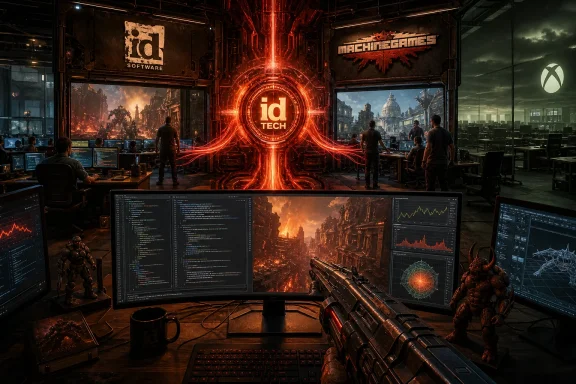 The Unreal rumor had a technical basis
The speculation was never simply about Unreal Engine’s popularity. It followed reports that id Software had lost a substantial portion of its staff, including people tied to engine development, after Microsoft’s latest Xbox restructuring. Windows Central previously reported that roughly half of id Software’s workforce had been affected, while Microsoft told the publication that reports claiming only one id Tech developer remained in Texas were inaccurate and that dozens of people worked on the technology across multiple locations.
Those two points can both be true: a team can retain dozens of contributors while still losing people with specialized knowledge that is difficult to replace. Modern engines are not interchangeable rendering packages. They contain years of work in build systems, asset pipelines, platform abstraction, tools, memory management, graphics code, level workflows, and the game-specific systems that let artists and designers ship content without waiting for a central engineering group to unblock them.
That is why “we are not switching to Unreal” should not be read as a promise that nothing has changed. A switch would carry its own costs: rebuilding content workflows, retraining teams, replacing technology that id and MachineGames already know, and absorbing Epic’s engine upgrade cadence into projects that may already be underway. But retaining id Tech after a major reduction in force means the studios must preserve and extend their own tooling with fewer obvious margins for error.
Stratton’s message settles the narrowest issue. It does not establish how much of the former engine organization remains, which id Tech components are actively being modernized, or whether the next project will have a longer pre-production period as the new arrangement takes shape.
MachineGames is central to the plan
MachineGames is not being mentioned merely as a sibling studio offering moral support. It is the clearest practical reason id Tech can remain viable after the cuts. The Stockholm-based developer has built its recent first-person games around technology descended from or adapted from id’s engine work, and Bethesda describes DOOM: The Dark Ages as powered by the latest idTech engine. MachineGames and id Software also collaborated publicly on the new Quake episode released for the franchise’s 30th anniversary this month.
That history makes closer engine coordination more credible than a vague pledge to “share expertise.” Both teams already understand the constraints of the technology, the tooling expectations behind first-person projects, and the performance targets associated with games designed for PC and Xbox hardware. A shared development model could reduce duplicated work on core systems and give the engine more than one production team validating its changes.
It also creates a more concentrated dependency. If id Tech becomes a shared platform maintained across id Software and MachineGames, its future is no longer determined solely by the next DOOM. It is tied to the ability of two studios to agree on priorities, version branches, tools, rendering features, and release schedules. That can make the engine more resilient than a single-studio project, but it can also make technical decisions slower when both teams need something different.
The public record does not say whether MachineGames will take a larger formal role in core engine maintenance, whether id Tech will have a centralized technical leadership group, or whether other Xbox studios will use it. Stratton’s remarks support collaboration, not a broader Microsoft-wide engine strategy.
Keeping id Tech is a product decision, not nostalgia
id Tech has long been more than branding for id Software. The engine is part of the studio’s identity, but it is also tightly connected to the kind of games it makes: fast first-person combat, high frame-rate targets, extensive visual effects, and aggressive platform optimization. Bethesda’s official material for DOOM: The Dark Ages specifically identifies idTech8 as the technology behind the game’s visual fidelity and performance ambitions.
That does not mean Unreal Engine could not power a future DOOM. Many studios have successfully made technically demanding shooters in Unreal, and Unreal’s large ecosystem can make hiring, outsourcing, middleware integration, and cross-studio development easier. The decision is about trade-offs, not whether one engine is universally superior.
For id Software, however, a transition now would likely mean moving teams away from a stack they already control at the same moment they are trying to recover from layoffs. Stratton’s refusal to entertain that route suggests the studio sees proprietary technology as an asset worth protecting, even under reduced headcount. It also preserves a meaningful distinction inside Xbox, where many teams have increasingly used third-party engines.
The implication for players is less about a guaranteed frame-rate number than about continuity. Future id and MachineGames titles can continue to build on the technical assumptions behind recent releases rather than starting over with a new engine’s rendering behavior, content pipeline, and optimization model. That is valuable, but it is not the same as a guarantee that future games will match the performance or scope of DOOM Eternal, DOOM: The Dark Ages, or Indiana Jones and the Great Circle.
The real test arrives with the next unannounced game
Stratton told Windows Central that id Software will continue making its own games rather than becoming a support studio for other Xbox projects. He also acknowledged the human cost of the cuts, saying internal discussions about the future should not diminish the pain felt by departing colleagues and the people left behind.
That acknowledgment matters because the company’s engine pledge arrives after a layoff process that former id Software VFX and technical art producer Andrew Willis described to Windows Central as a short, muted Microsoft Teams meeting for roughly 95 employees. The contrast between an ambitious technical commitment and the loss of veteran staff is the central tension in this story.
id Software does not need to announce a new DOOM immediately to validate Stratton’s statement. It does need to show, over time, that id Tech is receiving sustained development rather than maintenance-only support while production carries on elsewhere. The first meaningful evidence will be a future project reveal that identifies its engine, demonstrates the studio’s technical direction, and shows that the post-layoff organization can still deliver the kind of performance-focused PC game id Software has made its reputation on.