
For Windows PC gamers, this is not merely executive-movement news. Game engines decide far more than an editor’s interface: they influence the performance profiles of PC releases, the range of hardware a studio can support, the ease of modding and tooling, the availability of platform services, and ultimately the visual and systemic ambitions that make it into a finished game. A credible new engine is a long-term bet, but the formation of Immens suggests that experienced engine architects see room for a different answer to the same pressures reshaping Unreal Engine 6, Unity, Godot, and the wider PC development ecosystem. PC Gamer
 Background: Why De Jong’s Exit Matters
De Jong announced on June 18 that his final week at Epic had passed, ending 12 years at Epic Games and a relationship with Unreal Engine stretching back 27 years. His own account describes a career that moved from modding and map-making through development work and studio experience to years spent helping studios adopt Unreal Engine at scale. Hourences
That history gives his new effort particular weight. De Jong was not a distant observer criticizing Unreal from outside the ecosystem; he was a senior director and former lead evangelist whose role involved working directly with developers, presenting at events, and helping teams solve practical production issues. Reporting on his departure also notes that he had been using Unreal since 1999, initially becoming known for level design and mod work before later joining Epic officially. Shacknews
In his June statement, De Jong described the games business as being at a “pivotal point,” saying the previous era had come to a close and that it was strategically necessary to work out how to adapt to the challenges and opportunities ahead. That language sounded broad at the time, but the Immens announcement supplies the missing context: his response is not simply to leave a major engine company, but to attempt a ground-up alternative. Hourences
The distinction matters because major engines tend to evolve through layers. They retain existing workflows, maintain compatibility for long-running projects, acquire new tools, absorb platform requirements, and add features that satisfy different markets. Those decisions protect existing customers, but they can also make an editor feel immense in the less flattering sense: powerful, mature, and burdened by decades of assumptions.
The Immens Engine Proposition: A Clean Start Rather Than Another Layer
According to De Jong, the central premise behind Immens Engine is that the market’s dominant tools have become progressively larger and accumulated more baggage over time. He argues that this growth has contributed to stagnation, and that a “clean, modern engine” built from the ground up could give developers a more adaptable foundation. PC Gamer
That does not mean Immens is being pitched as a stripped-down engine for simple games. The stated ambition is more nuanced: developers should be able to create a more bespoke toolset for their own production needs, while the engine is designed from its inception to work with external tools, services, and libraries. PC Gamer
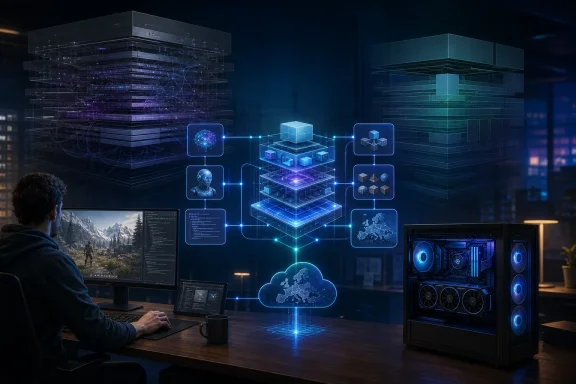
In practical terms, that could mean an engine that treats the editor less as a monolithic destination and more as a composable development platform. A studio might want a tightly integrated asset pipeline, a proprietary procedural-generation service, specialized build infrastructure, custom version-control tooling, or a domain-specific simulation library. A modern engine can support some of these ideas through plug-ins and APIs, but Immens appears intended to make that integration model foundational rather than additive.
A project name worth watching closely
There is a small but relevant naming wrinkle. PC Gamer refers to the new project as Immens Engine, while earlier reporting around Brussee’s effort called it The Immense Engine. PC Gamer Video Games Chronicle
The overlap in personnel, design philosophy, and timing strongly indicates that this is the same venture, potentially with branding still being refined. Until the founders publish official product materials, developers should be cautious about treating the exact final name, licensing model, technical specification, supported platforms, or release timeline as settled facts.
What is clear is the strategic direction. Immens is being framed as a competitor or alternative in the game-engine market, not as a plug-in layer for Unreal Engine or an AI-powered content generator pretending to be a complete engine. PC Gamer
Arjan Brussee Adds More Than a Famous Resume
The decision to build Immens with Arjan Brussee strengthens the project’s credibility. Brussee worked on Epic’s Jazz Jackrabbit games in the 1990s, co-founded Guerrilla Games, later helped establish Boss Key Productions, and returned to Epic in a global director of product management role for Unreal Engine. Video Games Chronicle
That background matters because engine development is difficult in ways that are easy to underestimate. Rendering technology is only one component. A commercially viable engine needs robust content import, asset cooking, editor usability, profiling, debugging, scripting, networking, platform abstraction, build automation, documentation, support processes, and a sustainable answer to console access and certification. It also needs to win developer trust before its technical advantages can matter.
Brussee had already publicly discussed building a European alternative to major American and Chinese engine platforms. He described an engine that would be fully European-hosted, built by Europeans, and aligned with European rules and guidelines, while potentially serving 3D simulation work in areas such as defense and logistics as well as games. Video Games Chronicle
That Europe-first dimension could become a differentiator, especially for organizations with data-residency, procurement, compliance, or sovereignty requirements. It is also a reminder that the game-engine market extends well beyond entertainment. Architecture, automotive visualization, training, industrial digital twins, defense simulation, and logistics all use real-time 3D technologies, creating a larger addressable market than PC game development alone.
However, regional hosting and compliance should not be mistaken for an automatic technical advantage. Studios choose engines for practical reasons: capability, staffing, workflow speed, documentation, support, cost, middleware compatibility, and the ability to ship. Immens will need to translate its regional and architectural philosophy into those day-to-day benefits.
AI-Friendly Is Not the Same as an “AI Engine”
The most closely watched aspect of Immens will be its approach to agentic AI. De Jong has said that the engine is designed to accommodate AI agents as one category of external tool, but he explicitly rejects the label of an “AI engine.” His description is more restrained: a proper game engine that is friendly to an AI architecture. PC Gamer
That wording is important. The present discussion around AI in game development frequently collapses several distinct ideas into one vague category:
- AI-assisted code generation and code review
- AI-controlled editor automation
- Asset tagging, search, and workflow organization
- Procedural content-generation tools
- Runtime NPC behavior and simulation
- Generative images, dialogue, audio, or 3D assets
- Autonomous agents coordinating tasks across a production pipeline
An engine can support one or several of these without handing the creative process to a machine. De Jong’s stated position is that developers still need to do the development work, and that the objective is not a button that produces disposable games at industrial scale. PC Gamer
The critique of human-first tools
De Jong’s argument is that existing engines and development tools were built around human interaction over many years, raising the question of whether they can properly serve agentic systems without deep architectural compromise. PC Gamer
Brussee has made a related case, arguing that current engines were designed for users clicking through menus with a mouse and that changes often need to be accommodated across the entire engine. He sees AI agents as an opportunity to rethink the construction of this core software, including the possibility of small teams accomplishing a substantially larger amount of work. Video Games Chronicle
The opportunity is real, but the language needs careful interpretation. An AI agent that can reliably inspect a project, make a narrow change, run tests, recognize failure states, produce a useful report, and leave a reviewable trail could reduce drudgery without replacing the people responsible for design and quality. An agent that can alter a large game project without predictable constraints is a production risk, not an efficiency breakthrough.
For Windows PC developers, the most promising AI use cases may be unglamorous ones: profiling shader compilation bottlenecks, auditing asset budgets, tracking content dependencies, reproducing crashes, preparing test cases across different GPU configurations, or automating repetitive editor work. These functions could improve the quality of PC releases if they help teams find performance problems earlier instead of masking them with late-stage settings changes.
Immens Is Emerging Alongside Unreal Engine 6, Not After It
The timing is impossible to ignore. Epic announced that Unreal Engine 6 is in development on June 17, positioning it as a convergence of Unreal Engine 5’s high-end standalone capabilities and the development pipeline Epic has built and tested through Unreal Editor for Fortnite. Epic Games
Epic’s UE6 roadmap openly embraces AI-assisted production. The company says it expects large language models, generative AI models, and tools such as Claude and Codex to play a central role in helping developers build content faster, while maintaining creative control. It also plans broad exposure of engine capabilities through the Model Context Protocol, allowing developers to connect their preferred models and build custom integrations on an open UE6 MCP foundation. Unreal Engine
This means Immens is not entering a market in which the incumbent has ignored agentic workflows. Quite the opposite: Epic is actively committing Unreal Engine 6 to model-assisted authoring, custom integration, and tool exposure. UE6 is also designed around a broader interoperability vision in which content and code can be portable across games and engines through standards, open specifications, APIs, and shared conventions. Unreal Engine
The real disagreement is architectural
The disagreement is therefore less about whether AI should assist game development and more about how deeply the engine should be designed around it. Unreal Engine 6 is evolving one of the industry’s most established engines, carrying forward a massive ecosystem of projects, developers, Blueprints, assets, knowledge, and platform relationships. Epic says it intends to provide a manageable migration path, keeping Actors and Blueprints in early UE6 versions before eventually deprecating them when the new framework matures. Unreal Engine
Immens, by contrast, has the freedom—and the risk—of starting with no legacy user base to protect. It can make more radical assumptions about automation, interfaces, APIs, data models, and external services. It also lacks the immediate advantages of Unreal’s maturity, including years of content-pipeline development, extensive documentation, a large labor pool, and broad production validation.
That is the classic start-up-versus-incumbent trade-off. The established platform can be heavy because it supports so much. The new platform can be elegant because it supports less—at least initially. The challenge for Immens will be retaining the benefits of a clean design as it gains the features studios need to ship real games.
What a New Engine Could Mean for Windows PC Gaming
Windows remains the practical proving ground for new game-development technology. It offers a broad hardware spectrum, different graphics APIs and driver behaviors, a large modding culture, and a demanding player base that notices shader stutter, poor CPU scaling, memory instability, weak ultrawide support, inconsistent frame pacing, and limited graphics controls.
A new engine cannot solve every PC optimization problem automatically. Performance is the result of design decisions, content budgets, rendering paths, asset streaming, QA resources, deadlines, and developer expertise. Yet an engine’s defaults and profiling tools can make good practices easier—or leave teams to discover costly problems after core systems are entrenched.
If Immens succeeds at its stated goal of enabling bespoke pipelines, it could appeal to studios that feel constrained by the assumptions built into larger engines. That might be especially relevant for:
- Small teams that want more control without building an engine from scratch
- Mid-sized studios with specialized pipelines or distinctive simulation needs
- PC-first developers that prioritize flexible graphics and systems design
- Non-game organizations building interactive 3D training or visualization tools
- European institutions that value local hosting and compliance alignment
The prospect is appealing, but adoption will not happen because an engine is philosophically attractive. Studios will ask harder questions: Can it build and debug reliably? Can it ship on Windows without friction? Does it support the necessary graphics features? Does it work with audio, physics, analytics, accessibility, anti-cheat, input, localization, and storefront systems? Can a team hire developers who already know it?
Those questions are not a dismissal of Immens. They are the operational reality that separates an intriguing engine architecture from a platform capable of sustaining commercial production.
The Strengths of the Immens Strategy
Immens begins with several notable advantages, even before a public build or feature list exists.
Founders who understand production constraints
De Jong and Brussee are not entering the field as general AI entrepreneurs trying to apply automation to games from a distance. Their experience across Unreal Engine, Epic Games, studio development, tools, and production should help them identify pain points that are invisible in a feature checklist. PC Gamer Video Games Chronicle
A more specific AI vision than “generate a game”
The project’s framing is comparatively measured. Immens is not being described as a system that replaces developers or turns prompt writing into instant commercial games. Instead, it is presented as an engine that can allow AI architecture and human development to work together. PC Gamer
That position could resonate with developers skeptical of AI hype but interested in automating repetitive technical work. It is a more credible proposition than treating generative output as a substitute for design direction, optimization, authored content, testing, or player trust.
A potential opening for better interoperability
A modern engine that is intentionally built around external tools, libraries, and services could reduce lock-in if its implementation matches the rhetoric. Studios increasingly rely on a mixed environment of source control, cloud services, build systems, asset tools, analytics, automated testing, and proprietary internal software. A platform that makes those components easier to connect could provide value even before it matches Unreal’s most advanced rendering features.
Europe as a concrete market position
The Europe-first message is not just branding. For customers whose procurement, hosting, and regulatory needs favor European infrastructure, a locally rooted engine platform may offer a more comfortable governance model than tools controlled elsewhere. Video Games Chronicle
The Risks: Engine Development Is a Marathon, Not a Feature Pitch
The largest risk is straightforward: building a general-purpose game engine is extraordinarily expensive and slow. A small, talented founding team can establish a compelling architecture, but an engine becomes viable through years of iteration under real projects and thousands of edge cases.
Every capability has consequences. A renderer must be performant and debuggable. An asset system must scale. A scripting model must remain understandable. The editor must stay responsive. Build tools must behave predictably. Documentation must cover both the happy path and the inevitable failures. On Windows alone, a serious engine needs to behave consistently across a vast range of CPUs, GPUs, drivers, display configurations, and user environments.
There is also a network-effect problem. Unreal and Unity do not dominate only because of their code. They benefit from trained developers, community answers, tutorials, plug-ins, marketplace assets, recruiters, consultants, middleware support, university programs, and teams that have already shipped with them. Godot has built momentum partly through a strong open-source community, but even it faces difficult gaps around broad commercial tooling and platform support.
Immens will need a clear answer to licensing and ecosystem development. No public pricing model, source-access policy, marketplace plan, or console-support strategy has been outlined in the reporting so far. Those omissions are normal for an early-stage engine, but they are precisely the details studios will require before betting a multi-year production on it.
AI can amplify both productivity and mistakes
The AI angle creates a second major risk. Agentic systems can accelerate tedious workflows, but they can also accelerate flawed decisions, create opaque changes, introduce licensing or provenance concerns around generated material, and make teams overconfident in output they have not thoroughly validated.
A robust AI-friendly engine will need more than model access. It will need permission boundaries, auditable logs, reproducible builds, testable actions, rollback mechanisms, clear ownership of generated changes, and tools that keep human review in control. In games, a fast incorrect change can be more damaging than a slow manual one when it contaminates content, breaks save compatibility, or causes platform-specific failures late in development.
The founding team’s insistence that developers will still have to develop is therefore one of Immens’ healthiest messages. Automation should expand the capacity for iteration and craftsmanship, not become an excuse for unattended production.
The Bottom Line
Immens Engine is still an early project, and it would be premature to judge it by engine benchmarks, visual demos, licensing, or shipping support that have not yet been publicly detailed. But the project is significant before those milestones arrive because it captures a real divide in game development: whether the next generation of tools should be built by extending today’s enormous platforms or by starting again with AI agents, interoperability, and tailored workflows embedded in the architecture.
Epic is pursuing the former path with Unreal Engine 6, combining UE5 and Fortnite-era tooling while exposing broader engine capabilities to AI systems and pursuing more open interoperability. Unreal Engine De Jong and Brussee are pursuing the latter, attempting to create a cleaner alternative that avoids carrying forward the baggage they believe has accumulated around the market leaders. PC Gamer
For the Windows PC gaming community, the immediate outcome is not a new engine to download or a new performance standard to test. It is a challenge to the idea that the engine market has already settled. If Immens can pair its founders’ experience with disciplined execution, transparent tooling, and a genuine commitment to human-led development, it could become more than an Unreal Engine critique—it could become a meaningful new option for the studios building the next generation of PC games.
