
That distinction is more than semantic for Windows handheld buyers. Intel’s official Arc G3 product database still lists two products only: the 14-core Arc G3 and the 14-core Arc G3 Extreme. Intel introduced those Windows 11 handheld chips in May with 2 Performance-cores, 8 Efficient-cores, and 4 Low Power Efficient-cores, while differentiating the models primarily through their Xe3 graphics configurations: 10 Xe3 cores for Arc G3 and 12 for Arc G3 Extreme.
The leaked part, if it materializes in a handheld, would be a very different machine. Four Performance-cores, no standard Efficient-cores, four LP E-cores, and four Xe3 cores would make it an eight-core CPU paired with a GPU containing 60% fewer Xe3 cores than the regular Arc G3 and roughly two-thirds fewer than the G3 Extreme. That is a plausible configuration within Intel’s wider Panther Lake family, but it is not yet proof of a budget Arc-branded handheld processor.
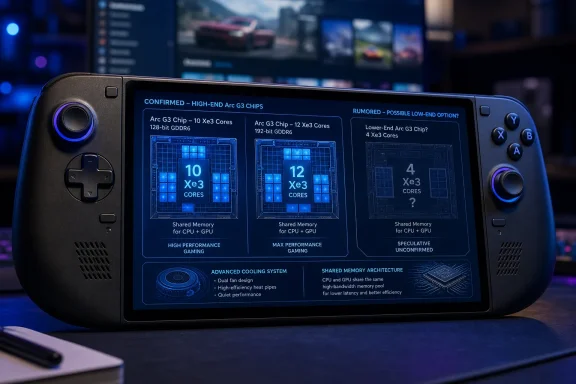 The leak describes a configuration, not an Arc G3 SKU
The source chain here is unusually thin. Jaykihn posted only the core layout, without an accompanying slide, product identifier, benchmark result, device listing, or claimed launch window. eTeknix supplies the “cheaper Arc G3” framing, while PC Gamer reads the same core string as a potential budget handheld chip. Those are reasonable interpretations, but interpretations are not confirmation.
Intel’s public record points the other way for now. Its Arc G3 series page identifies the Arc G3 and Arc G3 Extreme as Q2 2026 products, both with 14 total CPU cores. Its original announcement likewise said the family was launching with those two processors and directed buyers to OEMs for actual system availability.
There is no third model on that product page as of August 18, 2026. Intel has also not published a price for either chip—handheld processors are normally sold to device makers rather than as retail parts—so calling the alleged model “cheaper” gets ahead of the evidence twice: once on whether it will ship, and again on whether any savings would reach buyers.
A low-end design could be less expensive for an OEM to build around, especially if it uses less active graphics hardware and lower-cost cooling or memory configurations. But a handheld’s final price is driven by the display, storage, RAM capacity, battery, controls, Windows licensing, distribution, and vendor margin as much as its processor. The history of premium-priced handheld PCs is a warning against treating a cut-down silicon configuration as a promise of Steam Deck-class pricing.
Four Xe3 cores would change the target workload
The important number in the report is not the extra pair of Performance-cores; it is the four-Xe3-core integrated GPU. Intel built Arc G3 around a graphics-heavy design because current PC games in a small handheld are usually constrained by GPU throughput and shared memory bandwidth before they run out of CPU threads.
The established Arc G3 uses 10 Xe3 cores, while the Extreme version has 12. Moving to four does not imply a clean 60% or 67% drop in frame rate—clock speeds, memory bandwidth, thermal limits, game engine behavior, and driver maturity all matter—but it does set a sharply lower graphics ceiling. There is no basis yet to present this as a direct competitor to the Arc G3 Extreme, AMD’s higher-end Ryzen Z chips, or the premium Windows handhelds built around them.
A four-Xe3 handheld would make more sense at 720p or similarly modest render resolutions, with low-to-medium presets, aggressive upscaling, and games that are already well suited to portable hardware. It could also serve players whose libraries lean toward indies, older PC games, emulation, streaming from a desktop or console, and less demanding multiplayer titles. Those uses are legitimate, but they are a different proposition from running recent AAA releases locally at the high settings shown in marketing for top-tier handhelds.
Intel’s XeSS 3 software stack could help such a device, but it cannot erase the hardware gap. XeSS Super Resolution renders at a lower internal resolution before upscaling; Multi-Frame Generation can improve displayed smoothness in supported games; and Xe Low Latency is intended to address responsiveness. Each feature depends on game support and settings, and frame generation is not a substitute for enough base performance and consistent frame times. Buyers should be particularly wary if a future device markets an interpolated frame-rate number without stating the native render mode and the underlying frame rate.
The CPU layout is unusual for Intel’s current handheld strategy
The reported 4+0+4+4 layout means four P-cores, zero conventional E-cores, four LP E-cores, and four Xe3 GPU cores. By contrast, the existing Arc G3 family’s 2+8+4 CPU arrangement puts fewer large cores beside a much larger pool of standard E-cores and LP E-cores.
That change could be useful for workloads that favor strong foreground CPU performance: Windows desktop responsiveness, some older games, emulators, browser-heavy use, installation tasks, and games with uneven thread scheduling. Four P-cores would also avoid the simplistic assumption that this is merely a heavily disabled version of the standard G3.
But handheld gaming is a power-constrained task, not a desktop benchmark. More P-cores do not automatically make a better handheld chip if the device lacks the GPU resources to render modern games at the desired settings, or if the power budget forces the CPU and GPU to compete. The alleged four-Xe3 part may be designed around a different power envelope, a different manufacturing tile, or a product category that is not a conventional performance gaming handheld at all. None of that has been disclosed.
The central unanswered technical details are substantial:
- Intel has not confirmed whether the reported configuration belongs to the Arc G3 brand, a standard Core Ultra mobile processor, or an unreleased derivative.
- No clock speeds, package power range, memory type, memory bandwidth, cache configuration, NPU specification, display outputs, or connectivity details have surfaced for a handheld implementation.
- No OEM has announced a system using the alleged part, so there is no evidence on screen resolution, battery size, cooling, RAM capacity, storage, controls, or Windows software tuning.
- No benchmarks exist for this precise configuration in a handheld chassis, which makes every performance estimate provisional.
The Windows handheld angle is affordability, not raw specifications
Intel’s existing Arc G3 pitch is explicitly tied to Windows 11 handhelds, including Thunderbolt 4 docking, Wi-Fi 7, Bluetooth 6, XeSS 3, ray tracing support, and shader-related optimizations. That is an ambitious platform feature set, but it has also so far appeared in systems positioned above the truly mass-market end of the handheld market.
A credible lower-cost Intel platform could matter because Windows handheld buyers have long faced a blunt choice: buy an older discounted system, accept a lower-powered chip, or spend far more for current-generation performance. The alleged processor could give manufacturers an option between phone-like streaming devices and expensive flagship handheld PCs—provided they build devices around realistic display targets and competitive pricing.
For Windows users, the practical value would depend less on whether Intel calls the chip Arc G3 and more on whether the device maker gets the basics right. A 7- or 8-inch 720p display, 16GB or more of fast shared memory, sensible thermal controls, a reliable sleep-and-resume experience, proper controller integration, and regular Intel graphics driver support would do more for the experience than an inflated specification sheet.
Until Intel or an OEM provides those details, the alleged four-Xe3 design should be treated as a possible product configuration rather than an impending budget Arc G3 launch. The only confirmed Arc G3 choices remain the 10-Xe3 Arc G3 and the 12-Xe3 Arc G3 Extreme; anyone shopping for a Windows handheld today should make a purchase decision on those shipping products and their actual prices, not on a leaked core count.
