

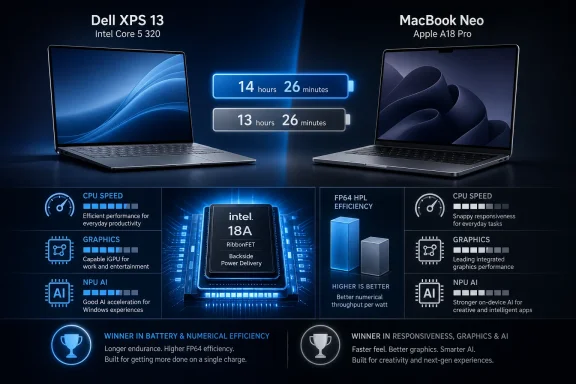
The benchmark result deserves attention because it is specific, repeatable in principle, and points to genuine progress in Intel’s low-power silicon. But the “first x86 win over Apple” framing depends entirely on what is being measured: double-precision floating-point throughput under a sustained, power-limited Linpack load. It does not establish that the Core 5 320 is more efficient than the A18 Pro in GPU work, on-device AI, single-thread responsiveness, or general application performance.
The useful conclusion is narrower and more consequential: Intel 18A has produced a $699 x86 laptop platform that can compete with Apple on sustained numerical CPU efficiency and battery endurance. That is a real change from the position Intel occupied only a few generations ago. It does not erase the areas where Apple’s A18 Pro platform still has a substantial lead.
HPL measures a real workload, but a specialized one
TechTimes reported that Geerling’s Dell XPS 13, equipped with Intel’s Core 5 320 “Wildcat Lake” processor and Fedora 44, delivered 127.91 GFLOPS at 20.6 watts in HPL, or 6.21 GFLOPS per watt. The MacBook Neo’s A18 Pro reportedly produced 57.012 GFLOPS at 10.6 watts, or 5.38 GFLOPS per watt. On those figures, Intel leads by about 15.4%.
HPL, or High Performance Linpack, solves dense systems of linear equations using double-precision floating-point math. Its FP64-based metric is familiar in high-performance computing; the Green500 ranking uses comparable performance-per-watt thinking to assess supercomputers. A chip that does more Linpack work for every watt is doing something objectively valuable, particularly for engineering, scientific, and server-style numerical workloads.
But HPL has a narrow view of a laptop. It heavily exercises CPU floating-point hardware and memory behavior under a sustained all-core load. It does not measure the GPU, media engines, NPU, display subsystem, SSD, browser rendering path, application launch latency, or operating-system scheduling behavior that collectively determine how a portable computer feels and how long it lasts in an office bag.
The raw figures make the distinction clear. Intel’s system drew nearly twice as much power during the HPL run—20.6 watts versus 10.6 watts—but delivered more than twice the reported FP64 output. That produces the superior ratio. It is a credible accomplishment, especially for a low-cost Intel mobile part, but it is not evidence that every watt consumed by a Core 5 320 laptop is more productive in ordinary work.
There is another reporting limitation. The claim that this is the first x86 processor to surpass the A18 Pro, or the first x86 entry in Geerling’s top ten efficiency ranking, rests on Geerling’s own results list and methodology rather than an industry-wide, independently audited database. The test establishes the result for these two tested systems and configurations; it cannot settle every possible x86-versus-Apple comparison.
Tom’s Guide found the result Windows buyers can use
Tom’s Guide’s July 25 review provides the more useful consumer comparison. Using its continuous Wi-Fi web-surfing test with screens set to 150 nits, the outlet measured 14 hours and 26 minutes for the 2026 Dell XPS 13 and 13 hours and 26 minutes for Apple’s MacBook Neo.
That is a full-hour win for the Windows laptop in a repeatable light-load test that resembles the work many budget-laptop buyers actually perform: browser use, web apps, documents, email, streaming, and video calls. It is also independent of Intel’s own marketing material.
The result should still be read as a comparison of laptops, not processors in isolation. Battery capacity, panel type and refresh behavior, firmware, memory configuration, operating system, wireless hardware, and background tasks matter. The Dell has a 13.4-inch 2.5K touchscreen, while the MacBook Neo is a distinct platform with different hardware and macOS. Tom’s Guide controlled brightness and workload, which makes the comparison useful, but no battery test can perfectly isolate the chip.
Even so, this is where Intel’s architecture appears to have landed a practical hit. Intel lists the Core 5 320 as a six-core, six-thread processor with two performance cores and four low-power efficiency cores, a 15W processor base power rating, a 35W maximum turbo rating, and Intel 18A manufacturing. The four low-power cores are built for the lightly threaded tasks that dominate a web-browsing battery test. A machine that can keep its larger CPU cores asleep longer will look far better in everyday endurance than one judged only by a stress test.
For Windows users, the change is material. The XPS 13 is no longer asking buyers to accept short battery life as the price of native Windows software, x86 compatibility, a touchscreen, and a user-replaceable 2230 NVMe SSD.
Intel 18A is the story behind the result, with an important caveat
Intel’s product record confirms that the Core 5 320 is an Intel 18A part. That makes Wildcat Lake an important proof point for the company because it places Intel’s newest process technology in a mass-market mobile processor rather than a costly flagship chip.
Intel says 18A combines RibbonFET gate-all-around transistors with PowerVia backside power delivery. RibbonFET gives the transistor gate more control over current in the channel than earlier FinFET designs, while PowerVia moves much of the power-routing infrastructure to the reverse side of the wafer. The objective is cleaner routing, better voltage behavior, and lower-power operation at a given performance target.
Intel claims that 18A can offer up to 18% higher performance at the same power or 38% lower power at the same performance compared with Intel 3. Those are Intel’s process-level claims, not a direct guarantee for every Wildcat Lake laptop. The HPL result and Tom’s Guide battery measurement do provide independent signs that the underlying efficiency improvement is reaching retail hardware, but they do not validate every percentage in Intel’s presentation.
The more immediate takeaway is that Intel has finally put leading-edge process technology behind a low-end Core-branded laptop part. The Core 5 320 is not positioned as a Core Ultra flagship. It carries two Xe3 graphics cores, a 16-TOPS NPU, up to 64GB memory support, and PCIe 4.0 connectivity. Its 8GB XPS 13 configuration remains a budget machine with clear limits, but the chip is no longer built on a process disadvantage so obvious that battery life is decided before the benchmark starts.
Apple still leads where the Core 5 320 has too little hardware
Tom’s Guide found the MacBook Neo ahead in CPU responsiveness and graphics. The A18 Pro system scored 3,535 in Geekbench 6 single-core testing against 2,684 for the XPS 13, a 32% lead when calculated from the published scores. In multi-core testing, Apple’s 8,920 also topped Dell’s 7,952. HandBrake video transcoding favored the Neo by 41 seconds, at 9 minutes 57 seconds versus 10 minutes 38 seconds.
Those figures undercut the idea that Intel has broadly “matched” Apple. For a person opening applications, loading complex web pages, compiling a modest project, or performing short bursts of work, the single-core result is far more relevant than HPL. Apple’s lead here is visible in ordinary responsiveness.
Graphics remains an even clearer disadvantage for the Core 5 320. Tom’s Guide recorded 2,455 points and 14 fps for the XPS 13 in 3DMark Wild Life Extreme, compared with 3,661 and 21 fps for the MacBook Neo. The Dell managed 8.7 fps in the publication’s 1080p Borderlands 3 test; the MacBook scored 9.6 fps. Neither is a serious gaming machine, but the result confirms that Intel’s two-core integrated Xe3 graphics setup is designed for display output, media, basic creative tasks, and light acceleration—not graphics-heavy workloads.
The NPU gap has a direct Windows consequence. Intel rates the Core 5 320’s NPU 5 at 16 TOPS. Microsoft defines a Copilot+ PC as a Windows 11 system with an NPU capable of more than 40 TOPS, and the program also expects at least 16GB of memory. The $699, 8GB Core 5 320 XPS 13 therefore misses the standard twice over.
This XPS 13 is a Windows laptop with an NPU, not a Copilot+ PC. It can use applications that support Intel’s NPU through OpenVINO, Windows ML, ONNX Runtime, DirectML, or WebNN, but it is not eligible for the Windows features Microsoft reserves for the Copilot+ class, including Recall, Click to Do, certain Live Captions capabilities, and other NPU-dependent experiences.
Apple’s reported 35-TOPS Neural Engine rating is not a Copilot+ qualification figure—macOS is not part of that Windows program—but it does illustrate the scale of Intel’s dedicated-AI deficit in this specific product tier. NPU TOPS are not universally comparable across vendors or models, yet 16 TOPS leaves little room to argue that the Core 5 320 was designed around local AI processing.
The buying decision is clearer than the benchmark headline
The Dell XPS 13’s wins are concrete. Tom’s Guide found substantially faster SSD performance, with 3,714 MB/s writes and 5,026 MB/s reads, against 1,440 MB/s and 1,585 MB/s for the MacBook Neo. The Dell also weighs 2.2 pounds and starts at the same $699 price point. For buyers who need Windows, want a touchscreen, prefer a 120Hz panel, value faster local storage, or want the strongest measured battery life among these two machines, it is an unusually credible budget option.
The MacBook Neo remains the stronger pick for GPU-accelerated work, single-threaded speed, and Apple’s software stack. It also avoids the awkward position of a new Windows laptop arriving with only 8GB of RAM while Microsoft’s premier local-AI category begins at 16GB.
Intel’s HPL win is therefore best understood as evidence of a manufacturing and architecture turnaround, not an all-purpose crown. The Core 5 320 shows that Intel 18A can make x86 competitive on sustained FP64 efficiency and help a Windows laptop beat Apple’s entry MacBook in a controlled battery test. It does not give this particular Core 5 platform enough graphics or NPU hardware to challenge Apple across the workloads increasingly used to sell new laptops.