
 Overview: What Makes a CPU Historically Great?
Modern flagship processors can complete work in seconds that would have overwhelmed a desktop from a decade ago. That is not, by itself, what makes them historically important. A truly great CPU changes the market around it, either by delivering a new level of performance, making premium performance attainable, or forcing a rival to respond.
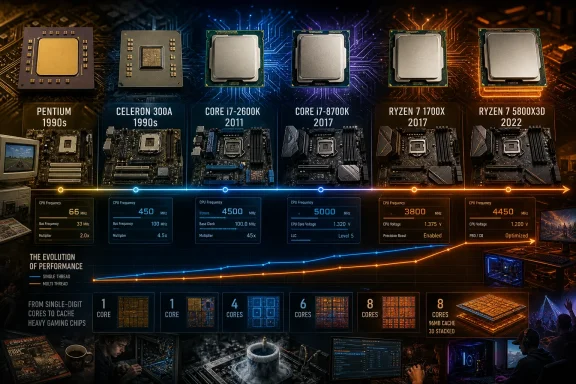
The six selections below span more than three decades of consumer computing. They include a low-cost overclocking phenomenon, two processors that reshaped Intel–AMD competition, the chip that made Pentium a household word, and a cache-heavy gaming processor whose relevance has outlived the platform it was designed to extend.
A useful way to judge the list is through five questions:
- Did the processor deliver a major performance gain for its generation?
- Did it offer exceptional performance per dollar?
- Did it influence competitors’ product plans?
- Did it remain useful well beyond its release window?
- Did it give PC builders a meaningful technical or economic advantage?
Measured against those criteria, the ranking is less about nostalgia than it may first appear. It is a history of desktop CPUs repeatedly proving that the most important product is not always the most expensive one.
6. Intel Celeron 300A: The Overclocker’s Value Revolution
The Intel Celeron 300A earns its place because it turned a budget processor into an enthusiast legend. Released in the late 1990s, the Mendocino-based chip became famous for a simple but transformative reason: many units could run at 450MHz after raising the front-side bus from 66MHz to 100MHz.
That represented a remarkable 50% frequency increase at a time when overclocking was far more involved than enabling a BIOS preset. Users needed compatible motherboards, sufficient cooling, and a willingness to take responsibility for settings that were outside Intel’s specifications. But the possible payoff was extraordinary.
The Celeron 300A contained 128KB of L2 cache directly on the CPU die, operating at full processor speed. Intel’s contemporary Pentium II chips carried more L2 cache, but their cache was external to the core package and ran at a fraction of the CPU frequency. Contemporary technical coverage noted that the Celeron’s integrated cache made it highly competitive with Pentium II systems at the same clock rate despite its smaller capacity. Tom’s Hardware documented the 128KB full-speed on-die cache and the common 450MHz result.
Why the Celeron 300A mattered
The key innovation was not that Intel intentionally built a bargain gaming champion. It was that enthusiasts discovered an unusually favorable combination of silicon headroom, a locked multiplier, and motherboard-level front-side-bus control.
At 450MHz, the Celeron 300A could approach or surpass far more costly Pentium II configurations in many games and consumer applications. That changed the standard for value-oriented DIY PC builds. It showed that a buyer willing to understand the platform could obtain near-premium performance without buying a premium-branded CPU.
Its legacy is still recognizable in modern PC culture:
- It made overclocking a central part of enthusiast purchasing decisions.
- It strengthened the importance of motherboard quality and BIOS flexibility.
- It demonstrated that cache design can matter as much as headline clock speed.
- It gave budget builders a memorable victory over artificial product segmentation.
The caveat: it was a product of its era
The 300A’s magic was never universal. Not every chip overclocked equally well, and the process involved a real stability risk. A successful 450MHz configuration did not guarantee long-term reliability, especially in systems using marginal cooling, weak power supplies, or low-quality motherboards.
That limitation actually reinforces its historical standing. The Celeron 300A was not great because it was effortless; it was great because it rewarded knowledge. Few CPUs have so clearly embodied the classic enthusiast proposition: spend less, tune carefully, and outperform expectations.
5. AMD Ryzen 7 1700X: The Eight-Core Mainstream Reset
The AMD Ryzen 7 1700X was one of the most consequential desktop processors of the 2010s because it restored genuine competition to a market that had become comfortable with quad-core mainstream flagships.
Before Ryzen, AMD’s FX-era processors struggled to match Intel’s per-core performance. The company’s Bulldozer-family designs used a resource-sharing approach that complicated the meaning of their advertised core counts, particularly in lightly threaded applications. Intel, meanwhile, was able to command premium prices for mainstream Core i7 models with four cores and eight threads.
AMD’s first-generation Zen architecture changed the direction of that story. The Ryzen 7 1700X arrived in 2017 with eight physical cores and 16 threads, a 3.4GHz base clock, a 3.8GHz boost clock, and a $399 launch price. Contemporary specifications list the 8-core, 16-thread configuration and $399 launch price.
More cores became a mainstream expectation
The 1700X was not always the fastest gaming CPU of its day. Intel still held an advantage in single-threaded performance, and that advantage could be visible in high-refresh-rate gaming. But Ryzen’s impact did not depend on winning every frame-rate chart.
Instead, AMD gave mainstream buyers a credible route to workstation-like multithreaded capability. The Ryzen 7 family challenged Intel’s much more expensive high-core-count products in workloads such as rendering, video production, compression, and software development. Tom’s Hardware described the Ryzen 7 launch as a push to bring 8-core/16-thread processors to dramatically lower price points.
For Windows users running several demanding applications at once, the difference was substantial. A system could encode video, compile code, run virtual machines, and keep the desktop responsive without requiring an expensive enthusiast or workstation platform.
The market response was the real proof
The 1700X mattered because Intel’s product strategy changed quickly after Ryzen’s arrival. The industry moved from treating four cores as the default enthusiast ceiling to treating six, eight, and eventually more cores as expected in performance desktops.
That does not mean the 1700X single-handedly created the modern multi-core PC. Software trends, gaming engines, content creation tools, and the rise of streaming all played a role. However, the processor was a highly visible demonstration that mainstream users would benefit from—and pay for—more real cores and more threads.
The 1700X also aged well. Software has become steadily better at exploiting parallel processing, so the chip’s 16 threads remained useful longer than many contemporary four-core parts. Its gaming performance has naturally fallen behind newer architectures, but its historical importance has only strengthened.
The risk of romanticizing first-generation Ryzen
Early Ryzen systems were not flawless. Memory tuning could be sensitive, BIOS maturity varied across boards, and gaming performance in some titles lagged Intel’s strongest options. Buyers in 2017 had to weigh an unusually strong value proposition against the normal growing pains of a major platform relaunch.
Those flaws should not be erased. They are part of why the 1700X is such an important CPU: it was not merely a polished incremental upgrade, but the beginning of AMD’s return to relevance in high-performance desktop computing.
4. Intel Core i7-8700K: Intel’s Necessary Six-Core Leap
The Intel Core i7-8700K was Intel’s clearest early answer to Ryzen. Released as part of the 8th-generation Coffee Lake lineup, it marked the moment Intel significantly increased core counts in its mainstream desktop range after years of relatively modest generational changes.
The i7-8700K offered six cores and 12 threads, a 3.7GHz base frequency, a boost clock reaching 4.7GHz, 12MB of L3 cache, and a 95W processor base power rating. Contemporary testing listed the processor at $359 and emphasized its 4.7GHz peak turbo frequency. TechSpot’s launch review details the six-core, 12-thread configuration, clocks, cache, and pricing.
A much-needed generational change
Its predecessor, the Core i7-7700K, had four cores and eight threads. The move to six cores and 12 threads was therefore more than a frequency adjustment; it was a redefinition of what Intel believed a mainstream enthusiast CPU needed to be.
The 8700K preserved Intel’s strengths in gaming: high clock speeds, strong per-core performance, and a mature platform ecosystem. But it also narrowed AMD’s multi-threading advantage considerably. For buyers who wanted a computer that excelled in games while also handling editing, streaming, and general productivity, the chip became a compelling all-rounder.
Ars Technica’s Coffee Lake review characterized the 8700K as a major gaming performer and noted its six cores, 12 threads, and 4.7GHz boost clock. In practical terms, it was a CPU that could keep up with the changing expectations of late-2010s PC gaming without sacrificing desktop responsiveness.
The enthusiast appeal of the “K”
The “K” suffix was important. Intel sold the Core i7-8700K with an unlocked multiplier, allowing users to overclock it when paired with appropriate cooling and a compatible motherboard.
This was not a Celeron 300A-style surprise bargain. The 8700K was a premium consumer processor and carried a correspondingly premium price. Yet it still appealed to enthusiasts because it offered enough headroom and enough core count to remain relevant for years.
That longevity is visible in the second-hand market and in aging gaming PCs still using Coffee Lake systems. A six-core, 12-thread processor remains workable for many Windows workloads, though it no longer belongs in a new high-end build.
The platform trade-off
The 8700K’s biggest weakness was its ecosystem cost. Coffee Lake required Intel’s 300-series motherboards, limiting easy upgrades for owners of earlier LGA 1151 systems. Contemporary coverage noted that Coffee Lake’s platform was not compatible with prior Skylake and Kaby Lake boards.
That is a significant contrast with AMD’s long-lived AM4 approach. Even so, the 8700K deserves recognition because it proved Ryzen had changed the competitive baseline. Intel had to increase mainstream core counts, and consumers benefited immediately.
3. The Original Intel Pentium: The CPU That Defined the Consumer PC
The original Intel Pentium, introduced in 1993, belongs on any serious list of historically important CPUs because it helped define what a powerful consumer PC could be.
Pentium was Intel’s fifth-generation x86 processor and the first Intel CPU branded with a word instead of a number. Intel’s own historical timeline identifies the March 1993 launch and explains that Pentium became the company’s first processor family named with a word.
The brand decision had an enormous cultural effect. “Pentium” became shorthand for a capable personal computer in the same way that “PC” itself had once represented a category rather than a particular product. It was a technical platform, a marketing success, and a symbol of the 1990s computing boom.
Superscalar execution arrives in the mainstream
Architecturally, the Pentium was a major advance over the i486. Its superscalar design could execute more than one instruction per clock cycle under the right conditions, improving throughput without relying solely on higher clock rates.
The processor also used a 64-bit external data bus, separate instruction and data caches, improved floating-point performance, and other changes that collectively made it far more capable for demanding desktop applications. Intel’s original Pentium documentation describes its optimized superscalar architecture and 64-bit data bus.
Those technical gains arrived at the right time. Graphical interfaces were becoming more demanding, multimedia software was expanding, and 3D games were pushing desktop hardware well beyond the expectations of the late 1980s.
Pentium made performance visible
The original Pentium helped move PC performance from an abstract technical concern to something ordinary buyers could feel. Applications loaded more quickly. Windows interfaces became more responsive. Games became richer, faster, and more ambitious.
Intel says the original Pentium contained 3.1 million transistors and was substantially more powerful than the i486 that preceded it. Intel’s historical account describes the Pentium as five times more powerful than the i486 and notes its 3.1 million-transistor design. Such comparisons should always be treated as period-specific vendor framing rather than a modern benchmark result, but they capture the scale of the generational jump.
Its legacy was larger than the chip
The Pentium line was not without controversy. The most famous issue was the early floating-point division bug, which became a landmark case in consumer technology accountability. That episode matters because it demonstrated that mainstream buyers were now paying attention to processor behavior, not just PC brands.
Still, the original Pentium remains historically essential. It transformed Intel’s processor naming, accelerated the mainstream PC’s capabilities, and created a brand that endured across generations long after the original P5 architecture had disappeared.
2. AMD Ryzen 7 5800X3D: The Cache-Driven Gaming Classic
The AMD Ryzen 7 5800X3D is unusual in this ranking because its story is still developing. Released in 2022, it was already a standout gaming processor; its enduring importance became even clearer when AMD brought it back as a 10th Anniversary Edition for the AM4 platform.
The original chip paired eight Zen 3 cores and 16 threads with an enormous 96MB of L3 cache, enabled by AMD’s 3D V-Cache packaging technology. AMD’s product page confirms the Ryzen 7 5800X3D and its 96MB L3 cache configuration.
Why 3D V-Cache changed gaming discussions
Cache capacity is not as intuitive to consumers as core counts or clock speeds, but the 5800X3D made its value visible in game benchmarks. By placing more data close to the CPU cores, the chip could reduce the need for slower trips through the broader memory hierarchy in workloads that benefited from it.
The result was not a universal victory in every application. The 5800X3D was built primarily for gaming, and workloads that scale aggressively with core count or frequency could favor alternative chips. But in titles responsive to large cache capacity, it delivered exceptional results and often challenged much newer processors.
Tom’s Hardware’s original review described the 5800X3D as a gaming leader powered by 96MB of L3 cache and 3D-stacked SRAM. That was a major shift in the consumer CPU conversation: a processor could improve gaming performance not by adding more cores, but by changing the memory subsystem around those cores.
AM4 longevity made it more valuable
The 5800X3D became especially important because it offered an unusually attractive upgrade path for owners of AM4 PCs. Instead of replacing a motherboard, memory kit, CPU, and potentially other components, many users could update their BIOS and install a significantly faster gaming processor in an existing DDR4 system.
That is why its later return carries more significance than a conventional re-release. AMD’s 10th Anniversary Edition arrived at $349, included a Carbice Ice Pad, and targeted users who wanted to extend AM4 systems rather than move to a DDR5-based platform. PCWorld reported the $349 re-release, its AM4 anniversary framing, and the included thermal pad.
For Windows gamers, that matters. CPU upgrades are often judged only by benchmark charts, but platform preservation has real value. Keeping a capable motherboard and memory kit can reduce both the cost and complexity of improving a PC.
A great upgrade is not automatically a great new build
The 5800X3D remains a special CPU, but it needs to be evaluated correctly in 2026. It is most compelling as an AM4 upgrade, not necessarily as the foundation for a brand-new system. A buyer starting from nothing should compare the total platform cost of older DDR4 hardware against current alternatives, including newer AMD and Intel platforms.
There is also a risk in treating cache-heavy gaming performance as a universal measure of CPU quality. The 5800X3D was remarkable precisely because it had a clear specialty. It is a gaming classic, not a universal workstation champion.
1. Intel Core i7-2600K: The Enduring Sandy Bridge Standard
At the top of the list sits the Intel Core i7-2600K, a processor that became synonymous with longevity. Launched in early 2011 as part of Intel’s Sandy Bridge generation, it combined strong per-core performance, Hyper-Threading, sensible power characteristics, and accessible overclocking in a way that kept it relevant for an unusually long time.
Intel lists the i7-2600K as a four-core processor with eight threads, 8MB of cache, a 3.4GHz base frequency, a maximum 3.8GHz turbo frequency, and a 95W rating. Intel’s Sandy Bridge product archive confirms those core, frequency, cache, and power specifications.
Performance that lasted
Four cores may sound modest now, but the 2600K arrived when quad-core CPUs were the mainstream enthusiast standard and many applications still struggled to use more than a handful of threads efficiently.
Its Hyper-Threading support helped it handle multi-threaded tasks more gracefully than four-thread CPUs. Its strong Sandy Bridge per-core performance also ensured that games and day-to-day Windows applications remained responsive long after launch.
The processor’s longevity was partly aided by slower progress in desktop CPU performance during the middle of the 2010s. But that explanation is incomplete. Plenty of products benefit from a quiet competitive period without becoming icons. The 2600K earned its reputation because it started from such a strong position.
Overclocking without the old fragility
The unlocked multiplier was central to the 2600K’s appeal. Enthusiasts regularly pushed the chip beyond stock frequencies with capable cooling and a suitable motherboard, and overclocking was more approachable than it had been on many earlier platforms.
Tom’s Hardware found that Sandy Bridge’s power control and Turbo Boost behavior reduced some of the guesswork and risk traditionally associated with achieving higher clock rates, while documenting an i7-2600K overclocking test using Intel’s reference cooler.
That did not make overclocking risk-free. Higher voltages still raise heat output and can shorten component life. Every stable overclock depended on the individual CPU, cooling solution, motherboard firmware, and workload. But the 2600K helped normalize the idea that meaningful extra performance could be achieved without extreme hardware.
Why it remains number one
The i7-2600K represents a rare intersection of strengths:
- Excellent launch performance for games and general computing.
- Eight threads at a time when many mainstream alternatives offered four.
- Strong overclocking potential through an unlocked multiplier.
- Long-term usefulness across several Windows generations.
- A broad enthusiast reputation built on real-world ownership rather than marketing alone.
It is no longer sensible to treat a 2011 processor as a recommended choice for a new gaming PC. Modern games, security requirements, media engines, storage standards, and operating-system expectations have moved far beyond Sandy Bridge. Yet historical rankings are not buying guides, and on historical merit, the 2600K is exceptionally difficult to beat.
The Common Thread: Value, Not Just Velocity
These six CPUs tell a more useful story than a list of record-setting benchmark results. The original Pentium made the modern consumer PC feel possible. The Celeron 300A showed that an inexpensive chip could embarrass expensive hardware. The 2600K defined longevity. Ryzen 7 1700X forced the industry to take mainstream core counts seriously. The 8700K proved Intel had to answer. And the 5800X3D showed that smart cache design and platform longevity could create a gaming CPU with staying power.
The best CPU of all time is therefore not necessarily the one with the highest clock speed, the most cores, or the largest benchmark number. It is the chip that changed what buyers could reasonably expect from a PC.
By that measure, the Intel Core i7-2600K remains the strongest overall choice in this ranking. But the larger conclusion is more important: desktop CPU history advances fastest when competition forces companies to deliver more performance, more choice, and more useful upgrade paths for ordinary PC owners.
