
VideoCardz first highlighted testing from Bilibili creator WestmereX, while Club386 independently detailed the benchmarks. The Core i9-14901KE appears to have been an embedded-market processor that Intel developed to a late stage before removing it from its product catalogue; there is no confirmed retail release or announced system using it.
At stock settings, the 8-core/16-thread CPU is configured for a 3.8GHz base clock, 5.8GHz boost clock, 36MB cache and 125W processor base power. That makes it effectively comparable to a Core i9-14900K with its 16 E-cores disabled, rather than a new architectural direction for desktop enthusiasts.
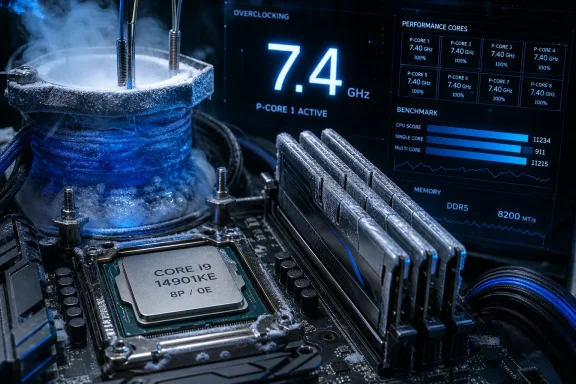 A P-Core-Only Raptor Lake With an Unlocked Multiplier
The unusual part is not merely the missing E-cores. Intel already sells several 14th-generation embedded parts with P-Core-only layouts, including the Core i9-14901E and Core i9-14901TE. The 14901KE, however, reportedly retained an unlocked multiplier, making it a conspicuous experiment in pairing embedded positioning with enthusiast-style tuning.
WestmereX’s Q49D sample ran Cinebench R23 at 5.5GHz across all eight P-cores, consuming roughly 190W at 1.225V. Raising the all-core clock to 5.8GHz pushed power consumption to about 269W, for a multi-threaded gain of less than 6 percent. That is a familiar Raptor Lake trade-off: substantially more power for increasingly modest performance returns.
7.4GHz Is a Showcase Result, Not a Practical Target
The reported 7.4GHz stable frequency required a cascade cooling setup operating around minus 100°C. The same test system completed SuperPI 1M at 6.9GHz with DDR5-8120 CL30 memory, an impressive validation result but not one relevant to air- or liquid-cooled PCs.
More importantly, VideoCardz concluded that removing E-cores did not unlock a special frequency ceiling. The engineering sample’s results were broadly in line with other sub-zero Raptor Lake overclocking demonstrations, undercutting the idea that E-cores themselves were the defining barrier to extreme clocks.
What It Means for PC Builders
For Windows PC users, this is a look at an abandoned product branch rather than a newly available upgrade option. A P-Core-only Core i9 could have appealed to niche workloads sensitive to hybrid scheduling behavior, but Windows 11’s Thread Director-aware scheduling and modern application support have made that argument less compelling than it was at the start of Intel’s hybrid-core transition.
The more durable takeaway is that Intel apparently considered an unlocked, P-Core-only 14th-generation SKU and ultimately did not bring it to market. The 14901KE sample demonstrates that the design was real; its benchmark results explain why it may not have justified a separate product line.
