

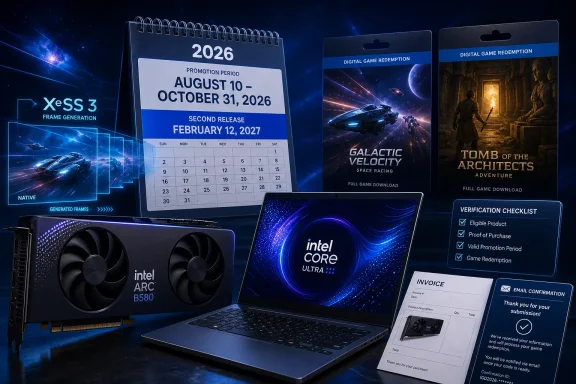
Igor’sLAB first outlined the promotion this week. Intel’s own Software Advantage terms confirm a purchase window that may run from August 10 through September 13, 2026, depending on the retailer, and place the stated average retail value of the two PC games at $119.98. The offer is only valid on qualifying SKUs from participating sellers; owning a listed Intel product, or buying it from a retailer that has not joined the campaign, is not enough.
The immediate practical point is simple: a prospective buyer should verify the exact product SKU and seller before checkout, preserve the invoice, and complete redemption by October 31, 2026. The bundle’s value is real only if both the retailer and Intel’s verification system recognize the purchase.
The calendar is the bundle’s biggest catch
STAR WARS: Galactic Racer is scheduled to launch on October 6, 2026, according to Lucasfilm’s official announcement. Tomb Raider: Legacy of Atlantis is scheduled for February 12, 2027, confirmed by the official Tomb Raider site—more than three months after Intel’s redemption deadline.
That creates a more complicated workflow than “buy card, claim game.” Intel’s terms require purchasers to redeem their offer between August 10 and October 31. For retailers using purchase verification rather than a supplied master key, the buyer must submit proof of purchase by September 30; Intel says its eligibility response can take up to 10 business days. Anyone whose claim has missing or inadequate documentation has until October 22 to correct it.
In other words, waiting until Legacy of Atlantis releases to deal with the bundle will forfeit the offer. Buyers need to activate their entitlement during the autumn redemption period, then rely on Intel’s offer system or its game-distribution partner to make the later game available at release.
There is a wrinkle worth stating plainly. Intel’s public terms repeatedly say that the software should be downloaded during the redemption period “or by the deadline indicated on-screen,” even though Legacy of Atlantis cannot be downloaded before February 2027. Intel’s campaign language establishes that the game is included, but the terms do not spell out in public-facing detail whether the Tomb Raider key is issued immediately, appears in an account later, or arrives by email closer to launch. That is not a reason to assume the game will be withheld; it is, however, a reason to save the activation confirmation and ensure the Intel account uses an email address the buyer will still control next year.
The timetable means Gamer Days is strongest for somebody already intending to buy qualifying Intel hardware and already planning to play both games. It is weaker as a reason to select otherwise inferior hardware, especially where a cheaper Arc A-series board is competing with a newer product offering more VRAM, better performance, or longer expected driver attention.
Intel is using the promotion to keep Arc A-series in the conversation
The qualifying-product list is unusually inclusive. Alongside Arc B570 and B580 graphics cards, Intel lists the Arc A580, Arc A750, and Arc A770. The CPU side reaches back to a substantial slate of Raptor Lake Refresh parts, including Core i5-14400 through Core i9-14900KS models, alongside Core Ultra Series 2 desktop and mobile chips and selected newer Series 3 mobile products.
That is a meaningful distinction from a bundle restricted to brand-new silicon. An Arc A770 buyer at a participating retailer can be eligible on the same general terms as an Arc B580 buyer, even though the two products sit in different generations. Intel is effectively using two unreleased, high-profile games to maintain retail relevance for Alchemist hardware while also promoting current Core Ultra laptops and discrete Battlemage boards.
But eligible families are not a blanket guarantee. Intel’s document says qualifying products “may include some, but not necessarily all” of the listed devices, and the exact selection can vary by seller. This matters most with prebuilt desktops, laptops, and handhelds: a system can contain a nominally eligible Core processor or Arc GPU yet still be excluded if the OEM configuration or retailer SKU was not enrolled.
The same limitation applies to the handheld portion. Intel lists Arc G3 and Arc G3 Extreme processors and identifies the MSI Claw 7 AI+ in the campaign’s qualifying material, but buyers should not infer that every handheld with an Intel chip qualifies. Check the system SKU, not the marketing family name.
Intel’s verification process can include its Hardware Scanning Tool, a proof-of-purchase upload, or both. The terms also require a phone-number-verified Intel account and a purchase survey. Those are mundane requirements, but they are exactly the sort of administrative step that turns an advertised game bundle into an expired code in a drawer.
XeSS 3 support is the more durable part of the announcement
Intel is positioning both games as launch partners for XeSS 3, the current suite comprising XeSS Super Resolution, XeSS Frame Generation with Multi-Frame Generation, and Xe Low Latency. The promise matters more to Arc owners than a generic “XeSS supported” logo because it describes an intended full implementation at launch rather than a later patch.
Intel’s developer documentation says Multi-Frame Generation can insert up to three AI-generated frames and that Xe Low Latency is a prerequisite for XeSS Frame Generation integration. The company also identifies Arc A-series and B-series discrete GPUs, plus Core Ultra systems with compatible Arc integrated graphics, as its most efficient XeSS 3 platforms.
The important qualification is that generated frames are not rendered frames. Multi-Frame Generation can make displayed motion look smoother and can raise the frame counter dramatically, but it does not make the game simulation, CPU processing, or player input occur at that same rate. Intel’s low-latency component is designed to manage the extra delay in the pipeline; it cannot erase the need for a solid native baseline.
This is especially relevant for Galactic Racer, where a fast racing game will make poor frame pacing and control lag obvious. A headline result based on 3x or 4x Multi-Frame Generation should be read alongside the base frame rate, frametime consistency, image artifacts, and input response. The feature is likely most useful when a system already has enough native performance to feel responsive before interpolation is enabled.
Intel’s documentation also separates platform support from game support. XeSS Super Resolution has a wider compatibility path, including supported non-Intel GPUs, while Intel says Multi-Frame Generation is available only on Intel devices. A game shipping with the XeSS 3 suite does not mean every setting will be exposed identically on every GPU, operating system, API, driver version, or quality preset.
There is better news for existing Arc A-series owners than the original Gamer Days announcement makes explicit. Intel’s February graphics-driver release notes expanded XeSS 3 Multi-Frame Generation support to Arc A-series discrete GPUs, Arc B-series boards, Core Ultra Series 2 Arc graphics, and Meteor Lake-based Core Ultra systems. Independent coverage from Tom’s Hardware reported that XeSS Multi-Frame Generation was designed to work through Intel’s Graphics Software in games that already support XeSS 2 Frame Generation, although the exact controls can still vary title by title.
So the technical story is not that Galactic Racer and Legacy of Atlantis will somehow unlock XeSS 3 for Arc A750 or A770 owners. The driver platform support already exists. What Intel is buying with these partnerships is two visible PC releases that should expose the feature set at launch—and, if the implementations are good, provide more useful real-world evidence than a synthetic benchmark.
Two launch dates, one unproven performance promise
Lucasfilm says Fuse Games’ STAR WARS: Galactic Racer will arrive on PC, PlayStation 5, and Xbox Series X|S on October 6. The game’s first playable PC release will therefore land close enough to Gamer Days that buyers can test their hardware purchase and claimed entitlement almost immediately.
Legacy of Atlantis is the long-tail part of the deal. Crystal Dynamics and Flying Wild Hog are making the Unreal Engine 5 reimagining of the original Tomb Raider, and the official release information confirms PC availability through Steam on February 12, 2027. PC Gamer reported published minimum requirements of a Core i5-8600 or Ryzen 5 3600, 16GB of memory, and a GTX 1070, RTX 2060 Super, or Radeon RX 5700; the recommended GPU tier climbs to an RTX 3080 or Radeon RX 6800 XT. Intel Arc is not named in that early specification, so there is no official Arc performance target to compare yet.
That absence makes the bundle a promise of software support, not a substitute for hardware due diligence. There are no public Intel performance figures for either game on Arc A770, Arc B580, Core Ultra integrated graphics, or the listed handhelds. There are also no published game-specific settings matrices establishing whether every qualifying device will receive the same XeSS 3 modes.
For Windows gamers deciding between closely matched offers, the $119.98 stated bundle value can legitimately tip the scale. For everyone else, it should be counted only after the base system has cleared the ordinary tests: price, GPU performance at the target resolution, VRAM, thermals, warranty, and whether the retailer actually supplies a valid offer path.
Buy during the seller’s qualifying window, submit the claim promptly if a master key is not included, redeem no later than October 31, and archive every confirmation email. The first game arrives October 6; the second will not arrive until February 12, 2027—and Intel’s public terms currently put the burden on the buyer to secure that entitlement long before Lara Croft’s release date.

