
As reported by Phoronix, the series was posted on August 7 and targets Meteor Lake and newer Intel display hardware. Its stated initial result is encouraging but narrow: Intel engineers report that “modes like 4K@120” work on lightly tested Panther Lake hardware, while testing across other Meteor Lake-and-later systems continues.
The important correction to the broad HDMI 2.1 framing is that this work enables FRL, the higher-bandwidth signaling method required when a display mode exceeds the older TMDS transport used by HDMI 2.0-era implementations. It does not yet complete the whole HDMI 2.1 feature set, and it does not mean every Intel laptop advertising an HDMI 2.1-capable port will suddenly gain every high-resolution or high-refresh option under Linux.
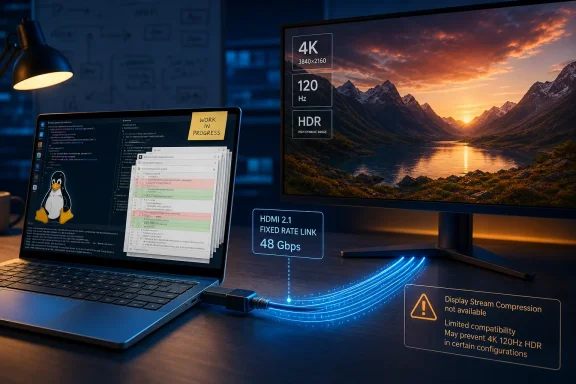 FRL Is the Missing Transport Layer for Higher-Bandwidth Modes
Legacy HDMI TMDS has a ceiling that becomes restrictive at 4K above 60Hz, especially once users add HDR, full RGB or 4:4:4 chroma, and higher color depth. HDMI 2.1’s Fixed Rate Link replaces that transport for higher-bandwidth modes, using multiple lanes rather than the older clock-plus-data arrangement.
For a Linux user connecting a Meteor Lake laptop to a 4K 120Hz television or monitor, that transport distinction is the difference between a mode appearing as a usable option and being constrained to 4K 60Hz, lower chroma, reduced bit depth, or a combination of those compromises. Games, desktop HDR, high-frame-rate video, and remote-desktop workloads can all expose those limits in different ways.
Intel’s cover letter describes this patch set as foundational work intended to establish the overall design before later additions. That language is significant. The series does not merely toggle an existing capability; it introduces and wires up the training, configuration, and hardware-control machinery needed for FRL to work reliably on Intel’s newer display engines.
There has been groundwork in the Intel Linux display stack before now. A late-2025 Linux graphics pull request, for example, included a refactoring that moved an HDMI FRL function into Intel’s HDMI code. But this new 44-patch submission is the first public series in years aimed at making native FRL usable on Meteor Lake-class hardware. The earlier 2022 effort cited by Phoronix never progressed into a finished upstream feature.
That long gap matters for anyone who assumed that native HDMI 2.1 hardware support and Linux HDMI 2.1 support were the same thing. They have not been.
Intel Has Tested Only Meteor Lake and Panther Lake So Far
The submitted scope says “Meteor Lake and newer,” but the testing statement is materially tighter. Intel says it has tested the series only on Meteor Lake and Panther Lake platforms, with Panther Lake described as lightly tested and validation on other systems still under way.
That leaves several practical unknowns:
- Intel has not published a laptop-by-laptop compatibility list for built-in HDMI ports, USB-C display output, docks, adapters, or specific television and monitor models.
- Intel has not said which display driver path users will need in deployed distributions, or whether every relevant configuration will behave the same across the legacy i915 and newer Xe driver stacks.
- Intel has not committed the series to a particular upstream kernel release.
The first point deserves particular attention. A physical HDMI connector on an Intel notebook is not enough to identify the graphics path behind it. Some systems route output through an NVIDIA discrete GPU, a USB-C-to-HDMI adapter, a DisplayPort-to-HDMI protocol converter, or a dock. Those configurations bring their own firmware, link-training, EDID, and bandwidth decisions into the picture.
That is not an abstract concern in Intel’s Linux graphics code. A separate patch series posted in June by Intel contributor Alexander Kaplan documented a real protocol-converter problem on a Panther Lake NUC connected to an LG OLED G4: Linux was training a 24 Gbps FRL link where the hardware supported 48 Gbps, and limiting 4K 60Hz RGB output to 8-bit color. The same hardware was reported to run higher-color-depth modes in Windows and macOS. Those fixes addressed a DisplayPort-to-HDMI converter path, not the native HDMI FRL enablement now under review, but they show why “HDMI 2.1 support” is not a single switch.
For Windows users who dual-boot, the immediate implication is straightforward: this patch series may eventually reduce a feature gap on the same Intel hardware, but it should not be treated as evidence that the Linux output path has reached Windows parity today.
Display Stream Compression Remains Absent
Intel explicitly lists Display Stream Compression over FRL as a known gap. DSC is a visually lossless compression method used to carry display modes that would otherwise exceed available link bandwidth. Without it, the initial FRL support cannot cover every mode users associate with HDMI 2.1.
The submission specifically calls out higher-resolution modes such as 8K as requiring DSC, which this series does not include. Even below 8K, the absence of DSC can matter for combinations of resolution, refresh rate, HDR, RGB/4:4:4 output, and 10-bit or 12-bit color. A display mode can be technically advertised by a panel or TV and still remain unavailable if the GPU, sink, cable, and Linux driver cannot negotiate a compatible uncompressed link configuration.
That limitation keeps the early success claim in proportion. “4K@120 is working” is meaningful progress, particularly given the years-long absence of native Intel FRL support in the upstream Linux path. It is not a promise of 4K 120Hz HDR at every color format on every monitor, nor a claim that 8K support is ready.
It also does not cover the wider HDMI gaming feature collection by itself. Variable Refresh Rate, Auto Low-Latency Mode, HDR behavior, audio, CEC, protocol converters, and display-specific interoperability are adjacent concerns. AMD’s separate open-source HDMI work illustrates the distinction: AMD already landed its FRL and DSC support, while its HDMI VRR and ALLM work remains under active review and, according to Phoronix, missed the Linux 7.3 feature window.
The Shared Intel Display Code Makes Review More Important Than the Patch Count
The “44 patches” figure makes this sound like a large feature drop, but the more consequential detail is where Intel maintains display support. Linux kernel documentation explains that Intel’s display code remains under the historical i915 directory yet is compiled for both the i915 and Xe graphics drivers.
That shared arrangement can be an advantage once the feature is accepted: display enablement does not need to be reinvented independently for each driver family. It also raises the stakes for review and testing. Link training is hardware-facing code that must handle sink capabilities, cable quality, hot-plug events, suspend and resume, and modesets without leaving users with blank screens or dead outputs.
The June protocol-converter work demonstrates the sort of failure modes that can emerge even after an FRL path exists: incorrect bandwidth selection, shallow-color fallbacks, and black screens from selecting a stream the converter cannot display. Intel’s current cover letter does not claim broad interoperability testing, and users should read that omission as a normal consequence of the series’ review-stage status rather than as proof of a completed implementation.
There is no reasonable action for mainstream users yet beyond avoiding out-of-tree patching unless they are equipped to test and report regressions. The appropriate audience for this first series is kernel and graphics-stack testing, especially owners of Meteor Lake or Panther Lake systems with known-good high-bandwidth HDMI displays.
No Kernel Release Has Been Promised
Phoronix suggests the work could become ready during the Linux 7.4 cycle later in 2026. That is a plausible reporting timeline, but it is not an Intel commitment in the patch cover letter. The message says the immediate goal is design review and landing foundational patches; it does not name a merge window, a stable-kernel target, or a distribution delivery date.
This distinction is more than calendar bookkeeping. A patch posted to a Linux mailing list must survive technical review, revisions, automated testing, maintainer acceptance, the next merge window, and then distribution packaging. Enterprise distributions may backport it later than rolling releases, and some OEM kernels will make independent choices about adoption.
The concrete news is that Intel has resumed a native HDMI 2.1 FRL effort that stalled after its 2022 proposal, and it now has a substantial public implementation for Meteor Lake and newer hardware. The concrete limitation is equally clear: the feature is not upstream, DSC is missing, and validation is confined to Meteor Lake and Panther Lake so far. Until those conditions change, a Linux user buying hardware for dependable 4K 120Hz or 8K HDMI output should still verify the exact laptop, connector routing, display, dock or adapter, and current kernel driver rather than relying on an HDMI 2.1 label alone.
References
- Primary source: Phoronix
Published: Fri, 07 Aug 2026 14:00:00 GMT
Intel Makes Progress On HDMI 2.1 FRL With Their Linux Driver For Meteor Lake & Newer - Phoronix
Following AMD making progress with HDMI Fixed Rate Link (FRL) and other HDMI 2.1 functionality for their open-source Linux kernel graphics driver, Intel is out today with a big set of 44 patches working on HDMI 2.1 FRL support for their kernel graphics driver with Meteor Lake hardware and newer.www.phoronix.com
- Related coverage: phoronix.com
Intel Preparing HDMI 2.1 FRL For Their Linux Driver, Native HDMI 2.1 For Meteor Lake - Phoronix
With next-generation Meteor Lake CPUs the integrated graphics are set to have native HDMI 2.1 display capabilities - Related coverage: mail-archive.com
- Related coverage: dri.freedesktop.org

Intel Display Driver — The Linux Kernel documentation
dri.freedesktop.org
- Related coverage: spinics.net
- Related coverage: community.intel.com
Bug #2081636 “INTEL ARC 915 flickers using XE drivers” : Bugs : OEM Priority Project
PDF documentcommunity.intel.com
- Related coverage: docs.redhat.com
- Related coverage: downloadmirror.intel.com
- Related coverage: publications.mupuf.org
- Related coverage: docs.redhat.com
- Related coverage: kernelnewbies.org
Linux_7.0 - Linux Kernel Newbies
Summary of the changes and new features merged in the Linux kernel during the 7.0 development cyclekernelnewbies.org - Related coverage: mirror.easyname.at
- Related coverage: bestbuy.com
- Related coverage: git.zx2c4.com
wireguard-linux - WireGuard for the Linux kernel
git.zx2c4.com
- Related coverage: spinics.net
- Related coverage: mail-archive.com
[PULL] drm-intel-next
www.mail-archive.com
- Related coverage: gitea.chxc.se
- Related coverage: lkml.indiana.edu
- Related coverage: lkml.indiana.edu
