
What Hi-Fi?’s new review of the 55-inch QE55S85H finds that Samsung’s cheapest OLED range delivers a punchy, impressively three-dimensional image, particularly after abandoning its aggressive default Eco preset for Filmmaker Mode. The publication says the set outshines the LG B6 in peak-brightness stress tests, preserving more colour detail in bright HDR scenes rather than turning highlights into flat white.
The S85H starts at $1,199 for the new 48-inch US model, with the reviewed 55-inch version launching at $1,499. Samsung’s own 2026 product materials confirm that the range runs from 48 to 83 inches and uses the company’s NQ4 AI Gen2 processor.
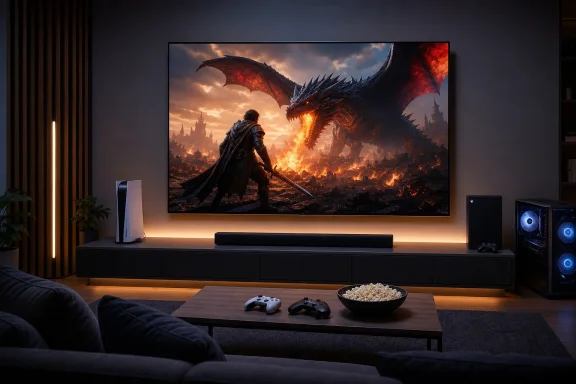 A full HDMI 2.1 complement makes this a serious gaming display
For PC and console users, the S85H’s strongest practical advantage is unusually complete connectivity at this tier. It has four 48Gbps HDMI 2.1 ports, all capable of 4K at 120Hz, with VRR, ALLM and eARC also included.
That is a useful configuration for a living-room setup containing an Xbox Series X, PlayStation 5, gaming PC and soundbar, without forcing buyers to continually swap cables. Wi-Fi 6E is also new for 2026, though it will only matter where a compatible router and network conditions can take advantage of it.
Samsung continues to omit Dolby Vision entirely, including Dolby Vision Gaming, in favor of HDR10, HDR10+ and HLG. That is not an obstacle for HDR gaming on Windows, Xbox or PlayStation, but it remains a consideration for movie viewers with Dolby Vision streaming libraries or UHD Blu-ray players.
The price saving shows up in refinement, not basic capability
What Hi-Fi? reports that the S85H can look overly sharp, smoothed and saturated out of the box. Its recommended setup—Filmmaker Mode, Warm 1 colour temperature and Active Dynamic Tone Mapping—improves the picture substantially, though the review still found reds and blues a little too forceful.
The more meaningful limitation is HDR finesse. In demanding dark scenes, the review observed some black crush; in bright scenes, the set can over-lift highlights and lose facial detail. Those are not failures of OLED’s per-pixel black levels, but signs that the entry model’s tone mapping lacks the control of Samsung’s higher-end S90H and S99H sets.
Samsung has also held back its Glare Free coating and Quantum Dot colour technology for costlier models. The S85H is consequently best suited to a controlled or dim room rather than a sunlit space with many direct reflections.
Treat a soundbar as part of the purchase
The S85H’s 2.0-channel, 20W speaker system was the review’s clearest weak point. What Hi-Fi? found dialogue separation and directional effects respectable, but said bass, impact and overall dynamics were too limited for action movies.
A basic eARC soundbar should be considered essential rather than optional for film and gaming use. Samsung’s Q-Symphony can combine compatible Samsung soundbars with the TV speakers, but buyers are not locked into that ecosystem: standard eARC hardware remains the straightforward route.
The S85H therefore lands as an OLED with few missing features and several visible compromises in execution. If discounts pull it well below mid-range OLEDs, its four HDMI 2.1 inputs, gaming support and bright, engaging image make it compelling. At a small price gap, however, the better processing, more natural colour and stronger HDR control of the next tier up will be difficult to ignore.
