
That distinction is easy to lose in the shorthand that the site is “set to open by 2031.” Intel’s own February 2025 construction update separates construction completion from operational production, and it puts the second fab’s start in 2032. WHIO-TV independently reported in March that Intel’s latest annual materials to Ohio still targeted 2030 for the first building and 2031 for the second. Nothing in Intel’s recent second-quarter earnings release, or in the company’s statement to WOSU this month, announces a return to a faster timetable.
For PC buyers and enterprise IT teams, Ohio One therefore should not be treated as a source of additional Intel-made capacity in the next several product cycles. It is a long-dated capacity option whose tempo is tied explicitly to customer demand and Intel’s capital discipline. The construction continuing at the site is real; a decision to equip, qualify and run the fabs at volume remains the more consequential—and still incomplete—part of the story.
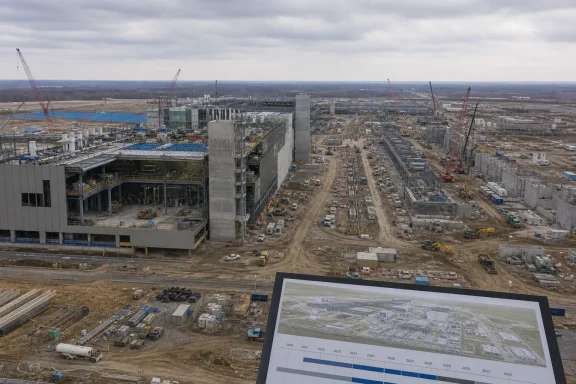 The factory has moved from 2025 to the next decade
Intel announced the New Albany project in January 2022 as a $20 billion initial investment in two leading-edge fabs, with production expected in 2025. The campus later grew to a stated planned investment of more than $28 billion, with room for as many as eight fabs if Intel ever fully develops the site.
The timetable has since been revised repeatedly. A 2024 delay shifted the expected completion of the first facilities into late 2026. Then, in February 2025, Intel pushed the first fab’s construction completion to 2030 and its operating start to 2030–2031; the second fab was moved to a 2031 construction finish and a 2032 operational start.
This is not a minor scheduling slip. The first fab’s anticipated production window is now roughly five to six years later than the one Intel announced in 2022. The project is still being built, but the original premise—that Ohio would quickly become a new pillar of Intel’s leading-edge U.S. manufacturing network—has yielded to a deliberately slower buildout.
Intel has been unusually direct about the reason. Its February 2025 update said it needed to align fab production with business needs and broader market demand, while keeping the ability to accelerate if demand justified it. Intel’s 2025 annual filing similarly described a new capital-deployment approach that slowed Ohio construction as the company sought to match investment to market demand.
That means the schedule is not simply an engineering forecast. It is a capital-allocation decision. The physical shell can progress without Intel committing to the expensive tools and production ramp that turn a construction project into a chip factory.
Construction progress is measurable, but the operational ramp is not
WOSU reports that Intel would not disclose how much construction is complete at Ohio One. That omission matters because a modern fab is not operational merely when its exterior structure is finished. The most expensive and time-sensitive phase comes with installing and validating the cleanroom infrastructure, chemical and gas delivery systems, power systems, water treatment, metrology tools, lithography equipment and production lines.
Intel has disclosed several construction milestones. In its February 2025 update, the company said the first fab had reached its go vertical milestone, meaning its below-grade work had been completed and above-ground structure work was under way. It also said crews had completed major sub-utility trench work, poured more than 200,000 cubic yards of concrete and logged more than 6.4 million construction hours by that point.
More recent state reporting gives a clearer financial measure. WHIO-TV reported that Intel spent $1.53 billion in Ohio during 2025, including completion of major underground utility work, bringing total capital spending at the campus to $5.26 billion. That is substantial construction activity, and it contradicts any claim that the site has been abandoned.
But it also frames the gap between the current site and Intel’s public commitment. Intel continues to call Ohio One a more-than-$28 billion investment for its first two fabs. The reported $5.26 billion in spending through 2025 is meaningful progress, but less than one-fifth of that planned initial figure. Intel also has not publicly identified the manufacturing process node planned for Ohio, the production equipment installed or ordered for the site, or a date for a production qualification ramp.
Those details would tell customers, suppliers and regional planners whether the first Ohio fab is transitioning from a concrete-and-steel project to a manufacturing program. Intel has not supplied them.
A better quarter does not mean Ohio has been accelerated
Intel’s second quarter of 2026 was materially stronger on revenue: $16.1 billion, up 25% year over year, according to the company’s July earnings release. CEO Lip-Bu Tan credited demand related to AI compute, Intel’s CPU business, custom chips, advanced packaging and foundry capacity. Intel also said it had committed to high-volume ramp of its 14A manufacturing process in 2028.
The revenue growth is important, but it should not be misread as an Ohio One update. Intel’s 14A production target does not identify New Albany as the manufacturing location, and the company has not announced that 14A production will run there. The 2030–2031 Ohio operating window also trails Intel’s stated 2028 14A high-volume-ramp plan by at least two years.
In practical terms, Intel must make its nearer-term process-node and foundry commitments work through its existing and earlier-starting manufacturing network before Ohio becomes relevant to current product planning. Arizona, Oregon and other established Intel manufacturing locations are much closer to the company’s immediate roadmap. Ohio remains part of the longer-term capacity plan, where a customer contract or sustained internal demand could justify moving faster.
That is a different role from the one associated with Intel’s 2022 announcement. Ohio One was presented as a major response to chip shortages and a vehicle for expanding U.S. leading-edge production. Four years later, it functions more like a strategically prepared expansion site whose activation is contingent on business proof.
The customer question has not been answered
WOSU quotes New Albany Mayor Sloan Spalding describing construction slowdowns but saying activity is picking up, and it quotes KeyBanc analyst John Vinh on Intel’s more financially disciplined approach to adding capacity. Those accounts fit Intel’s stated policy: build the site at a measured pace and retain the option to accelerate when customers support the investment.
The unresolved issue is who those customers are, and what capacity they would require. Intel’s foundry strategy depends on persuading outside chip designers to use its manufacturing services while also serving Intel’s own product groups. A factory shell cannot resolve that commercial problem on its own.
Speculation around potential partners should be handled cautiously. WOSU notes local discussion of an Nvidia connection and reports of a possible SK hynix arrangement. Neither establishes that either company will operate, lease, or manufacture chips at Ohio One. In fact, SK hynix made a formal filing with the Securities and Exchange Commission in July stating that it had not pursued or made a determination on acquiring Intel’s Ohio land and fab facility, responding to a report that it was in talks to buy the campus.
That filing does not rule out every possible commercial relationship between the companies. It does, however, directly undercut claims that an Ohio sale was already taking shape. Intel has not announced an Ohio tenant, an external foundry customer tied to the site, or a binding manufacturing program that would alter the public schedule.
Licking County Commissioner Tim Bubb’s question, reported by WOSU, captures the real uncertainty: Intel may remain the operator, or the eventual site could involve other companies. At present, the record does not support a more definite conclusion.
Ohio’s workforce promise is now on a delayed clock
Intel still publicly describes the initial Ohio phase as expected to create 3,000 Intel jobs and 7,000 construction jobs. It also says the site could support tens of thousands of longer-term jobs across suppliers and partners. Those figures are future-oriented estimates tied to construction and eventual production, not a description of the workforce currently on the campus.
WHIO-TV reported that Intel’s state filing listed 162 employees on site through the end of 2025. Intel says it has begun hiring Ohioans and training some at fabs in Arizona, New Mexico and Oregon, which is sensible preparation for a specialized workforce. But the difference between 162 site employees and 3,000 planned Intel jobs illustrates how much of the economic promise remains dependent on the production ramp.
The slower pace has tangible local effects. As Spalding told WOSU, suppliers that had expected to build around Intel are waiting, while local governments have been given more time to plan for the infrastructure, housing and traffic pressure a full-scale fab campus could bring. That breathing room may help New Albany manage growth, but it also pushes out the wage, supplier and tax-base gains used to justify the project’s public support.
Ohio One is not dead, and the evidence does not support calling it a stalled construction site. Intel is spending money, completing infrastructure work and maintaining a large-scale campus intended for leading-edge production. But the completed record is more restrained than the original promise: the first fab is not expected to operate before 2030, the second is scheduled for 2032, and Intel has not yet disclosed the customers, tools or manufacturing program that would turn Ohio One into a functioning fab complex.
