
The useful development is not a performance promise—none has been made. It is the possibility that Intel would carry a specialized large-cache die into notebooks instead of reserving it for high-end desktop parts. If the report proves accurate, it would place Intel in the same product category as AMD’s Ryzen 9 9955HX3D, a 16-core, 55W-to-75W laptop CPU with 128MB of L3 cache and 144MB of total cache.
For now, though, this is a single-source leak about an unannounced platform. Intel has confirmed that Nova Lake is due at the end of 2026, but it has not publicly announced Razor Lake, bLLC, its branding for those technologies, or a mobile large-cache SKU.
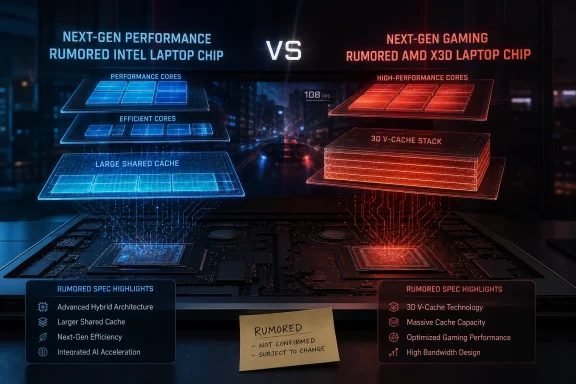 Razor Lake’s reported cache option is one sentence, not a product launch
Jaykihn’s August 18 post said only that “Razor Lake will come with bLLC mobile SKUs.” VideoCardz reported the post as an extension of earlier rumors that associated Razor Lake-S and Razor Lake-HX with both regular and bLLC-equipped compute dies.
That establishes the present state of the evidence: a known hardware leaker has repeated a specific claim, and VideoCardz has put it into the context of prior roadmap reporting. No second outlet has independently reported the timing, the SKU list, or the amount of cache planned for Razor Lake mobile processors. Intel has said nothing publicly about the codename.
That is an important limit because “mobile” covers dramatically different machines. A 75W gaming laptop with a desktop-class CPU, large cooling system, and discrete GeForce or Radeon GPU is not comparable to a 28W thin-and-light notebook. The report does not say whether bLLC belongs solely to HX-class gaming systems, reaches mainstream H-series laptops, or appears in a separate package aimed at integrated graphics.
Readers should also treat the “Core Ultra 500” implication as speculation. Intel’s current products use Core Ultra Series 3 branding for Panther Lake, and Intel has publicly named Nova Lake as the next-generation client platform. It has not assigned a retail series number to Razor Lake, or even confirmed that Razor Lake is the successor product being described in the leak.
AMD already sells the kind of laptop chip Intel is reportedly targeting
AMD’s Ryzen 9 9955HX3D provides the real-world reference point, rather than a hypothetical desktop contest. AMD formally introduced the processor as part of its Ryzen 9000 mobile portfolio and lists it as a 16-core, 32-thread Zen 5 part with a 55W default TDP, configurable up to 75W, 128MB of L3 cache, and an FL1 laptop package.
The part is not designed for an ultrabook. It is intended for large performance laptops, where manufacturers can pair it with a high-end discrete GPU and cooling hardware able to sustain high package power. Its large cache can improve performance in games and workloads that repeatedly access data sets too large for ordinary on-chip cache but small enough to avoid frequent trips out to system memory.
That last condition is why “more cache” is not a universal speed upgrade. Game engines, simulation workloads, emulators, compilation tasks, memory speed, graphics card choice, and notebook power limits all change the result. AMD’s own comparisons position the 9955HX3D against Intel’s Core Ultra 9 285HX in gaming laptops, but vendor-produced benchmark results are not a substitute for controlled testing across equivalent chassis and graphics configurations.
The practical opportunity for Intel is still clear. AMD has had a recognizable X3D option in the high-end mobile market, while Intel’s gaming-laptop story has leaned more heavily on CPU clocks, core counts, OEM tuning, and the discrete GPU. A cache-focused Intel die could give laptop makers a direct answer when AMD’s X3D badge becomes part of a buyer’s shortlist.
Desktop bLLC rumors do not tell us what a laptop implementation would be
The Razor Lake claim arrives after a long series of reports about Nova Lake desktop parts carrying bLLC. Earlier reporting from VideoCardz and Tom’s Hardware, also based largely on Jaykihn’s disclosures, described possible Nova Lake desktop configurations with up to 144MB of additional cache on a compute tile and larger totals on multi-tile designs.
Those figures should not be imported into Razor Lake reporting. They describe alleged desktop configurations, not a mobile package. The mobile design could use a smaller cache block, fewer CPU cores, a different tile layout, a different manufacturing process, or none of the rumored cache capacities previously associated with Nova Lake-S.
Power makes the distinction more than academic. Extra cache consumes silicon area and can affect cost, yield, thermals, and package design. A desktop processor can tolerate a substantially larger die, higher sustained power, and more aggressive cooling than a notebook processor. If Intel wants bLLC in a mobile part, it must make the larger-cache configuration viable within OEM thermal designs—not simply fit a desktop compute tile into a laptop socket.
There is also no verified technical description of bLLC from Intel. The label has become shorthand in leak reporting for a large last-level cache intended to compete with AMD’s 3D V-Cache products. Intel has not confirmed whether the cache is stacked, placed beside CPU cores, embedded in a tile, shared across tiles, or managed differently from standard cache. Any claim that bLLC has a particular packaging advantage or clock-speed tradeoff over AMD’s approach is premature until Intel documents it and independent testing becomes possible.
The first decision for buyers is to ignore Razor Lake as a purchasing timetable
Intel’s official roadmap statement is limited to Nova Lake arriving at the end of 2026. Even that leaves room between an announcement, the release of a first SKU, and broad availability in retail desktops and notebooks. Razor Lake is reported to follow Nova Lake, placing any actual bLLC notebook well beyond Intel’s currently confirmed public product window.
That means a buyer choosing a gaming laptop in 2026 should not delay a purchase for Razor Lake based on this report. There is no announced silicon, no OEM design win, no benchmark, and no launch schedule to plan around. Buyers deciding between a Ryzen 9 9955HX3D machine and an Intel-based alternative should compare available laptop reviews using the same GPU class, screen resolution, memory capacity, and power mode—not a future-leak headline.
For IT buyers, the report carries even less immediate operational weight. There is no platform validation material, vPro status, manageability roadmap, Windows support matrix, driver package, or commercial notebook commitment. Razor Lake’s reported bLLC option presently belongs to the enthusiast and high-end gaming discussion, not an enterprise deployment plan.
What would make this report meaningful
Intel will need to disclose four things before bLLC can be judged as a mobile X3D rival: the cache capacity, the processor’s sustained power range, the CPUs and laptop classes that receive it, and performance measured in matched systems. Cache alone will not answer whether the part competes with AMD’s current HX3D hardware.
The next meaningful evidence would be a second independent report identifying an actual Razor Lake-HX or Razor Lake-S configuration, an Intel development tool or official document naming the platform, or an OEM leak connecting a chip to a notebook design. Until then, the confirmed story is simpler: Intel has a publicly stated Nova Lake launch on its 2026 roadmap, AMD already ships a large-cache gaming-laptop processor, and one leak now says Intel’s later Razor Lake generation may bring a similar product strategy to mobile systems.
