
The central finding from Intel’s presentation, covered independently by ServeTheHome and Wccftech, is that Wildcat Lake is a purpose-built cost reduction of Core Ultra Series 3 rather than a simple rebadge of older laptop silicon. Intel kept its newer Panther Cove P-cores, Darkmont E-cores, Xe3 graphics architecture, Thunderbolt 4 and Wi-Fi 7, then removed enough expensive silicon and packaging complexity to target entry-level Windows laptops and embedded edge systems.
For PC buyers, the story is more specific than “new architecture at a lower price.” Wildcat Lake enables manufacturers to produce modern 18A-based laptops with a smaller package and simpler boards, but it does not qualify as Copilot+ PC silicon. Its NPU delivers 17 TOPS, while Microsoft’s Copilot+ hardware class requires an NPU capable of more than 40 TOPS; Intel’s quoted 40 platform TOPS combines CPU, GPU and NPU performance and does not meet that Windows requirement.
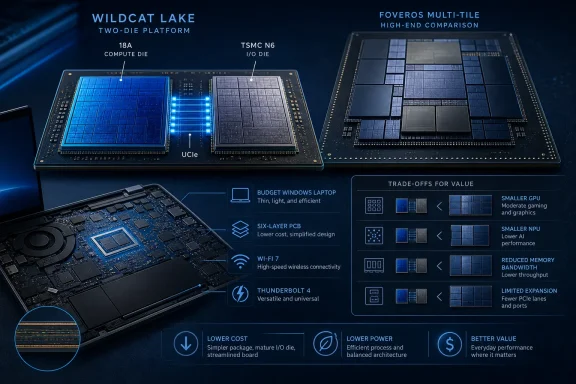 Foveros gave way to an organic UCIe package
Panther Lake’s Core Ultra Series 3 designs use Intel’s Foveros technology, which places tiles on a base die with dense die-to-die connections. That approach is useful when a design needs high bandwidth, fine-grained tile placement, or a broad range of configurations, but it carries manufacturing and assembly costs that make less sense in a lower-margin PC.
Wildcat Lake instead consists of an Intel 18A compute die and a TSMC N6 I/O die on an organic substrate. The two are linked with Universal Chiplet Interconnect Express, or UCIe, an industry die-to-die interconnect specification supported by Intel and other chip companies. Intel evaluated a monolithic design, according to the Hot Chips reporting, but concluded that a two-die package delivered the better cost result once it accounted for available IP, manufacturing, and assembly.
The package change is substantial. Wccftech reported a Wildcat Lake package measuring 35 by 25 by 1.23 mm, versus 50 by 25 by 1.5 mm for the compared four-Xe-core Panther Lake package. That smaller footprint frees board area, but the larger saving is that Wildcat Lake eliminates the Foveros base die and its advanced assembly process.
Intel did not get Foveros-like density for free. ServeTheHome reported that the organic UCIe connection uses a roughly 110-micron bump pitch, compared with about 36 microns for Foveros. The lower-density link requires more interface area and more lanes. Wccftech reported that Wildcat Lake’s die-to-die interface is 70% larger than an equivalent Foveros implementation.
That is the important trade: Intel accepted a physically larger on-die interface because the overall package costs less to manufacture. This is a practical demonstration of UCIe’s value for client chips. The standard is often discussed as a route to mixing chiplets from multiple suppliers, but Wildcat Lake shows another use: allowing a vendor to connect its own dies cheaply enough that a tile-based design can reach a price-sensitive laptop category.
Intel cut silicon where the mainstream platform could tolerate it
Wildcat Lake borrows the newer CPU and graphics architectures from Panther Lake, but the hardware resources are deliberately smaller. Intel reduced the maximum P-core count from four to two, cut last-level cache from 12MB to 6MB, and retained four low-power E-cores. Intel says single-threaded performance remains comparable with the larger design, a claim consistent with the reuse of the same core architecture, though it does not make Wildcat Lake a like-for-like replacement in sustained multi-core workloads.
The GPU falls from four Xe cores to two. Intel retained XMX matrix hardware, which supports AI workloads on the GPU, but removed hardware ray tracing. That choice makes sense for a low-cost integrated GPU, where gaming at settings that make ray tracing worthwhile is unlikely to be the design target. It also creates a sharper divide between an affordable productivity machine and the Core Ultra systems Intel wants to position for premium graphics and AI workloads.
The NPU receives the most consequential reduction for Windows shoppers. Wildcat Lake uses one NPU engine rated at 17 TOPS, down from the 53 TOPS Intel has cited for the larger Panther Lake configuration. Intel’s product specifications for the Core 7 350 confirm the 17-TOPS NPU figure, while also listing 21 GPU TOPS. Those numbers explain the company’s 40 platform-TOPS marketing claim.
But Windows’ Copilot+ label is based on NPU capability, not the combined throughput of several processors. Microsoft’s own developer guidance says Copilot+ PCs require an NPU capable of more than 40 TOPS for many of the platform’s on-device features. A Wildcat Lake laptop can run Windows 11 AI features supported on conventional PCs and can accelerate compatible applications through its GPU and NPU, but it should not be sold to buyers as a lower-priced route to Recall-class Copilot+ functionality.
Intel also removed the image processing unit and scaled back professional media capabilities. The memory interface was narrowed from 128-bit LPDDR5 to 64-bit LPDDR5, while system cache dropped from 4MB to 2MB. These are predictable reductions for a platform designed around everyday productivity, web use, video calls and light local AI, but they will matter in memory-bandwidth-heavy graphics tasks and in systems that would otherwise benefit from stronger integrated media pipelines.
The motherboard is part of the cost-cutting plan
The more revealing part of Intel’s presentation is that the savings do not stop at the processor package. A cheaper CPU attached to an expensive board would not accomplish much in a laptop segment where the display, memory, storage, chassis and power system dominate the final bill of materials.
The 64-bit memory interface allows manufacturers to use a six-layer Type 3 PCB rather than an eight-layer design, according to Wccftech’s account of the Hot Chips material. Intel also integrated Wi-Fi 7, avoiding a separate wireless module, and put a power-delivery controller into the USB retimer. Those changes reduce components and routing demands at the system level.
The I/O die was also cut by 15%, after Intel pared back features that would be expensive to validate or unnecessary in the intended machines. Wildcat Lake retains two Thunderbolt 4 or USB4 ports, two USB 3.2 ports and eight USB 2.0 ports, but it has six PCIe Gen4 lanes rather than Panther Lake’s higher-end I/O allocation. Camera PHYs were removed and the audio subsystem was scaled down.
This should influence purchasing decisions more than the processor’s branding. A Wildcat Lake laptop can still provide modern docks, fast external storage and Wi-Fi 7, but OEMs have less PCIe headroom for unusually elaborate storage layouts or discrete add-in hardware. The platform is optimized for compact notebooks and fixed-purpose edge devices, not for a machine intended to be expanded aggressively over several years.
There is also a display-specification discrepancy worth calling out. Wccftech’s Hot Chips write-up said Wildcat Lake retains “4K 60” and included “UHBR20” in parentheses. Intel’s public specification page for the Core 7 350 instead lists DisplayPort 2.1 HBR3, with a maximum DisplayPort resolution of 3840 by 2160 at 60 Hz. ServeTheHome likewise reported that Wildcat Lake loses the higher-bitrate display modes and resolutions available on the larger platform.
The conservative reading is clear: expect support for ordinary 4K60 displays, but do not assume Ultra High Bit Rate 20 support from that Wccftech parenthetical. OEM implementation, port wiring, and USB4 controller configuration will still decide what any individual laptop can drive.
UCIe introduced validation and power challenges
Foveros provides Intel with a familiar, tightly integrated physical connection. Moving to UCIe on an organic package meant Wildcat Lake had to handle its die-to-die traffic differently. ServeTheHome reported that Foveros traffic is not packetized in the same way, while UCIe required Intel to efficiently packetize communications between the compute and I/O dies.
Intel’s engineers also had to manage link power during display activity. In inexpensive laptops, the panel may lack panel self refresh, meaning display data must cross between dies frequently even when the displayed image is static. The reported solution was to buffer display traffic, allow the UCIe link to idle, then send data in bursts once buffers filled. That is a low-level implementation choice, but it is directly connected to idle power and battery-life behavior in the systems Wildcat Lake is intended to power.
Intel reportedly held the UCIe links to 8 GT/s to keep bit-error rates low enough to omit retry and forward-error-correction machinery. More physical lanes consume area, but avoiding those extra mechanisms reduced complexity and validation risk. For a high-volume budget processor, predictable manufacturing and power behavior are more valuable than chasing maximum interconnect density.
The company also said about 29% of compute dies could be recovered through different SKU configurations when a P-core, Xe core or NPU block is defective. Yield recovery has long been part of semiconductor binning, but it is particularly valuable here: Wildcat Lake’s product segmentation gives Intel a way to sell partially functional 18A dies rather than discard them.
Intel says it has more than 70 Wildcat Lake design wins, according to ServeTheHome. The meaningful test will be the systems that reach stores: whether OEMs pass the board, packaging and silicon savings through in materially lower prices rather than simply using Wildcat Lake to improve margins on familiar budget laptop designs.