
That is the strategic lesson worth carrying forward. The technology itself emerged from a specific public-health moment, but the model is broadly applicable: effective IT planning must connect business objectives, frontline workflows, physical infrastructure, cloud platforms, privacy controls, and measurable outcomes. When those pieces are planned independently, organizations buy impressive tools that struggle to produce sustained value. When they are planned together, technology becomes part of how the organization actually runs.
 Overview: From Crisis Tool to Integrated Operations Platform
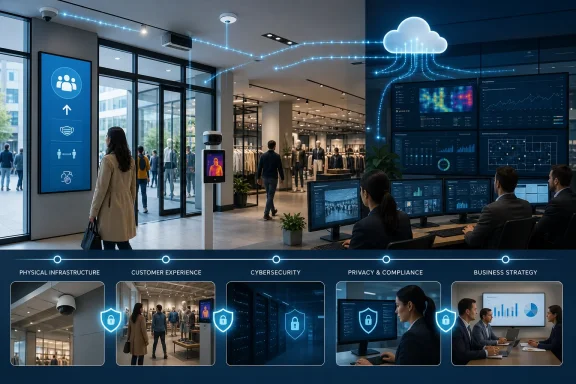
Interaction Care was positioned as a cloud-based solution for managing safety and traffic in physical venues. According to the original account, it could control entry based on occupancy, monitor the movement of people, identify higher-risk zones, show safety messages through digital displays, check temperature, and detect mask usage at entrances. The deployment target was intentionally broad: shops, supermarkets, pharmacies, bank branches, and other public-facing spaces. CIOReview’s description
Beabloo’s current Microsoft Marketplace presence places Interaction Care within its broader Active Customer Intelligence Suite (ACIS). The listing describes a set of technologies for communicating with in-store visitors, analyzing behavior, and creating automated or personalized physical-space experiences. It also explicitly identifies Interaction Care as the company’s response to the operational realities created by COVID-19. Microsoft Marketplace’s Beabloo listing
This matters because it demonstrates the difference between buying a point product and designing a strategic capability. A thermal camera alone is a device. A digital signage network alone is a communications channel. A people-counting sensor alone is an operational metric. A cloud content-management system alone is software. Combined with clear policies, safe workflows, responsible data handling, and staff training, they become a coordinated platform for managing a physical environment.
That shift—from component purchasing to capability design—is at the heart of fully integrated IT strategic planning.
Why Standalone IT Planning Fails
For decades, organizations could get away with treating technology as a separate domain. The IT department maintained desktops, servers, applications, network connections, and service desks. Business leaders created commercial plans. Facilities teams managed buildings. Marketing handled customer communications. Legal and compliance teams addressed regulations after a system was chosen.
That division is increasingly unsustainable.
A modern customer journey can cross a mobile app, a website, a point-of-sale terminal, a store entrance, a digital display, a camera, a cloud analytics service, and a customer-service interaction in only a few minutes. The systems may have different owners, but the customer experiences only one organization. A failure in any part of the chain becomes a failure of the whole experience.
Interaction Care makes this relationship unusually visible. An occupancy sensor may detect that a venue has reached an agreed capacity. But the operational result depends on more than sensor accuracy:
- The entry rule must be approved by business leadership and site management.
- The digital message must be understandable, accessible, and suitable for the brand.
- The staff escalation path must be clear when an alert occurs.
- The network must reliably connect sensors, screens, and management systems.
- The data policy must define what is collected, retained, shared, and deleted.
- The privacy notice must accurately explain the use of video or other monitoring technology.
- The procurement model must support ongoing software, device, maintenance, and integration costs.
- The success metrics must show whether the system is improving safety, flow, compliance, or customer satisfaction.
If any of those elements is ignored, a technically functioning deployment can still fail operationally.
The hidden cost of disconnected decisions
Disjointed planning often produces predictable problems. A retail team may purchase signage without involving information security. A facilities group may deploy cameras without a complete data-retention policy. A cloud team may establish a subscription without defining ownership for device patching and on-site support. A legal team may be asked to approve an implementation only after the hardware is installed.
These failures are rarely caused by a lack of effort. They are usually caused by a lack of shared planning mechanisms.
The result is familiar to many Windows and Azure administrators: separate dashboards, mismatched identifiers, unclear support boundaries, duplicated data, inconsistent access controls, and an endless series of “temporary” manual workarounds. The organization may technically own all of the required components, yet still lack an end-to-end service.
A strategic plan must therefore begin with the service the organization wants to deliver—not with the technology category it wants to buy.
Interaction Care as a Blueprint for Integrated Strategy
The reported architecture of Interaction Care offers a practical example of how to frame planning around outcomes. The system combined digital signage, thermal imaging, people-counting capabilities, real-time data collection, and Beabloo’s content-management platform. CIOReview’s technical overview
Each layer has a different purpose. The strategic value appears only when the layers work together.
1. Physical sensing and environmental awareness
The first layer is the physical environment. Sensors can count entries and exits, estimate occupancy, observe movement patterns, or detect conditions that trigger a defined response. In the Interaction Care model, the purpose was to give operators a real-time view of space usage and potential high-risk interactions. CIOReview’s report
For IT leaders, this means the strategy must account for hardware lifecycle management as seriously as software lifecycle management. Cameras, sensors, edge gateways, display controllers, and network appliances need inventory records, firmware policies, physical protection, connectivity standards, maintenance schedules, and replacement plans.
A strategic plan that identifies “IoT” or “smart retail” as a goal but does not define those practical operating requirements is incomplete. The device layer is not an implementation detail. It is part of the production environment.
2. Cloud coordination and content orchestration
The second layer is coordination. Information from the physical environment must be turned into action, whether that action is a dashboard alert, an entry-control rule, a staff notification, or an updated message on a screen.
Beabloo’s marketplace description emphasizes centralized management of digital signage and the use of customer data intelligence to inform decisions in physical spaces. Microsoft Marketplace’s ACIS overview That is a useful operational model because it avoids treating every screen or site as an isolated island.
Centralization, however, should not mean unchecked concentration of power. An integrated design should include:
- Role-based access control for content publishers, site managers, analysts, and administrators.
- Approval workflows for customer-facing messages.
- Segregated environments for testing and production.
- Audit logs for configuration changes and access events.
- Fallback operating procedures when a device, connection, or cloud service is unavailable.
- Data minimization rules so the platform does not collect more than the stated purpose requires.
This is particularly important in Azure-connected deployments. Cloud scalability is valuable, but scalability can also amplify configuration errors. A poorly governed policy applied to one location is a local incident; the same policy pushed centrally to hundreds of sites becomes an enterprise incident.
3. Human communication as an operational control
Digital signage is often categorized as a marketing tool. In a safety, crowd-management, or service-flow deployment, it becomes an operational control.
That distinction should influence IT planning. A message such as “Please wait,” “Use another entrance,” “Maintain distance,” or “This area is temporarily unavailable” must be timely, readable, accessible, and consistent with staff instructions. If the screen says one thing while employees say another, the organization creates confusion rather than control.
A fully integrated strategy connects signage governance with:
- Brand and communications standards.
- Accessibility requirements.
- Language and localization needs.
- Emergency communications procedures.
- Site-specific operating rules.
- Employee training and escalation procedures.
- Performance monitoring for content delivery.
In other words, digital signage should not sit in a separate budget and governance model merely because it has a display attached to it.
Azure Marketplace Changes the Procurement Conversation
Making a solution available through Azure Marketplace—or today’s broader Microsoft Marketplace experience—can simplify discovery and purchasing, but it does not eliminate governance responsibilities. Microsoft describes Marketplace as a way for organizations to find, buy, and manage partner cloud solutions through a unified catalog, while also supporting private offers and Azure commitment-aligned purchasing for eligible products. Microsoft’s customer overview
This creates real advantages for organizations that already standardize on Azure and Microsoft commercial agreements.
Strategic benefits of marketplace delivery
A marketplace-based acquisition model can help align technology purchasing with broader cloud financial management:
- Faster vendor onboarding through an established procurement channel.
- Consolidated billing rather than separate invoices and payment processes.
- Private offers with negotiated commercial terms for enterprise deployments.
- Azure-aligned governance through subscription, billing, and purchasing controls.
- Easier proof-of-concept paths before large-scale rollout.
- Closer coordination between business demand and cloud spending oversight.
Microsoft notes that Marketplace customers can use private offers to negotiate terms and test solutions, while eligible purchases may count toward Azure consumption commitments. Microsoft’s Marketplace documentation
For a CIO or IT finance leader, the key takeaway is not that Marketplace is automatically the best procurement route. It is that the marketplace becomes another part of the strategic architecture. Vendor selection, cost allocation, identity permissions, private marketplace policy, contract ownership, security reviews, and deployment processes should all be considered together.
Procurement velocity must not bypass review
A cloud marketplace can reduce friction, but friction is not always waste. Some controls exist to prevent unmanaged software adoption, security gaps, unexpected charges, or contractual exposure.
Microsoft’s guidance makes clear that Marketplace purchases require policy configuration and appropriate billing and subscription permissions. Organizations can also use a private marketplace model to control which offerings are available to users. Microsoft’s Marketplace purchase controls documentation
That is exactly the kind of governance capability integrated IT planning should embrace. The objective is not to slow innovation. It is to make innovation repeatable.
A well-run organization can enable teams to evaluate a solution quickly while maintaining a defined process for:
- Business sponsorship and expected outcomes.
- Security architecture review and identity design.
- Privacy and compliance assessment for data collection.
- Financial approval and cost-center ownership.
- Operational readiness for support and incident response.
- Pilot measurement before enterprise-scale commitment.
- Exit planning for data portability, device reuse, and contract termination.
The marketplace is the delivery channel. It should not become the strategy.
Privacy Must Be Designed Into the System, Not Added Later
The strongest claim in the Interaction Care story is not simply that it can observe physical space; it is that the solution was designed to do so while respecting privacy standards. CIOReview’s report That statement appropriately points to the central challenge of any system that combines cameras, analytics, behavioral observation, occupancy data, temperature measurement, or mask-related detection.
Even when a deployment is intended to improve safety, the organization must distinguish between aggregate situational awareness and individual-level surveillance.
The European Data Protection Board has published final guidance on the processing of personal data through video devices, underlining that video-based systems belong inside a formal data-protection framework rather than outside it. EDPB Guidelines 3/2019
Privacy questions every deployment must answer
A responsible IT strategic plan should require unambiguous answers before a location-based analytics system goes live:
- What information is captured?
- Is raw video stored, processed live, or discarded immediately?
- Are images linked to names, payment information, loyalty accounts, or employee records?
- Is data processed locally at the edge, in the cloud, or both?
- Who can access individual-level information?
- How long is data retained?
- Can the system identify a person, or only estimate anonymous occupancy and movement?
- Are alerts automated, advisory, or subject to human review?
- What are the documented purposes for data collection?
- How are visitors and employees informed?
- How can the organization respond to data access, deletion, or objection requests where applicable?
These are not paperwork questions. They determine the architecture itself.
For example, a design that processes video locally, derives anonymous occupancy counts, and promptly discards source imagery has a fundamentally different risk profile from a design that stores video centrally, preserves identifiable footage, and combines it with customer profiles. Both may be technically feasible. Only one may be necessary for the intended outcome.
Avoid overstating what AI can determine
Public-space analytics can easily drift into claims that outpace the technology. Temperature screening can flag an elevated surface reading, but it should not be presented as a diagnosis. Mask detection can identify a visual pattern, but it can produce errors in difficult lighting, crowded entrances, or unusual camera angles. People counting can estimate occupancy, but accuracy depends on sensor placement, entrances, site layout, and calibration.
Organizations should insist on measured claims, tested thresholds, and clear human oversight. This is especially important when automated outputs influence access, service, or staff intervention.
Where systems use face-related analysis or facial recognition capabilities, the risks become more acute. NIST has found that the performance of face-recognition algorithms can vary by demographic group, and that the majority of algorithms assessed in its study showed demographic differentials. NIST’s analysis of demographic effects
That does not mean every camera-based system is equivalent to facial recognition. It does mean organizations must be precise about what their system does, what it does not do, and how its accuracy has been evaluated in the specific conditions where it will be used.
The Operational Case for Integration
The temptation after a crisis passes is to remove the crisis-specific tools and return to siloed operations. That would miss the more durable value in systems such as Interaction Care.
Occupancy intelligence can support queue management. Digital signage can improve wayfinding. Environmental data can help schedule cleaning or staffing. Store traffic analysis can help identify congestion points. Central content management can make a distributed location network easier to operate. These are legitimate uses—but only if organizations resist converting every operational data point into a surveillance or marketing asset.
The best strategy emphasizes a narrow, defensible purpose. It asks: What decision will this data improve, and what is the least intrusive way to obtain it?
That discipline produces better technology and better trust.
Metrics that matter
A fully integrated IT strategic plan should not measure success merely by the number of sensors installed, displays connected, or cloud subscriptions purchased. It should track business and operational outcomes such as:
- Average queue time at key entrances or service points.
- Occupancy-rule compliance rates.
- Number and duration of congestion events.
- Staff response time to alerts.
- Device availability and content-delivery success rates.
- Customer complaints related to flow, communication, or privacy.
- False-alert rates and manual override frequency.
- Cost per supported location.
- Training completion and policy adherence.
- Security incidents, access-review outcomes, and retention-policy compliance.
These measures connect technology operations to the actual reason the system exists. They also reveal when a project needs redesign rather than more investment.
A Practical Framework for Fully Integrated IT Strategic Planning
Organizations looking to apply this lesson should use a planning model that starts with outcomes and moves methodically toward technology selection.
1. Define the business outcome first
State the problem in operational terms. “Install smart cameras” is not an outcome. “Reduce peak-time queue congestion while preserving a welcoming customer experience” is an outcome. “Improve site awareness during emergency events” is an outcome. “Maintain safe occupancy levels without assigning staff to manually count visitors” is an outcome.
The language matters because it prevents technology from becoming the objective.
2. Map the full service journey
Document what happens from the first signal to the final action. Include customers, employees, managers, support teams, data flows, device dependencies, and exception handling.
For a physical-space management system, the map may include entry, counting, analysis, threshold detection, message delivery, staff notification, incident logging, and post-event review. Every handoff should have an accountable owner.
3. Establish data and privacy boundaries early
Before selecting vendors, define which data is necessary and which data is prohibited. Set retention rules, access principles, notification requirements, and approval thresholds.
This is where privacy-by-design becomes real. It changes product requirements instead of merely producing a compliance document after deployment.
4. Design for security and resilience
Treat sensors, signage players, cameras, gateways, cloud dashboards, and administrator accounts as one security estate. Apply asset inventory, segmentation, least-privilege access, patching, logging, monitoring, and incident-response practices consistently.
A camera connected to a business network is not “just facilities equipment.” It is a managed endpoint with security consequences.
5. Pilot in real-world conditions
A demonstration environment cannot replicate all conditions of a busy public location. Test the solution across peak traffic, low light, different weather conditions, accessibility needs, varied customer behavior, staff turnover, and network interruptions.
Pilot goals should include technical accuracy, usability, operational workflow, privacy controls, and business benefit. A system that performs well in a vendor demonstration but causes staff confusion in a real store is not ready for scale.
6. Build governance for the entire lifecycle
Set up an operating model before the enterprise rollout. Identify who owns the business outcome, content, devices, cloud subscription, support desk, privacy compliance, security oversight, vendor relationship, and budget.
This is the stage where many projects quietly fail. They launch successfully but become difficult to maintain because ownership was never made explicit.
The Lasting Strategic Lesson
Beabloo’s Interaction Care deployment illustrates a broader truth about Azure-based business technology, retail analytics, and smart-space systems: the most valuable innovations are not isolated products. They are integrated services that connect cloud infrastructure to real operational decisions.
The solution’s original focus was reducing public-health risk through real-time awareness, occupancy management, on-screen communication, and connected sensor data. CIOReview’s report Its more enduring value lies in showing how a company can unite physical infrastructure, cloud delivery, customer experience, and operational policy around a common goal.
For IT leaders, the mandate is clear. Strategic planning must no longer be a yearly document written by IT and handed to the rest of the organization. It must be a shared discipline that connects technology choices to people, processes, physical spaces, governance, and measurable business results.
That integration is harder than buying a standalone tool. It demands more coordination, more accountability, and more rigorous decisions about data and risk. But it also produces the kind of resilient, practical technology that organizations can trust long after the immediate crisis that inspired it has passed.
