
Techpoint Africa first reported the August 26 launch, describing expanded recognition for code-switched conversations and speech generation in languages including Igbo and Hausa. Intron’s own Sahara v2.5 materials confirm the main release: bilingual language mixing across 12 African-language models, a Kinyarwanda–English–French trilingual workflow, streaming speech recognition and speech generation endpoints, and higher-concurrency infrastructure for production workloads.
The practical distinction is significant. Speech recognition failures in mixed-language dialogue do not simply create an awkward transcript. In healthcare, legal records, financial support calls, and voice-operated transactions, the omitted words can contain symptoms, names, amounts, identity details, or the actual request a system must act on. A model that is strong in English and separately supports a local language is not automatically competent when a speaker moves between both without pausing to accommodate the software.
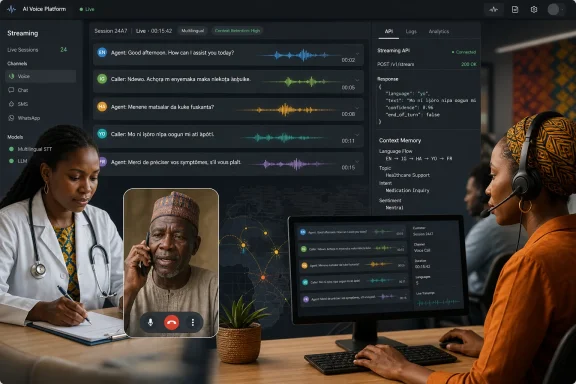 Sahara v2.5 targets the handoff between languages
Code-switching is often presented as a language-coverage issue, but the hard engineering problem is context retention. A recognizer has to identify that a word belongs to a different language, select the correct acoustic and language model behavior, and continue the transcription without incorrectly “correcting” a name or phrase into a more familiar English term.
Intron says Sahara v2.5 expands the Swahili–English switching capability available in Sahara v2 to 12 bilingual models. Its public material cites Hausa, Yoruba, Igbo, Pidgin, Zulu, Afrikaans, Amharic, Kinyarwanda, Luganda, and Swahili among the languages represented in its test tables, while also describing one trilingual Kinyarwanda–English–French configuration. The company says the release adds seven languages to a broader platform total of 63.
Those figures need careful reading. Techpoint Africa described the model as supporting switching across “about 20” African languages, then quoted Intron CEO Tobi Olatunji referring to 12 languages in the release. Intron’s own site consistently promotes 12 bilingual models for code switching, while separately advertising 13 languages for text-to-speech and 63 total languages across the wider platform. Those are different measurements, but the company does not currently provide one simple public compatibility matrix showing every supported language pair, which pairs are recognition-only, which are available for synthesis, and which features are generally available rather than in preview.
That gap is more than documentation housekeeping. An enterprise team planning a multilingual voice rollout needs to test its real combinations—such as English–Yoruba, English–Luganda, or local-language–French—rather than treating a total language count as proof that a specific conversation pattern is covered.
The model is being released as both product and research preview
Intron is positioning Sahara v2.5 as a production-oriented platform. Its product page advertises streaming ASR, streaming TTS, greater concurrency, and one API for building live transcription and voice-agent experiences. The company also highlights deployments and pilots in healthcare, courts, fintech, and customer service.
But another Intron page, for the Sahara CodeSwitch Africa Challenge, describes the August release as a beta research preview and offers API access to participants for prototype development and benchmarking. A challenge run with ML Collective Africa likewise describes access to Sahara v2.5’s code-switching APIs for teams comparing it with other speech models.
Both statements can be true: a vendor can have selected production customers while exposing newer endpoints to a broader developer audience as a preview. Still, “launched” should not be interpreted as blanket general availability for every enterprise deployment. Intron has not publicly spelled out the rollout scope, service-level terms, pricing tiers, regional hosting choices, rate limits, or which code-switching and TTS features are production-ready for all customers.
For developers, the sensible approach is to treat v2.5 as an integration candidate, not an automatic replacement for an existing transcription stack. Run a side-by-side evaluation on consented, representative audio from the exact users and environments involved: mobile calls, clinic consultations, noisy contact centres, regional pronunciations, local names, currency amounts, and the actual language-switching patterns your application receives.
Intron’s performance claims require reproducible testing
Intron has published tables comparing Sahara v2.5 with products and models from Google, OpenAI, Microsoft Azure, ElevenLabs, Deepgram, Meta, and others. Its code-switched ASR table reports word error rates ranging from 17.86% for Amharic to 43.87% for Luganda, with lower scores representing fewer transcription errors. Intron also reports that Sahara v2.5 outperforms several global systems on many listed code-switched examples.
Those results are useful signals, particularly because global ASR benchmarks often underrepresent African accents, local names, specialist vocabulary, and mixed-language speech. A 2025 research paper published through the ACL Anthology similarly found that widely used speech systems suffered sharply higher error rates on African speech and medical dialogue than on benchmark English audio, while a regionally tuned Sahara v2 model performed strongly on the datasets studied.
Yet the v2.5 figures remain vendor-published benchmarks, not an independently audited standard. Intron’s web page provides per-language results and competitor names, but not enough public detail to reproduce the complete tests: the number and source of clips per language, recording conditions, annotation procedures, normalization rules, domain balance, model versions, pricing assumptions, or whether competitor APIs were configured for the same streaming and language-detection conditions.
This is particularly relevant for administrators tempted to make a narrow comparison based on word error rate alone. Word error rate is valuable, but it can hide errors that have very different operational consequences. Mishearing filler words in a conversational transcript is not equivalent to mishearing a patient’s medication, a bank-account instruction, a witness’s name, or a payment amount. Teams deploying voice automation should separately measure named-entity accuracy, numeric accuracy, language-switch detection, latency, interruption handling, and fallback behavior.
Intron’s own CodeSwitch challenge is a constructive acknowledgement of that need. It asks participating teams to benchmark Sahara against at least three other speech models and document their methods. The more useful outcome will be public, independently repeatable evaluations on natural conversation rather than another vendor leaderboard.
Clinical notes and financial voice bots raise the stakes
Techpoint Africa reports that Meridian Hospital in Enugu is among the early users of the new capability, with doctors and patients frequently conversing in Igbo. The outlet says the hospital had used Intron’s English dictation model and is now looking toward conversation capture that would produce a draft note for clinician review.
That workflow can reduce documentation work, but it also illustrates why human review cannot be optional. A generated clinical note is a derived record, not a neutral recording. If a mixed-language utterance is transcribed incorrectly and then compressed into a structured summary, the error may become harder to notice because the system has turned uncertain audio into a confident-looking sentence. The appropriate design is an auditable workflow: preserve the source audio where policy permits, retain timestamps, display the transcript alongside the generated note, mark uncertainty, and require clinician approval before the note becomes part of the patient record.
The same rule applies to voice banking and customer-service automation. Intron argues that customers could conduct transactions or obtain assistance in the language they naturally use rather than navigating an English-heavy app. That may improve access, but automated financial actions need confirmation steps that are independent of a single speech-to-text pass. The system should repeat back an interpreted amount and recipient, require explicit confirmation, preserve a transaction trail, and route ambiguous requests to a human or a safer non-voice channel.
Intron says it can support offline deployments and zero-retention cloud arrangements, according to Techpoint Africa. Those are meaningful options for regulated customers, but they are not complete security answers. Buyers still need written answers on data residency, encryption, key management, model-update controls, access logs, retention enforcement, incident notification, and whether audio or derived transcripts can be used for model improvement.
The immediate opportunity is better evaluation, not blind automation
Sahara v2.5 addresses a real deficiency in voice systems designed around a monolingual or English-first assumption. Its promised combination of code-switched ASR, multilingual TTS, and streaming APIs could make African-language voice interfaces more usable in sectors where typing, app navigation, and standard English workflows create barriers.
The release’s unresolved issue is availability clarity. Intron has announced a broad platform, a limited set of bilingual code-switching models, a 13-language TTS claim, and research-preview API access, but has not published a single operational guide that maps language pairs, regions, pricing, hosting, production status, and measurable quality thresholds. Until it does, the strongest use of Sahara v2.5 is a controlled pilot with strict review and a benchmark built from the conversations a deployment must actually understand.