

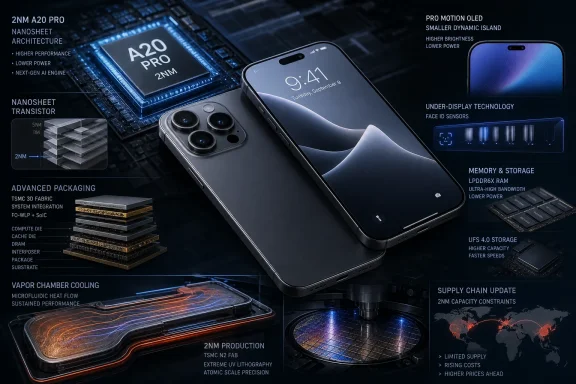
The important distinction is that the iPhone 17 Pro and iPhone 17 Pro Max arrived as products built around technologies that had already reached a comparatively mature stage of production. Apple could focus on turning that maturity into better sustained performance, battery life, cooling, and industrial design. The iPhone 18 Pro generation, if current supply-chain expectations are borne out, would instead be defined by how effectively Apple can commercialize technologies that remain costly, capacity-constrained, and more sensitive to yield problems.
That does not mean every rumored specification will reach shipping hardware. Apple has not formally announced the iPhone 18 Pro lineup, its processor, its final design, pricing, or release schedule. Still, the direction of travel is clear: the next Pro iPhones could test whether the smartphone industry can keep delivering major silicon gains without making flagship phones dramatically more expensive.
Overview: From a Mature 3 nm Platform to a Riskier 2 nm Cycle
The iPhone 17 Pro and iPhone 17 Pro Max represented a significant engineering reset for Apple’s high-end phone line. Their aluminum unibody construction, A19 Pro processor, and vapor-chamber cooling system were all designed to address a familiar problem in premium smartphones: delivering higher peak performance without allowing heat to reduce sustained speeds during gaming, professional video work, on-device AI tasks, or prolonged camera use.
Apple’s vapor-chamber approach was especially important because mobile processors increasingly operate like miniature laptop-class systems-on-chip. They include high-performance CPU cores, GPU resources, neural-processing hardware, image signal processors, media engines, secure components, memory controllers, and increasingly sophisticated wireless subsystems. Putting more capability inside a compact, sealed handset creates thermal limits that cannot be solved solely through software.
The iPhone 17 Pro generation benefited from a platform that was already evolution rather than revolution. Its advanced manufacturing technology had inherited lessons from earlier 3 nm production, and its thermal architecture had a clearer mission: make the existing performance envelope more usable for longer.
The rumored iPhone 18 Pro strategy is more ambitious. It would pair a new manufacturing node with potential design changes at the display and physical-control levels. Each change may be manageable in isolation. Taken together, they create an unusually demanding launch program.
Why “2 nm” Is Not Just a Smaller Number
The labels used for semiconductor process nodes no longer describe a literal transistor dimension. They are industry names for generations of manufacturing technology, design rules, materials, and transistor structures. Nevertheless, a transition from a 3 nm-class process to a 2 nm-class process remains a major technological event.
TSMC’s N2 family is notable because it moves from FinFET transistor designs to gate-all-around nanosheet transistors. In simple terms, the transistor gate controls the electrical channel more completely than in a FinFET design. That can improve switching efficiency and reduce leakage, helping chip designers pursue either greater performance at similar power levels or lower power consumption at similar performance levels.
For a phone processor, that flexibility matters more than benchmark headlines alone. Apple can decide where the gains go:
- Higher CPU and GPU clocks for demanding games and creative workloads.
- Lower power draw for better battery life.
- More neural-engine capacity for local AI features.
- Larger caches or more complex media hardware.
- Additional thermal headroom before sustained throttling begins.
The problem is that advanced-node advantages do not arrive for free. The design, validation, fabrication, packaging, and testing process becomes more expensive at every step.
The A20 Pro Challenge: New Silicon, New Economics
The central manufacturing challenge for the iPhone 18 Pro and iPhone 18 Pro Max is likely to be the rumored A20 Pro processor. Reports consistently point toward Apple using TSMC’s 2 nm technology for its next premium mobile chip, although Apple has not confirmed the name, process node, or final configuration.
TSMC has described the potential benefits of its N2 technology in the range of roughly 10 to 15 percent more speed at comparable power, or approximately 25 to 30 percent lower power at comparable speed, relative to a prior 3 nm generation. Those figures are process-level targets, not a promise that an iPhone will deliver precisely those results in real-world applications.
Apple’s actual outcome depends on several decisions that remain invisible until the product is announced:
- CPU and GPU architecture changes.
- Cache sizes and memory bandwidth.
- The number and capability of AI accelerators.
- Modem and connectivity integration.
- The thermal limits of the handset.
- iOS scheduling and power-management behavior.
- The quality of early manufacturing yields.
A20 Pro performance could therefore improve sharply, modestly, or primarily in efficiency. A chip that delivers longer sustained performance with less heat may be more meaningful than one that posts a dramatic peak benchmark score for a few minutes.
Yield Is the Silent Constraint
The most difficult part of a process-node transition is not producing a working chip in a laboratory. It is producing millions of high-performance chips consistently, quickly, and economically.
A silicon wafer contains many copies of a chip design. The number of usable chips depends on defect density, die size, packaging success, testing results, and binning requirements. Lower early yields mean fewer usable processors per wafer, which increases the effective cost of each good chip.
This matters particularly for Apple because the iPhone Pro line is produced at enormous scale. A relatively small yield problem can translate into a material supply shortfall when the target is tens of millions of phones. It can also force Apple to make difficult trade-offs involving launch inventory, regional availability, storage configurations, or component allocation.
Reports of 2 nm wafers costing around $30,000 should be treated cautiously because foundry pricing is not publicly standardized and varies by customer agreement, volume, packaging needs, and production timing. The broader point is far more credible: 2 nm wafer economics are expected to be materially more demanding than previous advanced-node generations.
That creates a cascading cost problem. Higher wafer costs do not merely raise the price of the processor. They increase the financial impact of every yield loss, packaging defect, test failure, and late design revision.
Packaging Could Matter as Much as Fabrication
Modern mobile processors are no longer defined only by the node used to fabricate their logic. Packaging technology has become an important part of the performance and manufacturing equation.
Rumors have connected the A20 Pro with advanced wafer-level multi-chip module techniques. While the final implementation remains unconfirmed, the broader trend is undeniable: tighter integration can improve performance, reduce footprint, and support more sophisticated memory or subsystem arrangements. It can also introduce new assembly, thermal, and reliability challenges.
Advanced packaging must manage:
- Heat distribution across densely integrated components.
- Signal integrity at high data rates.
- Mechanical stress from repeated thermal expansion and contraction.
- Manufacturing alignment tolerances.
- Testing complexity before and after final assembly.
- Repair and failure analysis complications.
For Apple, this is not merely a chip-industry detail. Packaging decisions affect the size of the logic board, the room available for batteries, the placement of cameras, and the thermal path from the processor to the chassis.
Thermal Design: The Performance Problem Consumers Can Feel
Apple’s iPhone 17 Pro models made cooling a visible part of the product story. The aluminum unibody design and vapor chamber were not cosmetic changes; they acknowledged that sustained workloads now matter on phones.
A 2 nm process should improve efficiency, but improved efficiency does not automatically make thermal engineering easier. Apple may use those efficiency gains to add more performance, more AI processing, more graphics capability, or larger workloads. In that scenario, total heat generation during peak activity can remain a challenge even when the chip is more efficient per operation.
The iPhone 18 Pro and iPhone 18 Pro Max may therefore require refinements beyond simply reusing the iPhone 17 Pro thermal architecture. Possible measures include:
- Larger or more efficient graphite heat-spreading layers.
- Revised vapor-chamber geometry.
- Changes in internal frame materials.
- Different battery placement to improve heat paths.
- More aggressive software-based workload scheduling.
- Tighter limits on peak clocks under extreme conditions.
Sustained Performance Is the Real Benchmark
The iPhone 17 Pro line reportedly achieved substantially better sustained performance than its predecessor when its A19 Pro processor was paired with Apple’s vapor-chamber design. That is an important benchmark for the iPhone 18 Pro generation.
Consumers rarely judge a phone by the fastest result it can post in a brief synthetic test. They judge it by whether a game becomes choppy after 20 minutes, whether video export slows down, whether camera processing remains responsive, and whether the phone becomes uncomfortable to hold.
The next Pro models will have to preserve or improve that experience while incorporating a potentially denser and more complex logic platform. The result may be a quieter, cooler, longer-lasting phone. It may also expose the limits of trying to turn a thin handset into a workstation-class AI device.
For Windows users, the same principle is increasingly familiar. Modern Copilot+ PCs, gaming laptops, and Windows-on-Arm systems all show that raw silicon efficiency matters only when it is paired with effective cooling, memory bandwidth, and software optimization. Apple’s iPhone roadmap is another example of the broader industry collision between AI ambitions and thermal reality.
Supply-Chain Pressure and the AI Memory Effect
The economic story around the iPhone 18 Pro may be just as significant as the engineering story. Advanced semiconductor capacity is increasingly contested by smartphone vendors, PC makers, automotive suppliers, cloud providers, and companies building AI infrastructure.
TSMC’s most advanced production capacity is especially valuable because it serves customers with demanding performance-per-watt requirements. AI data-center demand has increased pressure not just on leading-edge logic production but also on packaging capacity, high-bandwidth memory, conventional DRAM, substrates, and specialized manufacturing equipment.
The iPhone does not use high-bandwidth memory in the same way as a large AI accelerator, but it is not insulated from the broader market. When memory suppliers prioritize higher-margin products or when the industry faces strong demand across several categories, mobile DRAM prices can rise.
Why Memory Pricing Matters to a Pro iPhone
AI features make memory more important. On-device generative AI, advanced camera pipelines, large language models, richer multitasking, and more demanding games all benefit from capacity and bandwidth.
Apple may be under pressure to increase memory in its premium models, particularly if software features become more ambitious. Adding RAM is not just a technical decision; it affects component cost, board design, power consumption, and thermal behavior.
A more expensive A20 Pro chip paired with more costly memory creates a bill-of-materials increase that is difficult to hide. Apple can offset some of that pressure through its purchasing scale, long-term supplier contracts, product mix, and margins. But there are limits.
The potential outcomes include:
- Higher retail prices for the iPhone 18 Pro and Pro Max.
- More expensive storage tiers with stronger incentives to move buyers upward.
- Tighter launch availability for certain configurations.
- Selective feature differentiation between Pro and non-Pro models.
- Greater emphasis on trade-in offers to preserve perceived affordability.
The iPhone 17 Pro began at a premium price point, and the iPhone 17 Pro Max started higher still. Any upward adjustment for the next generation would be understandable from a manufacturing perspective, but it would also test consumer tolerance for increasingly expensive flagship phones.
A Split Launch Strategy Could Be a Manufacturing Tool
One of the most consequential reports surrounding the iPhone 18 cycle is the possibility of a split product launch. Under that scenario, Apple would introduce the iPhone 18 Pro, iPhone 18 Pro Max, and a first foldable iPhone during the autumn period, while standard iPhone 18 models would arrive in spring 2027.
Apple has not confirmed that plan. If it happens, however, it should not be viewed as a marketing gimmick alone. It would be a practical response to the economics of advanced manufacturing.
Launching an entire iPhone family at once creates tremendous simultaneous demand for processors, displays, memory, cameras, enclosures, batteries, and final assembly capacity. Splitting the cycle would let Apple prioritize the devices with the highest selling prices and likely strongest margins while avoiding a full-scale demand surge for components that may be constrained.
Benefits of Staggering the iPhone Roadmap
A split launch could give Apple several operational advantages:
- More time to build 2 nm processor inventory.
- Less pressure on final assembly partners.
- Better allocation of scarce premium displays and memory.
- More room to manage foldable iPhone production risks.
- A clearer separation between high-end and mainstream product campaigns.
- Reduced exposure if one model faces a component bottleneck.
It could also give the company more flexibility to adjust production after seeing early demand for the Pro models. That is increasingly valuable in an industry where component shortages and AI-related supply shifts can emerge quickly.
The Consumer and Retail Risks
There are downsides. Apple has trained customers to expect a broad iPhone family refresh in the fall. A staggered release may complicate carrier promotions, retail planning, accessory sales, and upgrade decisions.
Some customers may delay purchases because they expect more affordable models later. Others may feel pressured to buy a Pro model because it is the only newly released conventional iPhone available at the time. The strategy could also make comparisons across the lineup harder if Pro and standard devices are effectively built on different generations of components.
For retailers and enterprise buyers, a split cycle may create a more complicated planning calendar. Businesses that standardize on iPhone hardware could face uneven availability, while accessory manufacturers would need to spread their design, testing, and production investments across a longer period.
Display and Face ID Miniaturization: A Small Cutout, a Large Risk
The rumored reduction of the Dynamic Island is among the most visible potential changes for the iPhone 18 Pro family. Some reports suggest Apple could move part of the Face ID hardware below the OLED display, allowing the pill-shaped cutout to become significantly narrower.
The frequently cited figure of approximately 35 percent smaller should be handled as a rumor rather than a confirmed specification. Even if the final cutout is smaller, the exact implementation remains unclear. Conflicting reports have suggested several possibilities, including partial under-display sensor placement, a smaller centered opening, or a design that retains more visible hardware than early speculation indicated.
The engineering challenge is substantial regardless of the exact layout.
OLED Panels Are Not Transparent in the Usual Sense
Face ID relies on a collection of specialized components, including infrared sensing and projection hardware. Moving any of those elements beneath an OLED panel requires the display to permit enough light through while preserving image quality, color consistency, brightness, durability, and power efficiency.
Apple would need to balance several conflicting requirements:
- Reliable facial authentication in bright sunlight and darkness.
- Consistent operation across millions of panels.
- Minimal visible display irregularities above the hidden components.
- Strong resistance to aging, burn-in variation, and color shifts.
- High production yields from display suppliers.
- No compromise to security standards.
This is why a smaller Dynamic Island may be more plausible than a completely cutout-free iPhone. Partial integration is a meaningful step, but it avoids the higher risk of hiding every component under the display before the technology is ready.
Display Yield Can Become a Launch Constraint
OLED panels already require careful manufacturing and quality control. Introducing under-display biometric hardware can make the acceptable defect threshold even tighter.
A panel that looks perfect to the eye might still fail if its optical characteristics interfere with infrared sensing. Conversely, a sensor arrangement that works in the lab may be difficult to reproduce consistently across panel batches, brightness levels, temperatures, and long-term display aging.
If the iPhone 18 Pro does adopt partial under-display Face ID, display yield could become as important as chip yield. That would be a notable departure from the iPhone 17 Pro generation, where the display architecture was comparatively conventional even as other aspects of the phone changed.
Solid-State Buttons: An Attractive Idea With Familiar Pitfalls
Another recurring iPhone 18 Pro rumor involves a move to capacitive solid-state buttons for power and volume controls, supported by enhanced haptic feedback. Such buttons would not physically move like traditional switches. Instead, sensors would detect pressure or touch and use haptics to simulate a click.
The idea is compelling. Solid-state controls could potentially improve sealing, reduce mechanical wear, free internal space, and create a more uniform exterior design. Apple has extensive experience using haptics to make non-moving controls feel convincing.
But the concept carries real usability and manufacturing risks.
Reliability Must Extend Beyond Normal Use
A physical button is simple: it moves, actuates a switch, and provides tactile feedback. A solid-state system requires sensors, firmware, haptic hardware, calibration, and power-management logic to work together in many scenarios.
The buttons would need to function reliably when the phone is:
- Powered off.
- Restarting after a crash.
- Wearing a thick protective case.
- Wet, cold, or exposed to sweat.
- Used with gloves.
- Pressed at an angle.
- Handled by people with different grip strength or accessibility needs.
The phrase “works inside a case” sounds straightforward, but it is a major product-quality requirement. Millions of third-party cases would need to transmit pressure correctly, and a control that feels excellent without a case could feel vague or inconsistent with one.
Apple would also have to ensure that solid-state buttons retain reliable emergency behavior. Physical controls are central to force restart procedures, accessibility shortcuts, emergency calling, screenshots, and recovery workflows. Replacing mechanical certainty with haptic simulation introduces another layer of validation.
The iPhone 17 Pro models retained conventional mechanical buttons, which is a reminder that Apple has historically favored reliability over introducing a new interface simply because it looks futuristic.
What the iPhone 18 Pro Could Mean for Pricing and Positioning
If the iPhone 18 Pro and iPhone 18 Pro Max combine a new 2 nm processor, advanced packaging, higher memory costs, tighter display tolerances, and redesigned controls, a price increase would not be surprising.
That does not make one inevitable. Apple has several ways to protect its pricing structure, including reducing margins, changing storage configurations, adjusting component specifications, or using the Pro Max model to absorb the most expensive features. But the likelihood of pressure is higher than it was for the iPhone 17 Pro generation.
The company’s broader positioning may explain the strategy. The Pro models are no longer merely larger or more premium versions of the standard iPhone. They are Apple’s primary platform for introducing expensive silicon, advanced camera systems, new materials, and features that eventually filter downward.
A split launch schedule would reinforce that role. It would make the iPhone Pro line the initial vehicle for the industry’s most advanced mobile manufacturing technologies, while the standard models could arrive later using components with more predictable availability and cost.
The Bottom Line
The iPhone 18 Pro and iPhone 18 Pro Max are not yet official products, and several details circulating around them remain speculative. The specific A20 Pro configuration, the extent of any under-display Face ID system, the future of solid-state buttons, the final launch calendar, and pricing all require confirmation from Apple.
Even so, the underlying manufacturing pressures are real. The transition to 2 nm-class silicon is a far more difficult undertaking than a routine annual chip refresh. Gate-all-around transistor technology, expensive wafers, early yield sensitivity, advanced packaging, AI-driven memory demand, and display miniaturization all raise the stakes.
The iPhone 17 Pro models were built around a refined, performance-focused 3 nm-era platform with mature cooling and a bold but manageable industrial redesign. Their successors may be defined by something less visible but more important: whether Apple can turn emerging semiconductor technology into a reliable, high-volume consumer product without allowing complexity and component inflation to overwhelm the value proposition.
If Apple succeeds, the iPhone 18 Pro generation could deliver meaningful improvements in sustained performance, battery efficiency, AI capability, and display design. If yields, supply, or thermal behavior prove more difficult than expected, the same generation could reveal the growing economic limits of annual flagship smartphone innovation.