
The display story is especially notable because it does not appear to be about an obvious downgrade. Reports indicate that Apple is seeking sharply lower prices from OLED suppliers for panels destined for the iPhone 18 Pro and iPhone 18 Pro Max, despite the devices being expected to use more advanced display materials and production techniques. At the same time, early user sentiment around the foldable iPhone Ultra suggests that the appeal of a top-tier Apple handset does not automatically transfer to a larger, more complex, and likely much more expensive folding device.
For Windows users who increasingly work across iPhone, Android, PCs, tablets, cloud services, and Microsoft 365, the significance goes beyond Apple’s own ecosystem. The next iPhone generation could influence the price ceiling for premium phones, the pace of OLED innovation, and the long-running competition between conventional flagship handsets and foldables.
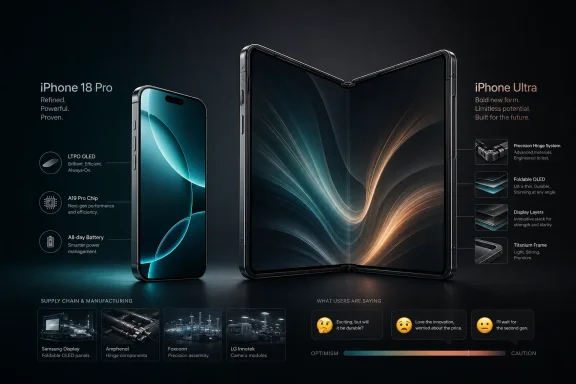 Overview: Two Very Different Apple Hardware Stories
The first story concerns the conventional flagship: the iPhone 18 Pro. Apple is reportedly pushing Samsung Display and LG Display to reduce what they charge for OLED panels used in the upcoming Pro models. Estimates suggest that the panel cost for the largest iPhone 18 Pro model could fall to roughly the mid-$60 range, representing a substantial year-over-year reduction.
The second concerns the potential new flagship category: the iPhone Ultra. Widely expected to be Apple’s first foldable iPhone, the device could arrive as the company’s most expensive and most ambitious phone yet. But a recent reader-facing performance comparison and related polling discussion indicate that it is attracting less enthusiasm than competing high-end foldables and conventional premium models.
These reports should be treated carefully. Apple has not announced the iPhone 18 Pro, iPhone 18 Pro Max, or iPhone Ultra, and no final specifications, prices, release dates, or retail names have been confirmed. Supply-chain reporting can be useful, but it reflects negotiations and projections rather than a finished product.
Still, the pattern is plausible. Apple has every incentive to defend the pricing and margins of its highest-volume premium phones while approaching foldables with a more selective, less mass-market positioning.
The iPhone 18 Pro OLED Cost Story
A lower component cost does not necessarily mean a cheaper iPhone
The immediate headline is easy to misread. Cheaper OLED panels do not automatically mean a cheaper iPhone 18 Pro.
A modern flagship phone is an assembly of dozens of costly systems, including:
- Application processors and wireless components
- High-capacity memory and storage
- Camera sensors, lenses, stabilizers, and image processors
- Batteries and charging hardware
- Titanium, aluminum, glass, and structural components
- Modems, antennas, satellite connectivity hardware, and radio-frequency parts
- Manufacturing, testing, logistics, warranty coverage, and software development
A display is one of the most expensive parts of a premium smartphone, but it is only one line item in a much larger bill of materials. If Apple saves $15 or $20 on a display panel while memory, chips, camera modules, or logistics become more expensive, the retail price may stay flat—or rise.
That is the central reality behind the iPhone 18 Pro OLED reports. Apple’s supplier negotiations may be less about creating a bargain flagship and more about limiting the impact of broader component inflation.
Why Apple would pressure OLED suppliers
Apple operates at a scale few consumer-electronics companies can match. That gives it enormous purchasing leverage, especially with suppliers that value long-term volume and predictable orders.
Samsung Display and LG Display have deep expertise in high-end OLED manufacturing. Both suppliers have experience meeting Apple’s tight quality requirements, and both stand to benefit from securing large panel commitments. But that relationship also gives Apple room to negotiate hard on pricing, production yields, delivery schedules, and quality standards.
The reported iPhone 18 Pro panel pricing points to a familiar dynamic:
- Apple seeks premium technology at lower unit costs.
- Suppliers accept narrower margins to preserve high-volume business.
- Manufacturers pursue better yields and process efficiencies to offset the price pressure.
- Consumers may receive improved hardware without seeing a matching reduction at retail.
This is not necessarily a negative outcome. If Apple can secure a more efficient, longer-lasting OLED panel without compromising visual quality, buyers may benefit through better battery endurance, higher sustained brightness, or improved longevity. The concern is whether suppliers can absorb deeper price cuts without increasing quality-control risk.
What an Advanced OLED Panel Could Mean
The importance of OLED material sets
The iPhone 18 Pro lineup is expected to use an advanced OLED material system often described in industry reporting as an M16 OLED stack. In simple terms, the material stack refers to the layers of organic compounds used to generate red, green, and blue light in an OLED display.
A newer stack can potentially improve several areas:
- Power efficiency, reducing the energy needed to reach a given brightness level
- Color performance, especially under different brightness conditions
- Panel longevity, which may help reduce degradation over extended use
- Peak and sustained brightness, though final brightness depends on more than the materials alone
- Thermal behavior, an increasingly important consideration in thin flagship phones
For buyers, the promise is not merely a prettier screen. More efficient displays can have a direct effect on battery life, particularly during web browsing, video playback, social media use, navigation, and always-on display operation.
That matters because the display remains one of the biggest power consumers in a smartphone. Even a modest reduction in display energy use can create room for brighter outdoor viewing, longer battery endurance, or both.
More advanced does not mean visibly transformative
There is also a danger in overselling display upgrades. iPhone screens have already reached a very high level of quality in color accuracy, contrast, refresh behavior, and outdoor readability. For many buyers, moving from one excellent OLED panel to a slightly more efficient excellent OLED panel may be difficult to notice in everyday use.
The improvements may be most visible in specific scenarios:
- Viewing HDR video outdoors
- Reading maps or messages in bright sunlight
- Extended gaming sessions at high refresh rates
- Long video playback sessions
- Always-on display use
- Keeping the phone for several years
This is why the iPhone 18 Pro display could be important without becoming an obvious headline feature. The best display improvements frequently disappear into the experience: fewer brightness compromises, less battery drain, smoother operation, and stronger consistency over time.
The Risk of Cost-Cutting in a Premium Display
Panel pricing is not the same as panel quality
A cheaper panel contract should not be confused with a cheaper panel design. Apple can negotiate a lower price while retaining detailed specifications for brightness, color calibration, low-refresh performance, touch response, durability, and burn-in resistance.
However, cost pressure always creates some risk.
OLED display manufacturing is sensitive to yields. Producing panels that meet demanding performance requirements at scale is difficult, especially when a new material stack or revised LTPO backplane technology is involved. If suppliers are asked to deliver more sophisticated screens at a lower price, they must make up the difference through:
- Improved manufacturing efficiency
- Higher production yields
- Reduced material waste
- Better equipment utilization
- Supply-chain optimization
- Longer-term volume commitments
Those changes can be entirely legitimate and beneficial. Yet aggressive cost targets can also incentivize shortcuts if quality oversight weakens. Apple’s manufacturing controls are famously strict, so a wholesale decline in display quality is unlikely. The greater risk is subtle: uneven panel behavior between suppliers, lower tolerance for yield losses, or delayed production if manufacturing targets prove difficult to meet.
Supplier diversity remains an advantage
The involvement of both Samsung Display and LG Display remains strategically important. Apple does not want to depend completely on a single supplier for one of the most critical components in its most profitable phones.
Multiple qualified OLED suppliers can offer Apple several advantages:
- More resilient supply during production disruptions
- Better leverage in pricing negotiations
- Reduced dependency on one manufacturer
- Increased ability to scale during launch periods
- Greater flexibility across different iPhone models and regions
For consumers, multi-sourcing can reduce the chance that a supplier bottleneck delays availability. But it can also lead to ongoing concerns about a “panel lottery,” where devices sourced from different manufacturers show minor differences in tint, brightness behavior, or viewing angles.
Apple generally calibrates its displays tightly enough that ordinary users should not notice meaningful differences. Still, display enthusiasts will inevitably scrutinize iPhone 18 Pro units more closely if both Samsung and LG are producing high volumes of advanced panels under significant price pressure.
The Bigger Cost Problem: Memory, Chips, and Premium Hardware Inflation
The push for cheaper OLED panels appears linked to a wider problem facing the smartphone industry: premium components are not getting cheaper in every category.
Memory pricing, advanced chips, packaging technologies, camera systems, and connectivity hardware all put pressure on flagship phone costs. The rise of on-device artificial intelligence has added another layer to that challenge. Even if consumers do not use every AI feature, manufacturers increasingly need capable processors, larger memory pools, faster storage, and stronger thermal designs to support modern workloads.
For Apple, this creates a difficult balance.
The company must decide whether to:
- Raise iPhone prices
- Reduce costs elsewhere
- Accept lower margins
- Limit upgrades in certain areas
- Create sharper separation between standard and Pro models
- Introduce new high-priced categories, such as a foldable Ultra device
The reported OLED negotiations suggest Apple is attempting several of these moves at once. It may protect the iPhone 18 Pro’s premium feature set while making the underlying cost structure more manageable.
That would be a pragmatic approach. The danger is that consumers may see another expensive Pro iPhone with incremental improvements and conclude that the value proposition is weakening.
The iPhone Ultra Faces a Different Challenge
Foldables are still a niche category
The rumored iPhone Ultra sits at the opposite end of Apple’s product strategy. It is expected to be a foldable device—likely combining a phone-sized exterior with a larger internal display when opened.
That concept is no longer experimental in the broader smartphone market. Samsung, Huawei, Google, Honor, Oppo, and other manufacturers have all explored folding designs. But foldables remain a niche category relative to traditional slab-style phones.
There are clear reasons for that:
- They cost far more than standard premium phones
- They are thicker and heavier than conventional models
- Their displays and hinges are more complex
- Repair costs can be intimidating
- Long-term durability concerns have not disappeared
- Software experiences are inconsistent across some apps
- Many buyers simply do not need a phone that unfolds into a small tablet
Apple’s challenge is not to prove that foldables can exist. That has already happened. Its challenge is to show that a foldable iPhone offers enough practical value to justify the added complexity and likely premium price.
Reader sentiment is a warning, not a verdict
Recent reader sentiment suggests that the iPhone Ultra is underperforming compared with other devices in a user-facing comparison. Samsung appears to be leading strongly, with Huawei also drawing notable support, while Apple’s foldable concept is generating less immediate enthusiasm.
That result should not be treated as a sales forecast.
Online polls tend to attract enthusiasts, critics, existing brand loyalists, and readers who are already closely tracking leaks. They are not representative samples of the global smartphone market. They also often reflect incomplete information, because the iPhone Ultra has not yet been fully revealed and has no confirmed public price.
Nevertheless, the sentiment is useful. It shows that Apple cannot assume its brand alone will make a foldable iPhone an instant winner among knowledgeable phone buyers.
The iPhone Ultra may have the strongest potential appeal among existing iPhone owners who want a bigger screen without leaving iOS. But that group still needs a compelling reason to accept a larger device, a high price, and the trade-offs that come with a folding mechanism.
Why Samsung Has the Early Advantage
Samsung has spent years refining foldable phones. Its advantage is not only technical; it is also cultural.
The Galaxy Z Fold line has helped normalize the idea of using one device as both a smartphone and a compact tablet. Samsung has had time to improve hinge designs, software multitasking, app continuity, stylus support, durability messaging, repair programs, and carrier partnerships.
That experience matters because foldables succeed or fail on dozens of small details:
- How naturally apps transition from the cover screen to the internal display
- Whether the phone is comfortable to use one-handed when closed
- How visible the display crease is
- How well the hinge resists dust and wear
- Whether the cameras feel compromised for the price
- Whether the battery can keep up with two displays
- Whether the unfolded device feels useful rather than merely impressive
Apple could enter the market with a more polished first-generation foldable than many early Android foldables. That possibility should not be dismissed. The company often waits until a category matures, then focuses on integration, reliability, and ecosystem fit.
But Samsung’s early lead means Apple will be judged against an established benchmark, not against an empty market.
Apple’s Possible Strategy: Keep the Pro Mainstream, Make Ultra Aspirational
The contrast between the iPhone 18 Pro OLED negotiations and weak early Ultra sentiment may reveal Apple’s likely product logic.
The iPhone 18 Pro and iPhone 18 Pro Max are likely to remain Apple’s mainstream premium models. They need to sell at high volume, perform reliably, and appeal to users upgrading from several years of older iPhones. Better OLED efficiency and lower display procurement costs make sense in that context.
The iPhone Ultra, by contrast, may function as a halo device:
- A showcase for foldable engineering
- A premium option for early adopters
- A device designed to raise the average selling price of the iPhone lineup
- A way to expand iPhone screen sizes without simply creating a bigger Pro Max
- A signal that Apple can compete in the foldable segment on its own terms
This makes strategic sense even if the Ultra sells in much lower quantities than the Pro lineup. Apple does not need a foldable iPhone to replace the regular iPhone. It only needs the device to attract profitable buyers, reinforce brand leadership, and create a path for future generations.
The potential problem is price. If the iPhone Ultra arrives at a level that feels closer to a laptop-and-phone bundle than a normal handset purchase, it may struggle to move beyond a narrow audience.
What This Means for Windows Users
For Windows users, Apple’s 2026 iPhone strategy remains relevant even if the devices themselves run iOS rather than Windows.
Many PC users rely on an iPhone alongside Windows 11, Microsoft 365, OneDrive, Outlook, Teams, Edge, Xbox services, and cloud-based work tools. The quality of the phone display affects daily workflows that cross device boundaries, including document review, authentication, video calls, remote access, messaging, scanning, and media consumption.
A more efficient iPhone 18 Pro OLED display could improve several real-world use cases:
- Longer battery life during Teams meetings or video calls
- Better outdoor visibility while using Microsoft 365 mobile apps
- More comfortable reading of Word, Excel, and PDF documents
- Improved endurance when using OneDrive photo backup
- Better always-on display efficiency for notifications and calendar alerts
The foldable iPhone Ultra could be more disruptive if Apple makes iOS multitasking substantially more capable on a larger internal screen. A device that opens into a compact tablet could become useful for reviewing spreadsheets, controlling remote Windows PCs, managing email, editing documents, or attending meetings away from a laptop.
But Apple would need to prove that the software is as compelling as the hardware. A larger display alone is not productivity.
The Most Important Unknowns
Several questions will determine whether these early reports amount to a meaningful iPhone 18 story or merely supply-chain noise.
Will Apple keep iPhone 18 Pro pricing under control?
A lower OLED cost could help Apple avoid a major price increase. But it cannot guarantee that outcome. Memory pricing, chip costs, carrier economics, tariffs, exchange rates, and storage configurations may have a larger effect on final retail prices.
Will the iPhone 18 Pro display deliver visible gains?
The expected OLED technology may improve efficiency, brightness, and lifespan. The best-case scenario is a display that feels noticeably better outdoors and helps battery life without any compromise. The worst-case scenario is that the advance remains so subtle that it cannot justify another high-priced upgrade.
Can the iPhone Ultra create a convincing foldable use case?
The iPhone Ultra needs more than a crease-free screen or a premium hinge. Apple must show why folding the device changes how people work, watch, create, communicate, and travel.
Will Apple’s first foldable avoid first-generation compromises?
The usual concerns remain: thickness, weight, battery life, camera compromises, durability, repairability, and price. Apple’s reputation will raise expectations, not lower them.
Conclusion
The early iPhone 18 Pro and iPhone Ultra reports present Apple with two very different tests. The iPhone 18 Pro must continue the company’s profitable premium-phone formula while absorbing rising component costs and delivering improvements that feel meaningful in daily use. Cheaper OLED procurement could help Apple protect that formula, especially if advanced panels provide better efficiency and longevity without compromising display quality.
The iPhone Ultra faces a more difficult assignment. It must persuade buyers that a foldable iPhone is not simply a more expensive iPhone with a larger screen, but a genuinely better device for specific tasks and lifestyles. Early reader sentiment suggests that Apple has not yet won that argument among smartphone enthusiasts.
That does not mean the foldable iPhone is destined to fail. Apple has repeatedly entered established categories late and reshaped them through hardware-software integration, retail reach, and ecosystem strength. But the company’s next flagship cycle may show that conventional excellence and category-defining ambition are not the same thing. The iPhone 18 Pro appears positioned to refine Apple’s winning formula; the iPhone Ultra may have to earn its place from the ground up.
