
If it reaches users, the feature would let someone copy supported material on an iPhone and paste it on a paired Windows PC, with the transfer also working in the other direction. That sounds like Apple’s existing Universal Clipboard, which already moves copied text, images, photos, videos, and other content between nearby Apple devices. The difference is that Apple’s current consumer documentation confines Universal Clipboard to iPhone, iPad, Mac, and Apple Vision Pro hardware signed into the same Apple Account. Windows is excluded by design today.
The practical catch is timing and geography. The reported project plan puts development completion in fall 2027, followed by testing and a public release. Apple’s own documentation for the accessory-transport framework identified in the proposal says customer use is limited to devices physically located in the EU and signed in with an Apple Account set to an EU country or region. For an iPhone owner in the United States, this is not a coming Windows 11 convenience feature. It is, at least on the available record, an EU interoperability remedy.
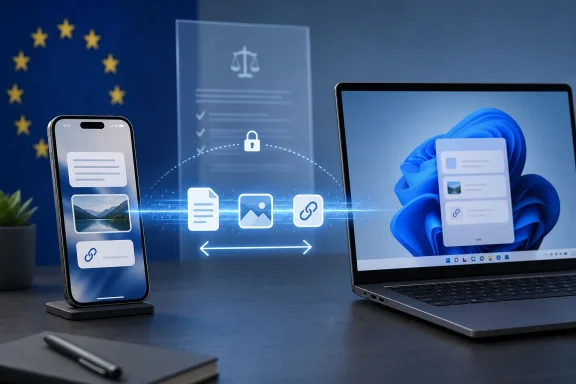 The request is about an API, not a Windows 11 feature
Windows Central says Microsoft asked Apple for an implementation of “cross-device copy and paste” as a continuous productivity function, rather than an app that must be brought to the foreground whenever a user wants to send something. MacRumors first reported the request, and 9to5Mac expanded on the proposed mechanism.
Apple’s response, as described in that reporting, is to create an extension that can share and import pasteboard items with a paired accessory. In Apple terminology, the pasteboard is iOS’s system clipboard. Apple says the solution will follow patterns used by its Accessory Notifications and Accessory Live Activities frameworks, allowing an extension to be notified when content is copied and then send it to a paired device through an Accessory Transport Extension.
That wording is more limited than the headlines suggest. Apple has not announced a Windows 11 update, a Phone Link update, a pairing screen, or a system setting called “Universal Clipboard for Windows.” It is committing to an iOS-side interoperability mechanism. Microsoft still needs to turn that mechanism into a reliable Windows experience, likely through an updated Phone Link, Mobile Devices component, or another Windows-side service.
The distinction affects deployment planning. A public API can enable a Microsoft feature, but it does not guarantee that the feature will land in a particular Windows release, reach Windows 10 as well as Windows 11, work with local accounts, or operate in managed environments. None of those details have been published.
Apple also has not said which clipboard formats will be supported. “Pasteboard items” could mean plain text first, then images and URLs; it could eventually cover richer formats. Existing Apple Universal Clipboard can transfer considerably more than text, but there is no evidence that the Windows implementation will match its format support or behavior. IT administrators should assume nothing about file transfers, rich Office content, clipboard history, or sensitive-data exclusions until Apple and Microsoft publish implementation documentation.
The EU limit is written into Apple’s current framework
The territorial limitation is not merely a pessimistic reading of Apple’s DMA history. Apple’s developer documentation for Accessory Transport Extension explicitly says developers can build and test with the framework in any region, but customer installations can use it only on devices located in the EU and using an Apple Account whose country or region is in the EU.
That is a much tighter rule than “available in European app stores.” It appears to combine two conditions: the device must be in the EU and the Apple Account must be configured for an EU country or region. Apple has not explained whether a traveler’s iPhone, an enterprise-managed Apple Account, or a user who changes their account region will qualify. Those are consequential unanswered questions for organizations with staff who work across jurisdictions.
The framework itself is also documented as iOS-only. Apple says it ignores calls from Mac Catalyst applications, visionOS apps, and iOS apps running on Apple silicon Macs. That does not prevent a Windows client from receiving data through the paired-accessory transport, but it confirms where the core permission and transfer logic will live: on the iPhone, inside an Apple-controlled extension model.
Apple’s choice to make this a paired-accessory protocol, rather than expose a broad background clipboard-read permission to an ordinary app, is important. iOS has long protected clipboard data from silent harvesting. A persistent Windows sync client that can observe every copied item would create an obvious channel for passwords, recovery codes, customer data, and internal text to leave the phone. The proposed design appears intended to establish a user-authorized relationship with a specific paired device before that can happen.
Apple has not published the precise consent flow, revocation controls, encryption design, or enterprise management controls for the new clipboard solution. Its existing Accessory Transport Extension documentation describes a security-oriented model for connected accessories, including entitlements and encrypted handling for notification forwarding. But the future clipboard API has not been documented, so it would be premature to claim that copied data will use precisely the same protections.
Apple’s published process explains the slow timetable
The reported fall 2027 target is long, but it fits Apple’s DMA interoperability process. Apple classifies accepted requests as requiring minor, mild, or significant engineering work. Its public process sets development targets of six months, 12 months, and 18 months respectively, with an outside limit of 24 months from submission in ordinary cases.
Apple reportedly called the Microsoft request a significant engineering effort. If that classification is accurate, the company is using the longest standard development window available in its published process. The date should still be treated as a planning target, not a ship date: Apple has not issued a consumer product announcement or released technical documentation for the API.
There is also a sequencing issue. Apple’s rules say solutions requiring significant engineering work should be released in the first major iOS or iPadOS version after development finishes, or in a dot release where necessary. Microsoft’s Windows work would have to align with that iOS release. A beta could arrive before broad availability, but neither company has identified the relevant iOS version, Windows build, or Insider channel.
The European Commission’s March 2025 specification decisions explain why Apple has a formal request process at all. The DMA requires Apple, as a designated gatekeeper for iOS and iPadOS, to make certain hardware and software features interoperable with third parties. The Commission’s published implementation schedule covers areas such as notifications for connected devices, proximity pairing, peer-to-peer Wi-Fi, close-range file transfer, automatic audio switching, and media casting. Clipboard synchronization was not one of those pre-specified categories; Microsoft appears to be using the separate request-based process.
That means this is not a blanket order requiring Apple to recreate all Continuity features on Windows. It is a response to one request for one interaction, with a bespoke technical answer. The narrow scope helps explain why it may arrive as a dedicated extension tied to a paired PC rather than a general-purpose opening of iOS clipboard access.
Windows users already see the Android gap
For Windows users, the appeal is obvious because Microsoft has offered cross-device copy and paste with selected Android devices for years through the Phone Link and Link to Windows stack. Microsoft’s earlier documentation described bidirectional text and image copying between Windows and supported Samsung devices, later expanding the broader Windows-to-Android story through Phone Link partnerships.
The iPhone has remained the conspicuous exception. Apple’s platform restrictions mean an iPhone app cannot simply sit in the background and continuously read the system clipboard whenever a user copies something. Third-party cross-platform clipboard apps can move content through their own apps, cloud services, shortcuts, or explicit sharing actions, but that is not the same as pressing Copy on an iPhone and pasting into any Windows application.
A native, authorized channel would eliminate a repetitive friction point for users who carry an iPhone but work on a Windows PC. It would also reduce the temptation to send a copied URL to oneself through email, messaging, Teams, Notes, or a consumer cloud clipboard. Yet that convenience is exactly why the security controls matter: an enterprise may want that flow disabled, restricted to compliant PCs, or prevented for managed-work content.
There is no statement from Microsoft on whether the eventual implementation will respect Intune app-protection policies, Windows Information Protection-style boundaries, Defender controls, or device compliance checks. Those omissions are normal for a feature that is still more than a year away, but they are the details that will determine whether the capability is usable in corporate deployments.
What Windows and iPhone users should expect now
Nothing changes on August 4, 2026. There is no iOS beta feature to enable, no Windows 11 build to install, and no confirmed Microsoft client to test. The story is a significant policy and technical opening, but it is not a product launch.
For EU users, the clearest outcome is that Apple has accepted a route to provide an iPhone clipboard-sharing capability to a non-Apple PC. For users outside the EU, Apple’s own present framework documentation says the mechanism will not be available to customer installations, even if Microsoft completes the Windows side. Apple could choose to expand the feature globally later, but it has made no such commitment.
The nearer-term milestone is not a Windows 11 update. It is Apple’s release of technical documentation for the pasteboard-sharing extension and Microsoft’s first public statement identifying the Windows component, supported content types, device requirements, consent model, and regional availability. Until those arrive, “copy on iPhone, paste on PC” remains an EU-bound interoperability project with a target measured in 2027, not a capability Windows users can deploy today.
Update: Report adds consent and rollout details for EU clipboard sharing (August 4, 2026)
GSMArena reports that Apple began work on Microsoft’s interoperability request in March 2026 and submitted its implementation plan in June. The report also says users would need to grant one-time permission before clipboard sharing with a paired Windows PC is enabled.
According to GSMArena’s reading of the request documentation, Apple plans to debut the capability in a developer beta after development concludes, before a broader public release. That is more specific than the earlier expectation that testing could precede general availability.
The reported consent requirement reinforces that this will not be unrestricted background clipboard access for any Windows application. Microsoft will still need to deliver the paired-PC experience and clarify how the feature handles managed devices, supported clipboard formats, and enterprise data-protection policies.
Update: Apple’s plan has reportedly entered implementation phase (August 5, 2026)
According to Tbreak, Apple’s clipboard-sharing project for paired iPhone and Windows devices is now in Phase 3 of its DMA interoperability process, indicating that implementation work has begun rather than remaining only at the proposal stage. The outlet dates Microsoft’s request to March 25, 2026, with Apple accepting the project plan on June 26.
Tbreak also identifies AccessorySetupKit as the expected consent mechanism. In practice, users would pair the Windows PC as an accessory and approve the permissions needed to share pasteboard content, rather than allowing unrestricted clipboard observation by a Windows app.
That framework detail further suggests the eventual Windows integration will depend on Apple’s paired-accessory model and an iPhone-side user authorization flow. It still does not establish which clipboard formats Microsoft will support or how the feature will work in managed Windows environments.
