
The study, published July 29 in Scientific Reports, evaluated the system at six New York City-area clinical sites: three primary-care clinics and three ophthalmology clinics. Participants were over 50 and had no known AMD diagnosis. Each received non-mydriatic images using the DRSPlus fundus camera; three ophthalmologists independently graded dilated images to establish the comparison standard.
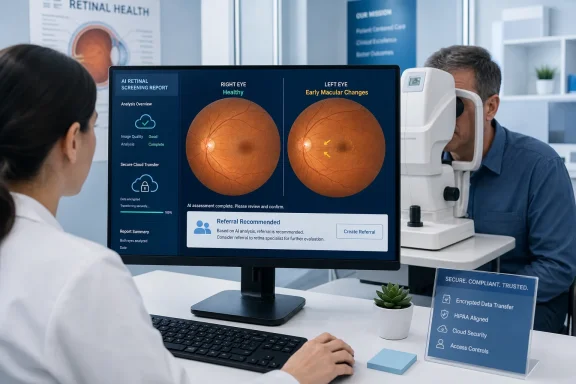
The system’s automated report arrives within about a minute and produces a referral recommendation when it detects intermediate or late-stage disease, collectively described in the paper as referable AMD. For patients screened as negative, the workflow recommends repeat screening in one year.
 The strongest result is its negative screen
At the patient level, the researchers reported a 97.79% negative predictive value. Put plainly, among people the system classified as non-referable, nearly all were also classified as not having intermediate AMD by the ophthalmologist review process.
Of 113 participants found to have referable AMD through the study’s ground-truth process, iPredict-AMD correctly flagged 102. The remaining 11 were directed to annual screening rather than immediate specialist referral. That is a meaningful operational trade-off: the tool can reduce missed opportunities for early detection, but it is not a replacement for comprehensive eye care or diagnostic imaging when clinical signs, symptoms, or risk factors point to disease.
The model is an ensemble of five deep-learning networks based on Xception, Inception-V3, and Inception-ResNet-V2 architectures. Images are first subjected to automated quality checks, then processed in cloud infrastructure before the service returns an assessment.
A practical AI deployment problem, not just a model benchmark
The paper positions iPredict-AMD as a software-as-a-medical-device workflow rather than a standalone algorithm. Its intended user is a clinician or assistant in primary or eye-care settings, with retinal imaging performed without dilation and results returned through a web-based report.
That approach shifts the practical challenge toward IT operations. Clinics need dependable fundus-camera workflows, secure image transfer, identity matching, cloud availability, retention policies, and referral integration. The study itself notes potential barriers in rural and lower-resource sites, including image quality, broadband capacity, and staff training.
For health organizations built around Windows endpoints, the important question is therefore not whether an AI model can classify a retinal photo in isolation. It is whether the imaging workstation, browser-based upload path, clinical network, EHR interface, and support model can deliver a fast result without creating a new privacy or workflow bottleneck.
Other retinal abnormalities produced referrals, but that is not a diagnosis
The authors also found that the AMD tool marked many images with other retinal abnormalities as referable. It identified 15 of 24 participants who had referable diabetic retinopathy according to human graders, as well as all participants cited with epiretinal membrane, high myopia, or macular pucker.
That finding could help route patients toward specialist review, but it should not be interpreted as validated detection of those conditions. The researchers explicitly state that iPredict-AMD was not designed or trained as a diabetic-retinopathy or broader retinal-disease diagnostic system. A positive result remains a referral signal, not a disease-specific conclusion.
Validation is promising, but deployment claims need a wider test
The study’s prospective, multi-site design is a stronger real-world test than retrospective image-set validation. Still, its geography was limited to New York City, 149 of the original 845 enrolled participants were excluded or did not complete the protocol, and the underlying dataset is held by iHealthscreen, one of the author-affiliated organizations.
The paper reports NIH SBIR support, while ClinicalTrials.gov lists a larger prospective iPredict study with an estimated completion date of July 31, 2027. For clinics considering AI-enabled retinal screening, the next milestone is less about another headline accuracy number than broader independent validation, interoperability with EHR workflows, and a clear regulatory status for the precise software version being deployed.
