
For Windows administrators and security teams working with Japanese partners, the immediate significance is less about a government “hack back” campaign than a new operating model around critical infrastructure: more mandated reporting, more government visibility into attack telemetry, and a greater chance that an attack chain touching overseas servers will trigger intervention by Japanese authorities. The law is aimed at attacks that threaten national security or essential services, rather than ordinary corporate breaches, but supply-chain incidents are exactly where that line can become difficult to draw.
Japan’s Cabinet Secretariat says the Cyber Response Capability Strengthening Act and its companion implementation law were enacted on May 16, 2025 and promulgated a week later. The legal package authorizes a three-part system: expanded public-private collaboration, collection and analysis of specified communications data to find attack sources, and access-and-neutralization measures against systems used by attackers. The October start date is now formal, rather than a proposed deadline.
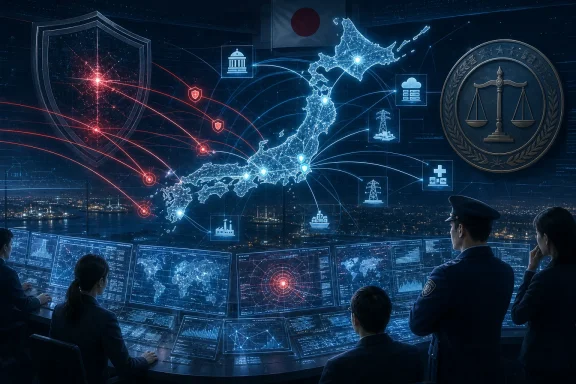 Police lead, with the Self-Defense Forces in a narrower role
The shorthand description that Japan’s military and police will both be free to disable hostile computers leaves out the law’s central division of responsibility. Parliamentary testimony on the bill states that access-and-neutralization measures are primarily a police function, framed as protecting public safety and order in circumstances short of armed conflict.
The Self-Defense Forces can participate, but not as an interchangeable second cyber-police force. Their role is reserved for particularly sophisticated, organized and planned attacks by foreign actors against government, critical infrastructure, or other designated important systems, and requires a finding by the prime minister that military involvement is specially necessary. The SDF are to act jointly with police under that framework.
That is more constrained than the popular image of a military being turned loose to conduct offensive cyber operations. It is still a meaningful expansion of Japanese state power. Until now, Japan’s cyber posture had a structural gap: authorities could investigate malware, help victims contain it, and work through diplomatic or legal channels, while attackers could stage from infrastructure outside Japan and repeatedly reuse it. The new law is intended to address that staging layer before an attack reaches the point of operational disruption.
Japan’s 2025 cybersecurity strategy says the objective is to impose continuing costs on attackers through a combination of defensive measures and active cyber defense. Its language is deliberate: the government does not describe the program as unrestricted retaliation, and the statutory framework treats the access-and-neutralization authority as a response to serious threats rather than a tool for settling routine cybercrime cases.
October brings oversight machinery as well as new powers
The crucial operational question is not whether Japan can technically reach an attacker-controlled server. It is who decides, on what evidence, and with what visibility into communications data before that action occurs.
The legislation establishes a Cyber Communications Information Oversight Commission, designed to approve and inspect specified information-gathering and access-and-neutralization measures. Diet research materials say the commission must also report annually to parliament, including aggregate information on approvals and notifications associated with neutralization actions. That reporting requirement may be the first useful public measure of how frequently the state uses these powers after October.
The framework also imposes limits that distinguish it from indiscriminate monitoring. Japan’s government has said collection and use of communications information must remain within the minimum scope necessary, while respecting constitutional protections around secrecy of communications. The problem is that minimum necessary is a standard, not a technical configuration. Its practical meaning will depend on the implementing rules, the oversight commission’s decisions, and what becomes public through its reports.
EL PAÍS highlighted concerns raised during the 2025 parliamentary debate by the newspaper Tokyo Shimbun, which argued that the measure could widen surveillance power and alter the character of the state. That criticism should not be dismissed as an argument against incident response. Modern intrusions frequently depend on infrastructure and communications paths that cross jurisdictions, cloud providers, and innocent intermediary systems. Locating an attacker’s true control point may require inspection of metadata and traffic patterns that are not confined to the victim network.
But the government’s answer cannot simply be that the threat is serious. The legal legitimacy of the program will rest on whether it can demonstrate specificity: narrowly defined targets, documented approvals, retention limits, and credible independent scrutiny after interventions take place.
Critical-infrastructure operators become the first operational test
Japan’s immediate focus is government systems and critical sectors, including services where a cyberattack could disrupt daily life at national scale. The government’s July cybersecurity policy, reported by The Japan Times, set out common countermeasure guidance around restricted system access, backups, and preparation for cyber incidents. It is to be implemented alongside the active cyber defense system in October.
That focus reflects Japan’s recent exposure to supply-chain and operational disruptions. The ransomware attack on Nagoya Port in July 2023 stopped container terminal operations for roughly two days. A 2022 incident at Kojima Industries, a Toyota supplier, forced Toyota to halt domestic production for a day. These episodes did not require a wartime scenario to create national economic consequences; an attack on a single supplier, logistics platform, or operational technology provider can ripple through companies that may have no direct relationship with the original victim.
For enterprise IT teams, this is the part of the story that matters more than the rhetoric of rearmament. A company may not be designated as critical infrastructure, yet still sit in a vendor chain for transport, manufacturing, telecommunications, energy, healthcare, or finance. Its Windows servers, remote-access gateways, managed service providers, identity platforms, and backup environments can become evidence in a broader incident investigation—or a pathway attackers use to reach a designated operator.
The law does not create a general reporting duty for every Japanese small and midsize business. That distinction is important. However, designated infrastructure operators will need reporting processes, and their suppliers can expect tougher contractual security requirements as customers try to meet their own obligations. For multinational organizations, that is likely to show up first in third-party questionnaires, incident-notification clauses, log-retention expectations, and demands for demonstrable recovery capabilities.
The practical baseline remains familiar:
- Organizations that support Japanese critical-sector customers should identify every internet-facing Windows, VPN, identity, and remote-management service in the delivery chain.
- Incident-response plans should distinguish between a normal security event and an incident that may affect a regulated customer’s operations, because notification timing and evidence preservation will matter more in the latter case.
- Backups should be tested for restoration, not merely existence, because Japan’s disaster-preparedness culture has already made recovery capacity a notable factor in its ransomware resilience.
The last point has a particular relevance to Windows environments. A ransomware event that corrupts Active Directory, virtualization management, endpoint tooling, and production file shares can defeat a backup strategy that only protects business data. Recoverability requires isolated credentials, immutable or offline copies where possible, documented bare-metal or hypervisor recovery, and rehearsed restoration of identity services before dependent applications are brought back online.
Japan is formalizing a capability it has been building for years
The October launch should not be read as Japan abruptly discovering cyber conflict. Japan’s government began coordinating national cybersecurity policy decades ago, and the Defense Ministry has gradually expanded the SDF’s cyber units. The country’s 2022 National Security Strategy explicitly called for active cyber defense against grave attacks that may fall below the threshold of armed attack.
What changed in 2025 and 2026 is the domestic legal bridge between detecting a threat and acting on infrastructure that supports it. Japan’s Defense Ministry has also publicly treated cyberspace as part of a wider security competition involving China, Russia, and North Korea. Its defense material has identified state-linked threat activity and placed active cyber defense alongside broader military modernization.
There is a risk in treating every hostile intrusion as a precursor to conventional war. Many of the most damaging attacks on businesses are financially motivated ransomware campaigns, opportunistic exploitation, or criminal services sold across borders. Japan’s new regime does not erase that distinction, and its police-first design recognizes that much malicious activity remains a public-safety and crime problem.
Yet the same technical ecosystem supports espionage, pre-positioning, sabotage, and extortion. A compromised edge appliance or stolen administrator credential does not announce the attacker’s geopolitical intent when it first appears in telemetry. Japan is building a legal process to act earlier when the indicators point to a serious threat—one that may be operating through infrastructure far beyond the victim’s network.
On October 1, Japan’s first test will be institutional rather than theatrical: whether the police, SDF, new oversight body, telecom operators, and critical-infrastructure companies can make fast, defensible decisions during a live intrusion. For organizations connected to Japanese essential services, the more immediate consequence is clear: cyber resilience is becoming a national-security expectation, and evidence of preparedness will increasingly be required before a crisis begins.